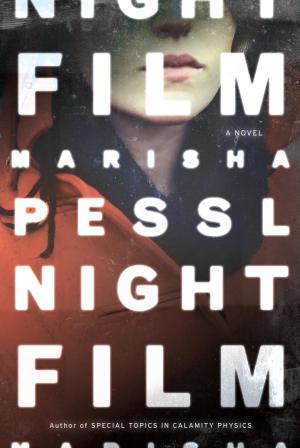
 It starts with a body: young Ashley Cordova, found dead in the elevator shaft of an abandoned New York building. The police say suicide, but there’s one man who isn’t sure. He’s a reporter named Scott McGrath, disgraced because of slander charges brought by Ashley’s father, the mysterious cult horror director Stanislas Cordova. McGrath’s got a personal interest in the case, and reasons to believe that Ashley’s death may have been murder—with her father tied up in it somehow.
With a premise like that, you’d be forgiven for thinking that Night Film is a pure genre thriller, a crime novel destined to explode onto the bestseller lists and quickly be forgotten. The elements are all there: a corpse, an amateur detective with something to prove, and a shady villain up to—well, he’s up to something.
But this is Marisha Pessl we’re talking about, and the world of book marketers and publicists have decided that her books should come packaged to us not as genre but as “literary thrillers.” Her first novel, Special Topics in Calamity Physics, exploded on the scene with a marketing push most writers only dream of, presented to audiences as the page turner that every smart reader had to buy. Special Topics was a tale of high school intrigue with juicy plot twists and encyclopedic, Nabokovian prose. Now, with Night Film, her second novel, Pessl is beginning to reveal something of a project: writing page-turning exercises in genre convention—and doing it better than everyone else.
There’s something thrilling about watching Pessl set up the chess pieces in the first 50 pages of the novel. The details of Ashley Cordova’s death and of her father’s strange and hypnotic films are deftly established in a collection of news stories, given beautiful visual treatment to make the reader feel as though she’s clicking through stories on the web rather than flipping through the pages of a book. Then it’s on to McGrath, our hero—a divorced dad and disgraced reporter with informants in the police department and an anonymous source with information about Cordova that he can’t shake: “He does something to the children…”
Night Film has all the makings of not just a mystery story, but a horror story as well. The elements are all in place to thrill and scare us.
Which is why I was surprised, some 200 pages in to this nearly 600 page novel, to realize that I was not, in fact, enjoying myself, and that all the suspense and eerie fascination Pessl had banked in the novel’s promising opening had been spent long ago.
I can’t fault Pessl on the literary side of this literary/mystery combination. The book is beautifully written, and McGrath’s obsession with Cordova and his daughter’s death twins neatly with Cordova’s cult following, raising themes of the relationship between artist, audience, and art. Cordova, meanwhile, is himself a reliable literary trope: the fabulist who works as a stand-in for the artist, a kind of dark Prospero for whom fiction and reality are blurred.
No, if Night Film has a flaw, it is not on the literary side but on the genre side in which it falls short. This shouldn’t be, given the literary establishment’s evident certainty that genre success lies only in the mindless execution of formula. If it’s the literary that’s truly “holy crap fiction,” as Christopher Beha has it—why are the literary elements of Pessl’s effort so satisfying, the genre elements so disappointing?
The answer is that literary fiction can often be quite formulaic, and mysteries, for all their rules and conventions, are difficult to do well even when a writer is checking all the formula boxes. Every hamburger has a beef patty, a bun, and a slice of cheese, but there’s a big difference between McDonald’s and In-N-Out; and every triple-axel-double-toe-loop combo looks the same, but it’s still a thing of beauty when a figure skater executes one perfectly and sticks the landing with a smile.
Likewise, all the elements of a satisfying mystery are here in Night Film, but Pessl doesn’t quite stick the landing. The issue is in the plot structure, which is the hardest part of any crime novel. The plot of a successful crime novel is a tightrope walk between mystery and meaning—the book must begin with the former, end with the latter, and balance both at each point in between to maintain the audience’s curiosity and the forward momentum of the plot. Not enough mystery, and the audience loses interest; not enough meaning, and the plot loses steam in a tangled mess of false leads.
The problem with Night Film is that it spends too much time in mystery. It’s a fascinating, promising mystery, to be sure—but for hundreds of pages, it simply doesn’t go anywhere. (A related problem: the book is about 100 pages too long.) As McGrath bounces around the city, searching for something, anything, on Ashley’s death, at one point even putting up flyers as if Ashley is a lost dog, pages turn without the clues taking shape into anything resembling a compelling meaning—which is to say, a compelling plot. The novel has little of the velocity of a great crime novel, the feeling of mounting tension as the detective caroms from one lead to the next, or the vertigo of a single clue that turns everything inside out and sends the plot veering in a completely different direction.
The novel also falls short as a horror story—the genre Cordova works in, and which Pessl attempts to work in for a time. Cordova’s films, we’re told, are so horrifying that you can’t watch one without emerging from the experience a completely different person. Yet we’re told little about what makes the films so scary. This was probably a deliberate choice on Pessl’s part, trying to scare us with what’s not there, but at times it read more as a lack of imagination, an inability to dream up something truly terrifying. In particular, a late chapter that should have been the book’s climactic horror set piece (I won’t tell you what it is, but you’ll know it when you get there) falls unfortunately flat.
Even McGrath’s obsession, a thematic crux of the book, starts to play false toward the end. He’s obviously obsessed with Cordova, but his reasons for being interested in Ashley aren’t entirely clear. As a result, I began to wonder why McGrath continued with the investigation in the first place.
A quick scan of Amazon and Goodreads reveals that I am in the minority in feeling underwhelmed with this book, and I must acknowledge that Night Film boasts some excellent writing and some scenes of real power. The narrative punch may be a long time in coming, but Pessl does eventually land it—compellingly, I think. Still, it came too late for this reader.
Marisha Pessl is an excellent writer, and I’ll be looking eagerly for future books from her. If she continues writing literary page-turners that mine genre tropes, her body of work will be very interesting indeed. But Night Film felt like a missed opportunity, an experiment that fell short of the killer crime novel it wanted to be—and a reminder that writing genre fiction is a lot harder than it looks.


Writing a mystery/crime novel has to be the hardest type of writing,at least it feels like it… As I am entertaining the idea of writing one… I ask myself, am I really ready to take on a project like that yet? Most likely no, but I’ll be sure to check out authors such as Marissa Pessl, who managed to do it, in one fashion or another.
It’s definitely difficult! I recently wrote a mystery novel, and it was extremely hard to simultaneously plan ahead in order to make sure that the mystery made sense, but still allow for spontaneity in the characters and storyline. Plus you need to plan red herrings, fake-outs, etc. It’s extremely difficult and I respect the hell out of Pessl for tackling something so difficult!
Maybe someday I’ll write a post about the mystery novel form and what I think it needs to achieve to be successful. It’s a bit formulaic, yes—but the formula is so hard to execute successfully that it’s really a thing of rare beauty when a mystery story gets everything right.