Alfonso Cuaron’s Gravity, the long-awaited 3D disaster-thriller in space, has finally arrived in theaters. The anticipation for Cuaron’s first feature film since Children of Men seven years ago created great, perhaps grave, expectations. Yet the film has been overwhelmingly praised, with attention focusing mostly on the technological and visual achievement. And for good measure. The film looks stunning, and as a visual experience, audiences can rest assured they’ve seen nothing like it before.
But one recurring criticism in the spilled digital ink concerns the simplicity of Gravity’s themes and characters. Written by Alfonso Cuaron and his son Jonas, Gravity tells a very simple story. A woman is alone in space, she can give up and die, or try, against breathtaking odds, to return to earth alive. Thus, in the grandest cinematic expression of humanity in space yet put on film, Cuaron tells the smallest story possible.
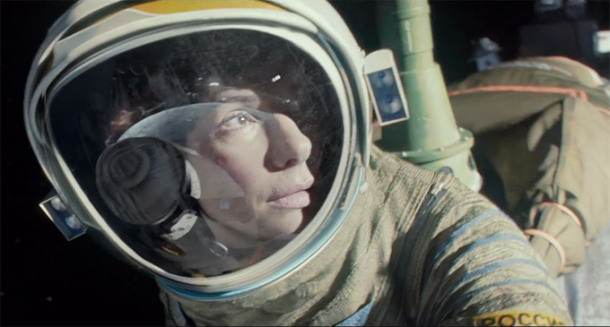
And this narrowness of story, this simplicity of theme and, for lack of better terms, message, has earned Cuaron some pretty strong criticism. Cuaron combines the utmost expression of what cinematic technology can achieve (if J.J. Abrams has a limited tool-box in this regard, Alfonso Cuaron has all the tools-all of them), and in doing so, he’s given something new and special to viewers. But accompanying that visual achievement with the simple, sad story of Ryan Stone (Sandra Bullock), has left some critics frustrated, cold, or, unbelievably, bored.
Richard Brody at the New Yorker comes down hard on the generic nature of Gravity: “The movie involves a far more menacing emptiness than the physical void of outer space: the absence of ideas.” And, “[Gravity] is a perfect example of the liberal cinema of excitement, of quietly moralized entertainment that’s self-congratulatory in its choice of method and perspective.” Brody has no interest in that liberal cinematic concern for “so called reality” and “everyday people.”
Others, with perhaps less antagonism, agree with Brody. Wesley Morris at Grantland thinks Gravity is “minor Cuaron.” While writing that the film provides “a perfect moviegoing experience,” Morris laments that the film’s “innovations feel entirely formal.”
Also granting the formal achievement of Gravity, David Edelstein at Vulture says “the movie is as cornball as all get-out and—once you discern the narrative arc—as predictable.” He “winced through some of the film’s climactic spiritual contortions, but I had plenty of awe of my own for visual-effects supervisor Tim Webber and his team of obvious geniuses.”
At Slate, Dana Stevens tells readers that “you have to see Gravity.” Which is true. Stevens, though, also finds the cornball element a little too heavy: “As their situation grows more grave and the movie’s tone more serious, the dialogue hits its thematic points—Loneliness! Courage! The Need to Connect!— a trifle too hard. Bullock’s character is given a back story that verges on the emotionally manipulative, and some late scenes where that story is referenced felt cooked up for the purpose of lending profundity to her struggle to survive this ordeal and get back to Earth.”
These reviews leave me confused. Cinema is a complicated and multi-faceted art form, and getting every element of the process just perfect-starting at the screenplay and ending in post-production-is a rare (if impossible) achievement.
But front in center in the film experience, the reason we lovers of the movies return time after time, is not to praise visual effects supervisors and technological achievement, while wincing through the film’s climax. We go to the movies to be moved by stories. Everything else is details, meant to move us in the story, but details nonetheless.
If Gravity combines poor story-telling with the highest in technological achievement, can we really say that it is actually a great film-or even one that qualifies as required viewing? How much value is there in a cornball narrative, steeped in emotionally manipulative back-stories, told in a stilted and cliched manner, even if accompanied by the stunning special effects of Tim Webber and his geniuses?
I would argue: not much.
Luckily for audiences, these reviewers are wrong. This understanding of the Cuarons’ story seeks, expects, emotional and narrative complexity to match the cinematic and visual complexity on-screen. But, in Cuaron’s most inspired decision, the film pushes these elements as far apart from each other as he can possibly manage.
Shortly after we see Ryan Stone literally spinning into space towards a complete isolation from all humanity, we learn about her personal, emotional isolation from the earthbound human experience. She has suffered incomprehensible loss from a freak accident-”the stupidest thing,” she calls it. Her story requires audiences to readjust the visual marvel that surrounds us. Gravity is truly majestic to behold: weightlessness of character and camera, 3D actually enhancing the viewer experience, special effects like nothing you’ve ever seen (the destruction of the ISS as Dr. Stone climbs into safety is truly one of the most incredible moments I’ve seen on-screen). But this all accompanies Stone’s, and our, confrontation with the simple, tragic reality of life: death is terrible, stupid, and inescapable.
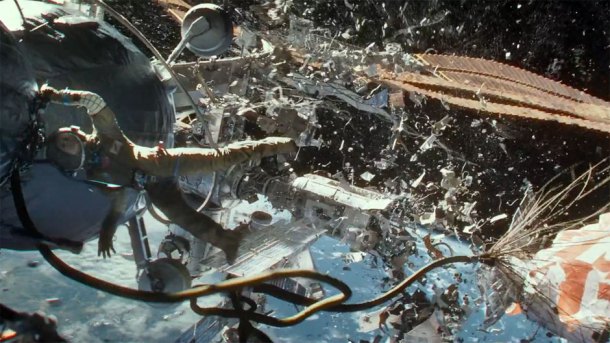
The story that Gravity offers, then, is a study in character, performed by Sandra Bullock with very little dialog or interiority, in a performance that leaves her in frame, mostly alone, for almost the entire length of the film. Only a jaded and cold analysis rejects such a story as simple. It is rich beyond words. It is the most beautiful and complicated and difficult story of human experience. A story we are living and telling over and over, all the time. And one we have seen, in equally “simple” treatments, by the masters of cinema throughout the history of the art form.
Cuaron appears to have purposefully rejected complicated narrative elements and “moral complexity”-a term of limited value to begin with-and instead chosen a small story surrounded by themes almost mythic in their simplicity. Striking images of physical isolation paired with emotional despair; spiritual loss paired with an infinite longing at our darkest moments; birth, death, re-birth in small, unknown, spaces. As viewers, we are situated in a familiar micro-story as we lose ourselves in the macro-sensory experience. Perhaps it is cliche. But if so, it is the cliche.
Several times in the 90-minutes I spent watching Gravity, I was reminded of Terrence Malick’s Tree of Life, a film dealing with similar thematic elements, and offering distinct a visual experience of its own. Where Tree of Life ricochets between one family and the entirety of cosmic history from the big bang to the after-life, Gravity restrains itself to the narrowest of scales-often much more difficult a task in storytelling- a single person’s experience in a single physical space, reacting to a singular event.
Tree of Life even received similar criticism. Like Gravity, Tree of Life was considered a must-see cinematic experience for its ambition and visual grandiosity. And, like Gravity, many found the story-telling and emotional core of the film lacking. Morris said of Malick’s masterpiece: ”This movie weighs so much, yet contains so little. It’s all vault and little coin.” Edelstein on Malick: “He either has no basic storytelling instincts or else purged them after all that time at Harvard with Stanley Cavell reading Heidegger and questioning whether we actually exist.”
And like with Gravity, these critics are wrong about Tree of Life.
Though Gravity appears to operate as the cinematic opposite of Tree of Life, I find a natural pairings in these films. Gravity is a commercial success by a renowned Hollywood director. Malick and Tree of Life skirt the edges of the film landscape, winning recognition and awards at festivals but struggling to find an audience at large.
And yet, both films represent masterfully crafted works of exceptionally skilled directors. Each film is a work of art, wholly original but built from the common mud of life as old as all humanity. The story of life and death, the enduring human spirit, how to conduct meaningful relationships with others (both living and dead), the desire to give up on living; these are the thematic elements central to both films. And though neither attempts to answer them, each explores them in unique ways that are wondrous to behold.
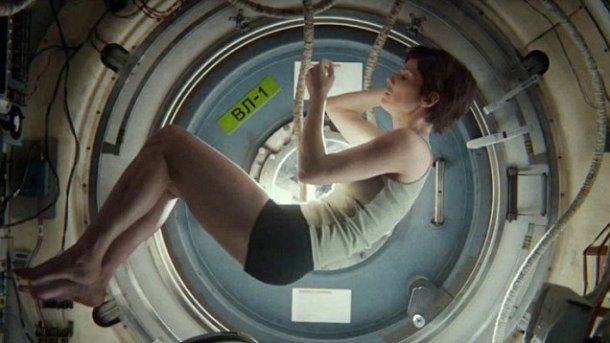
Perhaps this is sentimentality, a striving to defend and explain the construction of a film that fails to wed an emotional accomplishment to equal a remarkable visual accomplishment. But I don’t think so. If anything, I think films like Gravity and Tree of Life are increasingly important for the very characteristic that earns them critical fault: pairing earnest sincerity with cinematic dynamism. Gravity makes no attempt to hide its heart. Cuaron does not apologize (and never has) for his embrace of sentimental and emotional stories. And that is a rare and beautiful quality in science-fiction today.
What these critics mistake for cornball, cliche or moralizing in Gravity, is actually an intimate individual portrait of one woman’s catastrophic anxiety and loss. Bemoaning the perception that moralizing and spiritual contortions devalue the achievement of the film gets Gravity backward. We should be praising Cuaron’s daring endeavor to embrace the simple story of a woman’s broken-heart in such a profound, visually stunning expression of cinematic ingenuity.
In Gravity, one cannot be had without the other. The marriage of this intimacy with the epic disaster in space does not weaken, but strengthens the thematic measure of the film. It allows audiences to feel the intensity and stress of something we will never experience in our lives, while sharing once more a story that we all, by biological necessity, will experience over and over again.


Nice. It’s almost like a short parable isn’t it. So simple, but touches on the grandest and most common of life’s challenges. I also enjoyed the single person plot layered over all of SPACE. But some of the actual dialogue was exceptionally cheesy. That is what took away from it for me.
Pingback: 5 things Hollywood needs to learn from Gravity’s success | The Stake