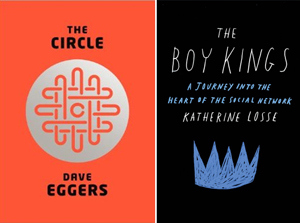
 Dave Eggers, founder of McSweeney’s and Gen X literary darling since his publication of A Heartbreaking Work of Staggering Genius, has stumbled into some scandal over his new novel, The Circle, due out from Knopf on October 8.
The Circle is the story of a woman hired to a powerful California tech company, initially dazzled by the lifestyle her new employment brings before finding something not quite right at the organization. Problem is, the novel apparently bares some similarities to a previously published book, The Boy Kings, Kate Losse’s memoir of working at Facebook.
Jezebel has a good round-up of all the ways that Eggers’ new novel resembles Losse’s memoir. The similarities are there, though some of the connections are a little thin—in particular the purported similarity between the names Kate Losse and Mae Holland, Eggers’ protagonist. (There’s just as much similarity in sound and syllables to the name Dave Eggers, after all.) And the plagiarism accusation brings with it some interesting questions about a fiction writer’s license in borrowing from real life. Most novels have a “similarity to persons living or dead is purely coincidental” disclaimer on the copyright page for this very reason. But when does real-life inspiration become stealing? Losse, for her part, admits to not having read Eggers’ book; and Eggers claims not to have read The Boy Kings.
In fact, Eggers’ denial may bring up another issue: lack of research. Not only did Eggers not read Losse’s book—he claims not to have done any research on tech companies at all. Eggers is responsible for two books—What is the What and Zeitoun—that were impeccably researched, so his decision not to do any research seems deliberate, indicative of a broader consideration of tech rather than a specific takedown of Google or Facebook. Still, if he portrays tech companies negatively in the novel, his lack of research may be a problem for some people.
Whatever happens with the plagiarism and research allegations—and it seems likely that they’ll fade away without much proof of wrongdoing—it’s important not to forget the gender dynamics at play, which Jezebel helpfully catalogs. Kate Losse wrote about her experiences at Facebook in 2012 to little fanfare. Now Eggers is writing a similar story, plagiarism or no, to critical raves. Is gender bias a factor in the reception of these two books? Almost certainly.


Regardless of whether plagiarism is afoot, this comment from Losse’s blog post is priceless.
“From all appearances, it is an unnervingly similar book, and I wrote it first (and I imagine mine is more authentic and better written, because I actually lived and worked in this world and am also a good writer).”
Good writers, ironically, do not often broadcast the fact that they are good writers. And Losse’s reader reviews on Amazon and Goodreads are pretty middling. We’ll find out about the plagiarism thing when Eggers book hits the shelves, but I sense that this is really more about examining why some books are ignored while others on similar topics take all the oxygen out of the room.
Pingback: Eggers, satire, and the importance (or not) of research | The Stake