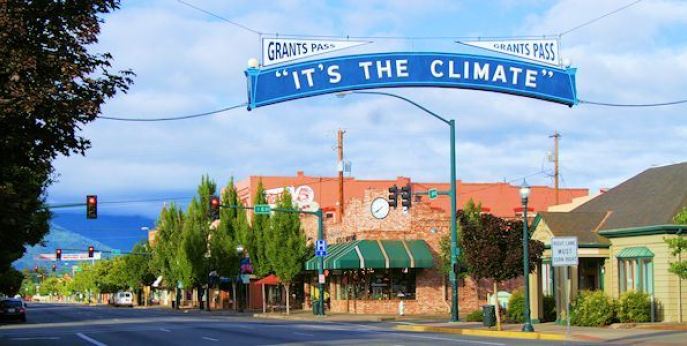
About four hours from Portland and six hours from San Francisco, there’s a city of nearly 37,000 people called Grants Pass, OR. The people of Grants Pass never seem to know what they want. Or sometimes they think they do, and later find that they don’t. The best place to see this in action is at the town’s one movie theater, especially during screenings of “difficult” film.
I have lived most of my life in mid to large cities, including the Twin Cities, Denver, and Portland. Since then I have followed my wife’s legal jobs to Kenai, Alaska, and Grants Pass, Oregon. Prior to that, I had never seen a person in line at a movie theater box office look up at the roster and ask the people around them, “What should we see?” In Grants Pass, this has happened a number of times; I would estimate more than four but less than ten in the 2.5 years we’ve been here.
People come to the movie theater and evidently have not yet chosen a movie or the time at which they’ll see it. This is one of the most mysterious phenomena I have ever experienced in person.
- How did they know they wanted to see any movie that’s currently out?
- What would they have done if there was nothing they wanted to see?
- What if the only one they could agree on was in three hours? Would they stand and stare at one another until then?
I, Tonya is an Oscar winner and a fun ride, with Allison Janney using her Drop Dead Gorgeous skills for evil, and Margot Robbie using her eyes and mouth in hugely expressive close-ups that make the movie. It came to Grants Pass about six weeks after its “wide release” as part of a slate of Oscar Nominees that stayed for maybe two weekends. The theater or the patrons in this town do not appear committed to continued exposure to this kind of movie. I can be confident in this assessment after I watched an older couple get up and walk out at about the 30-minute mark, with the man giving the dismissive “bah!” two-hand wave at the screen on the way out. I am not sure why he did this, since the theater was completely full. I am not sure what he was expecting from the movie, either, and I wonder if the pre-start text card about it being based on “irony-free interviews” with the players made him nervous. I also don’t really understand why people clap at the end of movies, but a few of my 7th-grade students have generated a theory that I’m a robot, so who knows why anyone does anything.
Three Billboards Outside of Ebbing, Missouri contains some of the most acid humor of any film this year, and certainly more than the rest of the best picture nominees (Get Out notwithstanding, I suppose), but our audience did not seem to care much about that, since there were constant questions about motivations and advice for the characters coming from people in the rows behind us, capped with disgusted groans when the film’s abrupt ending hit. We immediately heard (in a loud speaking voice despite the proximity of the person’s date), “What happened?! Well, I’ll just get the book so I can find out the ending.” In case it’s unclear, there is no book, and the abrupt ending was sort of the point, it seems. I don’t know what people want from film here, andI’m convinced they don’t either.
Darren Aronofsky’s mother!—in addition to its Against Me!-levels of bizarre, unexplained exclamation point usage—was, in my viewing, a dark, confrontational, punk-rock barrel of bummer-fun. Since this is my favorite kind of fun, readers will not be surprised that I made sure to see it in the local theater on opening weekend. I knew it would not last, so I made a point of it. As the final image of Her being engulfed in flames faded into the new, renewed house and a different woman re-enacted Her opening scene, vocal critics started to speak up from the back of the dark theater:
“Ugh!”
“Well, that was a big WTF!”
“Yeah, Academy Award, right?!”
And so on. I was so befuddled—and since it seemed like we were now having a conversation in the theater, I spoke up:
“Have y’all never seen any of his movies before? You never saw Black Swan?”
“Well, they could’ve warned us!”
“’Warned you?’ The trailers are online! You don’t watch a trailer before you pay to see a movie?”
“[Grumble]”
I know that the Cinemascore rating was historically low, and maybe the trailers misled people into thinking it was, like, a J-Law/Bardem romance in a pretty house or something? People think they know what they want, but not really.
I finally found relief from this phenomenon during a close call at a re-watch of mother! I did in Medford, Oregon, which is about 30 minutes southwest of Grants Pass and is the fourth-biggest metro Oregon, which is like most places: cities and The South most other areas. My stomach dropped when I saw a group of six middle-aged women in dressy-ish clothes, clearly on their fun weekend outing, walk in and take seats about two rows behind me. I was worried.
The opening shot of the film is of a woman—maybe Lawrence as Her—in a full screen of flames, staring into the audience’s eyes as she burns crispy. There was sudden, stunned silence behind me, and then I watched one of them walk down the stairs and out of the theater. She returned about four minutes later, and I heard whispered, “This isn’t the movie we are supposed to see! That one starts in an hour in another theater!” When they all walked out, I stifled my laughter as the realization that this habit of blaming movies when they hate them without doing any research is a wide-ranging problem, and with joy that they did not subject themselves to that gauntlet.
Southern Oregon—with the notable exception of college/ski-bum/hippie town Ashland—is TrumpLand. Josephine County, of which Grants Pass is the seat, went 66-22% for Dear Leader in the 2016 elections, and refused to pass a public safety tax levy for six consecutive attempts, due to tax-refusal philosophies among the poor whites in the county and the huge, wealthy California-retiree population. As I’ve told my 7th-graders, Socrates was hugely skeptical of democracy, in part because he believed that undereducated voters would be more supportive of demagogues, who he compared to a candy shop owner, than of serious leaders, who he compared to a doctor. Now, I don’t at all agree with his prescriptions to limit voting to some amorphous group of “wise” people, but Josephine County shows that his analysis was probably pretty correct, since tax cuts for the wealthy don’t really do much for the families of my students, who all receive free breakfast and lunch because the poverty rate is so high. I guess many of their parents are convinced (I’ve received complaints about my content generally as being too critical). Some people simply want stories, even if they don’t know it before they get to the ticket window.
Anyway, my thought is that they are looking hard for gifts from the candy shop owner when they go to the theater, and their expectation is to be given only the (predictable, please) treats they want. These films, all with varying degrees of thought and digital ink being spilled about them are made by doctor-artists, who find other reasons to make film besides simply telling stories. Stories are obviously fine (I’m sure readers will be relieved by getting my permission here), but the experience of trying to gather your thoughts about something difficult and weird while people are loudly complaining to no one in particular is a depressing interruption to a reverie.
These people are allowed to be voters—no matter what Socrates might think—and they to some degree dictate the poor-punishing policies that my students and I have to live under. My wish for them to be informed about movies in the hope that they can be informed about other things is perhaps misguided and only making things worse for myself. I naively believe that stories, in the form of literature, art, and film can speedily build empathy. We are in need of empathy here, and my desperation for it makes me a worse movie-going peer than I’d like to be, but I’ve had a long time to get comfortable with being no fun at all.
-Lee Pietruszewski

Leave a Reply