We’re ranking the films of Pixar Studios, leading up to the release of Inside Out.
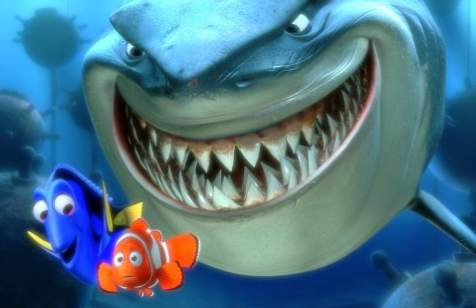
Finding Nemo
Directed: Andrew Stanton, Lee Unkrich
Writers: Andrew Stanton, Bob Peterson, David Reynolds
I had no expectation that Finding Nemo would come in this high on this list. The original ranking I had scratched out had Nemo coming in at #9. But with each new entry, Nemo just kept coming out above each head-to-head match up. Finding Nemo is better than I remember. Perhaps the cultural phenomenon that Nemo spawned is partially to blame for this misremembering? Perhaps I just forgot how excellent the movie is. Either way, I love Finding Nemo.
Finding Nemo, like Up, starts with death. The opening shows a pair of clownfish, Marlin and Coral, moving into a new home, in a new community, awaiting the spawning of their many, many eggs. It’s light and airy writing, perfect for Albert Brooks (who voices Marlin) to bring his anxious excitement to becoming a dad. The opening moments also highlight the underwater animation that Stanton’s teams creates, and establishes the scale and beauty of this ocean world.
Then, tragedy ensues, when a barracuda attacks. Marlin is knocked unconscious, Coral is killed, and all the eggs save one are lost. That one will hatch, and become Nemo. Nemo and his father develop an intense bond, with Marlin developing a deeply over-protective nature regarding the safety of his son. A protectiveness that Nemo sees as cowardice.
Attempting to show his fellow fish-kids that he is not scared like his father, Nemo swims far off the reef into the open ocean, where he is captured by scuba divers on the first day of school.
And so the film becomes a search and rescue story. Marlin desperately seeks his lost son. He pairs up with a royal tang suffering from short-term memory loss named Dory (Ellen Degeneres), and the two swim the seas getting into all kinds of trouble, swallowed by a whale, fighting off sharks, trying to reunite with Nemo.
If it’s possible to have an animated film provide a star-making performance for a person who is already star, Finding Nemo accomplished that task with Ellen Degeneres. Her work as Dory is hilarious. Degeneres’ comic timing is a revelation, and her work here is funnier than anything that I have seen her in before or since.
The scope of the animation in Finding Nemo dwarfs what had come before from Pixar. The realism of the ocean and the light, the movement of the water, the plant life, and the sea life is subtle and realistic backdrop for the bursts of color and character that define the story. The blues in this film…forget about it. You just want to live in this ocean.
In his review, Roger Ebert describes wanting to sit in the front row and let his field of vision be completely washed over by the images of Finding Nemo. Nemo and Up both have this sensation. The images and music alone are enough. No story could have come in this film, and it would still be an incredible work of art.
Nemo is full of great scenes, funny ones like the dentist’s office, and scary ones, like the shark attack. The bloodlust that turns a friendly shark named Bruce into a horrible predator is both hilarious and frightening. What’s the lesson here? Anyone can turn around and try to kill you?
What’s lovable about Nemo comes not in its witty finny fish encounters, but in its father-son relationship, and Dory’s search for a family. In the film’s opening, Nemo is embarrassed of his father’s reserve and caution. When he is lost, he is at times hopeless, thinking that Marlin is too scared and weak to find him. When he learns of what Marlin has endured to come rescue him, there is real excitement and awe, a feeling every dad hopes to inspire. Likewise, Marlin’s changing view of Dory, the silly fish without a memory, is touching. She wants a family and sees in Marlin’s devotion to his son a good man (fish?) who could provide her the community and friendship she needs.
There’s even a portion of this film when Marlin thinks Nemo is dead. The exchange between Marlin and Dory about the death of Nemo is not just sad, but painful to experience, as Marlin turns his back on his new friend.
Ellen Degeneres. Gawd.
This is lovable, moving stuff. But even without it, what’s lasting about Finding Nemo is the visuals. Watching it again, I am tempted to say that Finding Nemo is Pixar’s most beautiful, lush, encapsulating piece of animation. Which is enough to earn it the #4 spot on this list.
Best Expecting-Parent Line: “We’ll name one Nemo. But I’d like most of them to be Marlin, Jr.”
Best Punchline: “With friends like these, who needs anemones?”
Casting Drama: Pixar hired Megan Mullally (Karen Walker on Will & Grace) to voice a role in the film, but were disappointed to learn that her high-pitched nasal voice was not her actual speaking voice. They asked her to use her Karen voice in the film. She refused, and was let go from the film.
Box-Office Boom: When it opened, Finding Nemo was the biggest success yet for Pixar, grossing $380 Million domestically and over $930 Million worldwide. At the time, it was the highest grossing animated film ever made, surpassing The Lion King. It remains the second most successful Pixar film, behind Toy Story 3.
Worst Audience Response: The film inspired enormous interest in the purchase of clownfish for home aquariums, despite the films VERY CLEAR message against keeping fish as pets. The enormous interest in clownfish became a marketing strategy for some Asian nations, and New Zealand, and led to widespread harvesting of the animals, leaving the population devastated and environmental groups speaking out with a campaign to Leave Nemo in the Ocean.
Ratzenberger:
Best Animated Feature: Winner. It beat Triplets of Belleville, a fine, strange bit of animation in its own right, and one you should see.
Most Ambitious: Andrew Stanton, coming off the massive (MASSIVE) success of Nemo, became the first Pixar director to leave animation and try his hand at live-action filmmaking. Disney gave him the chance to make his dream project, which turned to be the massive (MASSIVE) failure John Carter of Mars. Whatever you think of that movie (I think it’s a terrible movie, badly directed), it’s a sign of how effective the Pixar creative process is. This is not to say that Andrew Stanton is a bad director. But so far he and Brad Bird are the only Pixar directors to make live-action, non-Pixar films after making hits with Pixar. And neither has made anything that reaches even close to the heights of Pixar Studios.
Return to The Pixar List Landing Page

Pingback: The Pixar List | The Stake
Reblogged this on myriamm58.