We’re ranking the films of Pixar Studios, leading up to the release of Inside Out.
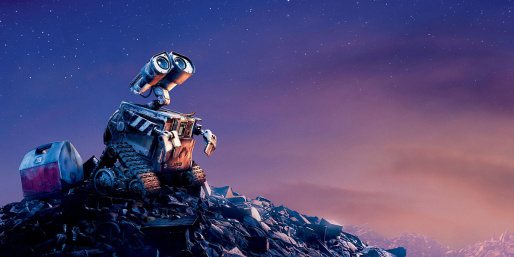
WALL·E
Directed: Andrew Stanton
Writers: Jim Reardon, Andrew Stanton, Pete Docter
Here’s a smash-hit children’s movie that opens with one of the lesser-known songs from a moderately notable musical from 1969. The song is “Put on your Sunday Clothes”; the movie musical is Hello, Dolly! When Andrew Stanton, director of the sci-fi animation love-story WALL-E, discussed his decision to open his movie with a 50 year old Broadway number, he called it: “the weirdest idea I ever had.”
That sentiment rings true for much of WALL-E . When WALL-E was released in 2008, it was easily the weirdest idea to come from Pixar Studios. A trash-compacting robot left on an abandoned earth, cleaning up the disgusting mess humanity has left behind. And here, right at the start, is a peppy pop tune telling us “there’s lots of world out there!” It is weird. And weirdly effective.
WALL-E is different from the remainder of the Pixar canon. First, it’s a genre film. The concept is hard science-fiction and Stanton hues closely to his genre’s demands. WALL-E is also the only Pixar film that is a romance. WALL-E falls in love with, pursues, and eventually engages in a romance, with EVE.
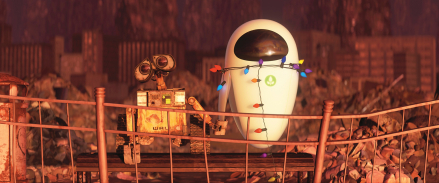
Which, to use Stanton’s language, is so weird. This means that a robot called Waste Allocation Load Lifter – Earth-class and another robot called Extraterrestrial Vegetation Evaluator will fall in love. That this love story works so well is a testament to Stanton’s visionary animation. Especially since EVE and WALL-E are characters that do not speak.
WALL-E suffers from a similar first-act problem as Up. How do you live up to an world and character introduction as stunningly conceived and executed as that which opens WALL-E? The film’s first half act is mostly wordless (except for the movie that WALL-E watches) and the visual creation of the spent Earth is beautiful in its horribleness.
But where Up fails to hit the emotional highs of its opening, WALL-E continues to advance the emotional richness of it’s story. The marriage of surprising visual content, environmental themes, and wordless storytelling provides the most interesting parts in the film. But WALL-E is made of more substantial stuff than its competitors. It advances not just its story but its depth, throughout the film.
Most of the thematic richness that layers Pixar’s films is emotional. The irony or satire is overlaid on a story about children, or family. But Stanton again bucks the Pixar trend, layering his story’s plot with environmental themes and heavy romantic overtones (the scene of WALL-E falling for EVE while La Vie En Rose plays on the soundtrack is a prime example of how steeped in romance this film is).
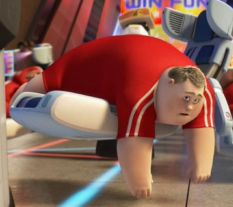
The same goes for the environmentalism of the film. WALL-E is not a satire alluding the problems human over-consumption. It is literally a story about human over-consumption. Humans have ruined earth. Humans have become so fat they no long walk on their own feet. Nature, know matter humanity’s best effort, cannot be overcome by humanity’s wasteful ways.
These are the elements that save WALL-E from succumbing to the first-act demise. WALL-E partakes in rich emotional relationships like Up (starring robots with no faces at all, nonetheless). But unlike every other story in the Pixar canon, WALL-E is not a comedy. It’s funny at times, but Stanton understands that his story is science-fiction.
In the final accounting of the film WALL-E, a strange love story between two robots is the thing that enables the human species to continue on living, and brings us back to our home.WALL-E is science-fiction made to entertain and enlighten, all ages through wonderful images and ideas that appear before us as both alien and familiar. It is truly one of the weirdest kid’s movies around.
Best Line: “Name?” “WALL-E.” “WAAAAA LEEEEE? Eve.” “EEE vaaah”
First Line: The first line of dialogue spoken by a character in the film comes at minute 39.
Animated Cinematography: Stanton consulted with Roger Deakins about how he would light and shoot scenes if he were going to make a live-action WALL-E. The sepia tones, and lens-effects that mark the distinct first half of the film are largely a result of this work.
Live-Action First: Fred Willard’s appearance as the CEO for Buy N Large Corporation is the first and so far only, live-action role in a has appeared in a Pixar film.
Ratzenberger:
Best Animated Feature: Yes. It was nominated for 5 others.

Pingback: The Pixar List | The Stake
How interesting! I never actually realized that this is the only Pixar movie that’s a romance. Learn something new everyday, I guess.