Today, the Guardian is reporting that the small press And Other Stories has decided to publish only female authors in 2018. They’re undertaking this “year of women” in response to author Kamila Shamsie’s challenge to the publishing industry to take drastic steps to end gender bias in the literary world.
My first response to this news was to cringe at the inevitable response of MRAs, cries of “reverse discrimination” against men. But my second response was to forget about those jerks, and remember an exchange in an interview between Diane Sawyer and Supreme Court Justice Ruth Bader Ginsburg (long may she reign). Sawyer asked Ginsburg how many female justices on the Supreme Court would be enough, and she said…well, you can see for yourself.
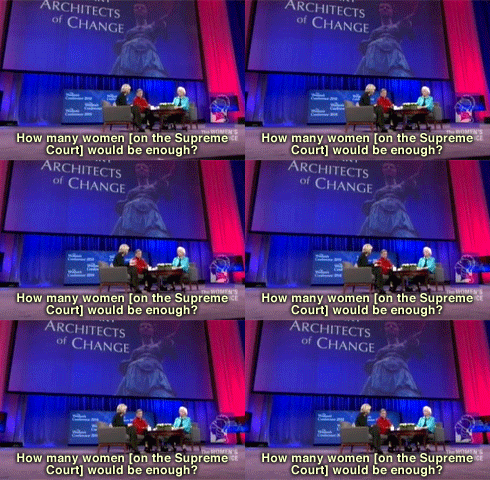
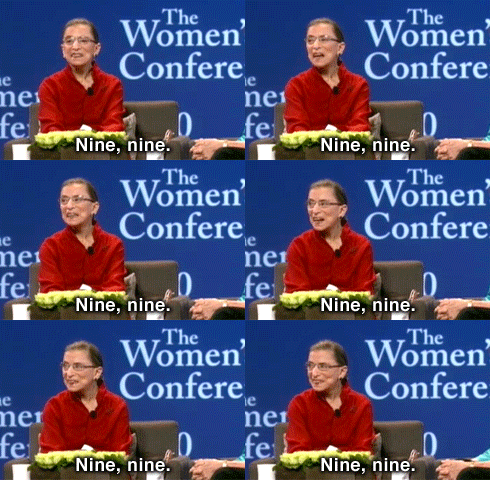
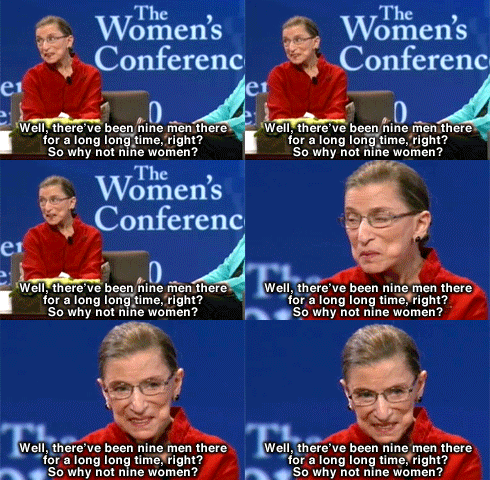
She’s awesome. And it strikes me that saying there should be nine women on the Supreme Court as a corrective to all the many years when there were only men on the court isn’t too far different from saying that we should have a year, just one year, where the literary world focuses exclusively on women. It’s not “reverse discrimination,” but a necessary corrective to an unequal state of affairs that has persisted for far too long. For many years, only men sat on the Supreme Court, interpreting the laws of the U.S. Constitution in ways that reflected their own views of the world, and which over time have become calcified by precedent into the way things work, the way things are expected to be. A period of time during which only women sat on the court would not only signal the high achievement of those women in their field, but would undoubtedly bring about changes in the way the law was interpreted in the United States.
And so it is with literary culture. For too long, the literary world was dominated by men—male authors, male critics, male arbiters of what stories were most worthy of attention and praise. This state of affairs has had lasting effects into the present day. It has influenced who gets published, who gets reviewed. But more than that: it has had an impact on what we think of as “good” or “bad,” what constitutes “literary merit.” We can see these attitudes play out in VIDA counts, which continue to demonstrate that male authors are perceived as more deserving of attention by the literary establishment; we can see them in author Nicola Griffith’s discovery that books by men and about men are far more often given awards than books by women about women.
Look, I’m a man. White, straight, cis, middle-class. Privilege across the board. I’m also a writer, an aspiring author who’d love to have a book published someday. If all publishers did what And Other Stories is doing, I wouldn’t like it very much, I suppose. That’s the selfish response. I have ambitions, dreams. So do many other writers—men and women alike. It’s part of what makes these conversations about who gets published so very difficult. For writers, this stuff is personal.
But this is about more than ambition. It’s about what kind of stories get told, and held up by the culture as being important. It’s about making sure that our literature truly reflects the human experience—all of it. That’s why what And Other Stories is doing in 2018 is so great, and why Kamila Shamsie’s idea to turn 2018 into a “year of women”—whatever form that takes—is such a great idea.
