Game of Thrones, all is forgiven. Well, I guess not all—there’s still a lot of stuff I’m mad at you about, and one good episode isn’t going to change that. But today, one week after I went on a tirade against a show that seemed to have gotten lazy, the series partially redeemed itself and, in the words of a friend on Twitter, leapt back on the rails by delivering one of the best episodes in recent memory.
Most of the talk online will probably center around the epic battle scene the episode delivered in its final 15 minutes, and justly so. (More on that later.) But this episode was something different from the very beginning; starting with the first scene, it felt more interesting and vibrantly alive than GoT has in ages. Characters moved forward, changed in small but important ways, and action seemed to happen against the backdrop of an actual world, teeming with life and humanity.
Things started off with Tyrion and Jorah facing off against Dany in her throne room, where she was ostensibly considering whether or not to kill both of them. Tyrion and Dany are among the series’ most beloved characters, and their first real interaction onscreen didn’t disappoint. One of the show’s most reliable pleasures has been watching Tyrion survey a situation, think about the angles, and then speak his mind—this is what happened when, as his first bit of advising to the Mother of Dragons, he told her what he thought she should do with Mormont: don’t kill him, since “killing those who are devoted to you won’t inspire devotion,” but don’t keep him around either, since he’s proven himself a traitor. Jorah is banished, and rather going straight to a maester to find a cure for his greyscale, he went back to the fighting pits for another shot at impressing the queen he loves.
Tyrion, on the other hand, buys himself some more time to impress Dany—and impress her he does. In their next scene together, these two discover one major thing they have in common: they’re both the children of terrible fathers who made, also, terrible rulers. Aerys Targaryen was a mad king whose brutal rule inspired a rebellion; Tywin Lannister was a schemer who cared more for his family’s power than for the peace and well-being of his subjects, and whose conniving ultimately got him murdered on the shitter by his own son. Dany and Tyrion know who their fathers were, know their flaws—the question is, can they, together, find a different way to rule? Can they be “the right kind of terrible, the kind that keeps people from being even more terrible”? Tyrion, for his part, thinks that together they have the best chance of doing the most good in Slaver’s Bay, but Dany wants to go home. When Tyrion tells her that she’ll need some alliances with the powerful families to take Westeros, Dany gives one of those analogies for the world of Westeros that the show has become so famous for (it’s a game, it’s a ladder…); today Westeros is a wheel, with one family, one spoke, always on top. And Dany doesn’t want to stop the wheel. She wants to break the wheel. A little on the nose, but coming at the end of a delightfully talky scene, I can forgive it.
Meanwhile, in King’s Landing, things are looking increasingly desperate for Cersei. I’ve been critical of this plotline, and I still think it’s a little sloppy. How the Sparrows have managed to take the entire city, how many of them there are, and why no one in the ruling classes seems to be taking any action to take power—or their beloved family members—back are all things that the writers need to establish a little better. And this episode didn’t actually move things forward much in King’s Landing, instead marking time until the trial, or the inevitable confrontation, or whatever. But if all the episode could do was mark time, then at least it marked time in an intelligent, interesting way, by showing us the events in the city solely through Cersei’s eyes, in her dungeon: offered a drink of water in exchange for a confession she refuses to give, visited by one of her minions and told that her own son is too weak, to ineffectual, to visit her.
The rest of the action came from the Stark kids. (We were, blessedly, spared another dopey scene in Dorne.) Arya’s education in being no one continues as she lives into a false identity and is given the mission to spy on, and presumably kill, a crooked merchant. Sansa, meanwhile, has another confrontation with Theon, wherein she discovers what was done to him to make him Reek, and gets another important bit of information as well: Theon didn’t kill Bran and Rickon, after. What she can do with that information remains to be seen. What’s certain, though, is that Sansa won’t be bowed by her mistreatment at Ramsay’s hands: she’s still a vital and strong character, and whether she manages to kill Ramsay herself or convince Theon to do it by waking him to himself, she’ll be someone who attempts to make her own fate in whatever circumstances she finds herself.
But this episode really belonged to the North. In Castle Black, Sam reassures Olly that Jon’s doing the right thing by telling him, “Sometimes, a man has to make hard choices, choices that look wrong to others, but that he knows are right.” Olly asks, “You believe that?” Sam does—but I wonder what Olly’s real takeaway from the lesson is. Olly’s suffered a terrible trauma, seeing his family killed in a raid led by Tormund Giantsbane. So when he walks away from Sam, deep in thought, is he reconciling himself to Jon’s alliance with the Wildlings, or his he making his own hard choice that will look wrong to others, but that feels right in his own heart—a decision to take his vengeance? We’ll see, I suppose.
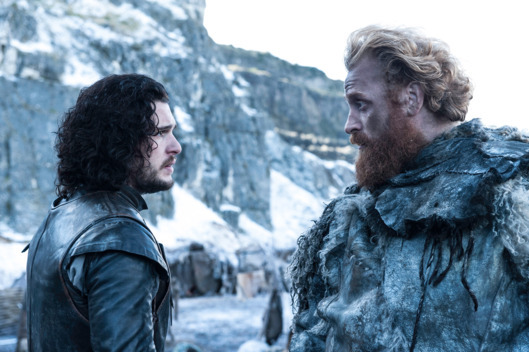
In Hardhome, the Wildling stronghold that gives the episode its name, Jon is reaping the consequences of his own hard choice, trying to convince a people whose identity consists in their unwillingness to yield that their best chance of survival lies in alliance with their greatest enemies. Some of the Wildlings pledge to join him, others (Thenns, of course) refuse—but it’s all prelude to the episode’s, and perhaps the season’s, great setpiece: the attack of the White Walkers.
And what a setpiece it is. The scene delivers the kind of pulse-pounding, bloody action GoT has become known for—and yet, to begin with, it’s actually a wonderful bit of filmmaking from a different genre completely: horror. The scene begins with a change in the air, the coming of a white mist, and it’s then that the Wildlings realize that trouble is coming and lock the gates. Some are left behind on the wrong side of the wall, clamoring against the wooden door. But then, they’re enveloped by mist and their feet, visible under the door, just disappear. I’ve no idea what happened there, but the imagining is worse than the seeing—a wise choice for a show that far to often shows us everything, even those things we don’t want or need to see. Then, of course, the White Walkers fling themselves against the wall, and all hell breaks loose.
Action scenes on film and TV are often criticized, these days, for being deliberately confusing, constructed of shaky images and a barrage of cuts that convey a feeling of peril and chaos without combining into sense. Last night’s action was sometimes guilty of these sins—it wasn’t always clear who was doing what, where different characters were, or the spatial relationships of the combatants. But I think this was a deliberate choice. The shots of the White Walkers clamoring through tiny holes in the wall, often canted, weren’t so much action shots as they were horror shots; zombies haven’t been this terrifying since 28 Days Later. When the action needed to be comprehensible, it was. And the scene managed to fit in at least one wordless revelation: dragonglass isn’t the only thing that can kill White Walkers. Valyrian steel can, too.
There are at least a few images from the scene that deserve special mention. A battalion of White Walkers flinging themselves off a cliff and landing on the ground like a flock of dead birds, only to stand again and fling themselves against Jon and his men. The image of one of the Ice Kings (I’m sure this guy has a name, but I lack the energy to wiki it; readers, chime in below in the comments) lifting his arms to add the dead Wildlings to his ranks. And Jon Snow’s boat slipping silently away, one commander looking at another across the water. Perhaps the boldest choice of all was to cut to black in silence, and to let that silence, filled with the chilling sounds of the wind over the Shivering Sea, linger on through the credits.
What a great scene. What a great episode. I’m excited about Game of Thrones again.
