Last night’s episode of Game of Thrones was titled “Unbent, Unbowed, Unbroken.” These words apparently refer to House Martell—but as I process what I saw last night, I can’t help but wonder if the showrunners meant for us to apply them to Sansa Stark, who was raped by her new husband Ramsay Bolton in the final scene of the episode. Is Sansa truly unbent, unbowed, unbroken? Would it be naive and callous to think so? Rape is treated so casually in the world of Game of Thrones that last season the show portrayed a rape it didn’t even acknowledge as a rape, so for this season to portray the actual emotional consequences of Sansa’s rape—to show her as neither unbroken nor irreparably broken, but somewhere between—might count, I suppose, as an improvement.
Such are the nauseating calculations one has to make when watching Game of Thrones—well, at least this rape scene wasn’t as bad as the last one. On Twitter, some are understandably upset at the show for writing into the plot yet another rape that wasn’t in the books. They’re only half right: it’s true that Ramsay didn’t rape Sansa in the books, but Ramsay didn’t marry Sansa in the books either. Instead, he married her childhood friend Jeyne Poole, who was posing as Arya Stark, and the wedding night was even worse than the one we saw in the show. Instead of simply making Theon watch, I’m told he was actually forced to participate in sexually assaulting Jeyne before Ramsay raped her. So I guess we can feel lucky, or something, that we weren’t forced to watch Sansa be subjected to that?
Ugh. Real talk: Ramsay Bolton is a sadistic fuck, Sansa’s married to him, and for the show to stay true to the character and to the situation, Sansa had to learn about his true nature eventually. That doesn’t necessarily mean that this particular scene had to exist, of course. But it does exist, and it’s the least-bad version of the scene that I can imagine: not lingering voyeuristically on images of Ramsay’s violation, instead focusing on Theon, wearing the vicarious agony of Sansa’s ordeal on his face. Whether this scene turns out to be completely gratuitous to the show’s plot and character development remains to be seen; in any case, it was certainly upsetting, and I wouldn’t begrudge anyone who was finally done with the show because of it.
On to other plot strands. The episode actually began with Arya, washing a dead body with something approaching tenderness. In a show where the casual destruction of bodies is so pervasive, it was almost jarring to see Arya treat the body of a dead person with as much reverence as she did. But then, after she was done, the body was simply carted out of the room to who-knows-where—and Arya, attempting to follow, was again denied. I’ve been growing a little tired of the faceless men’s Zen koan style of education, all this business of serving and becoming no one before Arya can truly learn what it is she’s come to learn. Even so, there was a satisfaction in discovering that what Arya was meant to learn was not to become nobody, but to lie about who she was while keeping her desire for vengeance; not to serve the dead but to become more callous toward them, to create more dead by pushing the poison water on a sick girl. (Still: it’s no “wax on, wax off.”)
In Dorne, meanwhile, Jaime and Bronn have reached their destination, but instead of finding Myrcella Lannister in peril, they find her kissing a cute boy, her intended. She doesn’t need or desire rescue as much as Jaime had expected. Not, at least, until the Sand Snakes come to capture her, and Jaime and Bronn fight back. The scene almost seemed to belong to another show—between Bronn’s one-liners, Jaime’s Errol-Flynn charm, and the Sand Snake’s dexterity and use of interesting weapons (one wields a whip), it’s pure swashbuckling fun. But the scene also felt different in a bad way, not up to Game of Thrones’ usual standards. The ease with which Jaime and Bronn snuck into the palace (or the Water Gardens or whatever) was almost comical, as were the sudden abundance of guards showing up at the exact right moment. I’ve got no idea what happens next with both Jaime and the Sand Snakes in custody, but I’m confident we haven’t seen the last of any of them.
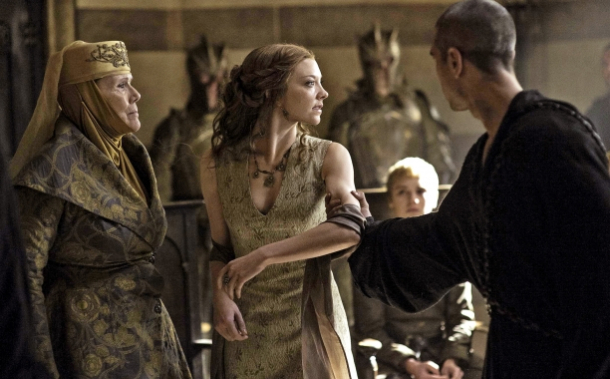
If Jaime’s not having much luck in Dorne, Cersei at least is seeing her plans work out better in King’s Landing—though to what end, I’m not sure. At an inquest into the sodomy accusations against Loras, the High Sparrow succeeds in marshaling enough evidence to justify further imprisonment and a real trial. He also ships off Margaery to jail for assumed perjury in the inquest. And Cersei and Tommen just let it happen. Cersei has certainly demonstrated her power to make the lives of those she doesn’t like difficult, but as I said last week, I don’t understand her endgame. Like Petyr Baelish, she’s a sly political manipulator, but unlike Littlefinger she operates too often from a place of emotion rather than cold, calculating reason. Judging by the look on her face, seeing Margaery carted off to prison may have pleased Cersei, but it’s not in her best interest for either Loras or Margaery to be ultimately convicted. As Lady Olenna made abundantly clear, the Tyrell alliance is an important one for the Lannisters. Cersei should be courting friends and avoiding war, not the other way around.
By episode’s end, though, it’s Tyrion who finds himself in the direst straits of the three Lannisters. Captured by slavers, he’s kept alive only as long as it will take them to find a “cock merchant” (such people, apparently, exist and make a good living in Essos) who can visually confirm that he’s a dwarf and thus validate the value of his…well, you get the idea. Jorah, meanwhile, is headed for the fighting pits of Mereen, where he can either get back in Dany’s good graces, or go down fighting like dear old Dad (he just learned of the elder Mormont’s death from Tyrion, who let it slip not knowing that Jorah didn’t know).
The episode, as I’ve said, was called “Unbent, Unbroken, Unbowed,” but I wish it had been titled “The Game of Faces.” There’s a part early in the episode where Arya says “I don’t want to play anymore!” and her cruel master replies, “One never stops playing the game of faces.” Then she’s led into a vast hall (the House of Black and White must be built like a TARDIS because it’s HUGE inside!) where a bunch of human faces—the faces, presumably, of the dead—are displayed on the walls and columns.
One never stops playing the game of faces. It’s as true in the rest of Westeros as it is in the House of Black and White—just as often true that the one who wins is the one who’s learned, as Arya is learning, to die. Those who allow their faces to betray their true motives, like Cersei, say, or Ramsay, seem destined to lose; those who’ve learned to use their faces to mask emotion rather than betray it, like Sansa, may suffer now but seem likely to win in the long run, biding their time, waiting for their opportunity to strike.
The best player of the game of faces is probably Petyr Baelish, who revealed new levels of duplicity in a conference with Cersei. On the surface, Littlefinger appears to have betrayed Sansa yet again—except he’s so good at hiding his real motivations that it’s likely he’s lying to Cersei, too. What Littlefinger has gotten for himself is the opportunity to march the Lords of the Vale on Winterfell unmolested by either Bolton’s men, who think he’s coming to assist them against Stannis, or the Lannisters, who think he’s allied with them. In reality, Littlefinger will probably do what Littlefinger does: arrive at the scene of battle, quickly discern the lay of the land, then take the side of whoever seems most likely to win. Whatever his allegiances, we now have three parties set to fight over Winterfell: the Boltons, who hold it, Stannis Baratheon, who wants to take it, and Littlefinger, who’s a wild card. Whenever they arrive, we’re set for an epic battle. For Sansa’s sake, I hope it’s soon.
