“A good mother never gives up on her children,” Daenerys said last night. “She disciplines them if she must. But she never gives up on them.”
Then she pushes one of the masters of Mereen in front of her dragons, who proceed to light the guy on fire, rip him in half, and eat him before he’s finished screaming.
Yikes. Thanks for making Mother’s Day extra horrifying, Game of Thrones! It was hardly the cheeriest way to end a day dedicated to appreciating moms, to brunch and flowers and mimosas—but the ways in which motherhood, and parenthood in general, were played out in the episode were anything but accidental. In the world of Ice and Fire, politics is family, and family is politics. Last night was full of children both literal and figurative testing their status with a parent—and parents, like Dany, negotiating the difference between discipline, tough love, and outright violence as they tried to get their kids to shape up and fly right.
Daenerys Targaryen’s relationship with motherhood is complicated: her only baby, so far, was stillborn, but she’s become known as the “Mother of Dragons,” and in her role as the Breaker of Chains in Slaver’s Bay, she’s “Mhysa,” or mother, to the people that she’s freed. But being the queen of a city torn apart by years of violence and injustice—being the mother of Mereen—is no easy task. Last week, the Sons of the Harpy (yet another familial metaphor) wounded Grey Worm and killed Ser Barristan the Bold. Now, this week, Dany became her angriest, most ass-kicking self again: the avenging mother of dragons.
But is the avenging approach the right one for Dany? The right one for Mereen? Before he died, Ser Barristan was advising mercy; Daario Naharis, meanwhile, thinks she should just kill all the former masters and leave the former slaves to make their own city out of what remains. (It’s a tempting proposition, if nothing else, from a story standpoint; the faster Dany can move on from Mereen the faster she can bring everything she’s learned to the struggle for the Iron Throne in Westeros.) Instead, she listens to Missandei, who for some unaccountable reason still has faith in Dany’s skills as a ruler and tells her to listen to her own heart or something. What Dany ultimately decides to do is take on another familial role: not wife, but mother, to an advisor and the head of an old Mereen family who the Internet tells me is named Hizdahr zo Loraq. Considering she was threatening to feed him to a dragon the last time she saw him, this is sure to be a good and supportive marriage strengthened by bonds of mutual trust, respect, and—BAAAHAHAHA just kidding it’ll be a train wreck.
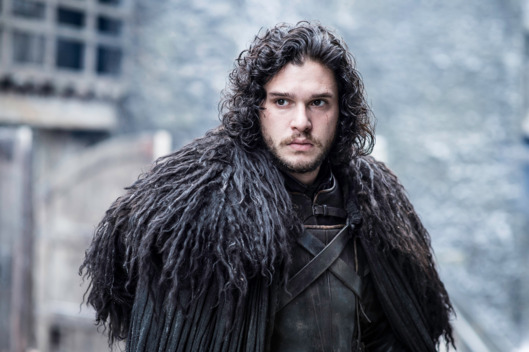
In the North, where Sam is reading up on Dany’s exploits, Jon Snow is another young leader working through the responsibilities of authority through a parent-child relationship of sorts—except that in this case, Jon’s both the parent and the child. Faced with a difficult decision, Jon’s advised by Maester Aemon to kill the boy. Only then, he says, can the man emerge. Given that the episode’s called “Kill the Boy,” it’s not too much of a stretch to say that this is an important scene. Aemon, you’ll remember, is a Targaryen himself, and as such he has more than a few reasons to be intimately familiar with the various symbolic deaths of leadership. His kinswoman is experiencing those deaths across the Narrow Sea in Essos; and now so is Jon, giving up any chance he might have had of popularity to try to make an alliance with the Wildlings.
What Jon’s trying to do here is not that dissimilar from Dany’s struggle in Mereen: he’s faced with forging bonds of peace between groups of people torn apart by years of violence and oppression. The men of the Night’s Watch all know people who’ve been killed by the Wildlings—one boy in particular, one of Jon’s supporters, saw his family killed by the Wildlings. But as Jon points out, the Night’s Watch have killed the Wildlings, too. An alliance is necessary if they have any chance of turning back the White Walkers. Jon needs to get the men he leads to give up their hatred of each other to see the bigger picture and unite against a greater threat. That’s no easy feat.
The third major setting for last night’s episode was Winterfell. It’s among the first places we were ever introduced to in Game of Thrones, but it’s changed over the years and the seasons, as Sansa points out: the place is familiar, but the people are strange.
Are they ever. Held by the Boltons, Winterfell is hardly the safe place Sansa knew it to be when she was a girl. She learns this firsthand when she meets Myranda, Ramsay Snow’s girlfriend and sometimes partner in sadism. At first, Myranda seems to be a friendly presence, complimenting Sansa’s dress and speaking kindly of her mother’s memory. (More mothers…) Sansa’s learned enough to be suspicious of Myranda, though, and the reasons for her suspicion are confirmed when Myranda points her to the creepy kennels, where she discovers a face from the past: Theon.
What a cruel scene it was. For Sansa to see a familiar face from her childhood might be a good, comforting thing—but seeing Theon was almost certainly anything but comforting, both because of what he’s become due to his torture at her future husband’s hands, and because of what Sansa still thinks that Theon did to her youngest brothers. Theon didn’t really kill them, but Sansa doesn’t know that. Roose and Ramsay do, though, which is what makes the scene at dinner so fascinating and awful.
It’s worth going through the dinner scene in a bit of detail. First, Ramsay stood and toasted his and Sansa’s pending marriage; Sansa pointedly didn’t drink to his empty sentiment. Next, Roose and his wife revealed that they’re expecting a child, and that the Maester thinks it’s a boy. Ramsay immediately sees his status as a favored Bolton son begin to slip away, and so he proceeds to do what Ramsay does best: make everyone else in the room miserable. He drags out Theon/Reek to pour some wine, then forces him to apologize to Sansa for killing her brothers. That Roose lets this charade take place says something interesting about him, I think—he’s not as obviously sadistic as his bastard son, but the look on his face suggests, I think, that he’s getting a kind of perverse enjoyment out of Sansa’s discomfort, and Theon’s.
Roose later tells Ramsay that he made a fool of himself at dinner, but I get the feeling that his heart’s not really in the scolding. Ramsay is his father’s son: born after Roose raped his mother, the wife of a man he’d just executed. When the mother brought Ramsay to her rapist, Roose decided to keep him because “I could see that you were my son.” The only difference between father and son is that Roose is a little smarter—he could easily put an end to Ramsay’s shenanigans if he wanted to, but he keeps the sick bastard around because his love for violence serves Roose’s ends, and the older man gets some pleasure out of observing his son’s sadism besides.
Yuck. I’m definitely cheering for both of these men to die—the only thing I’m not sure of is who I’d rather see do it. Stannis? He’s marching south from the Wall, so he’s the most likely to be the one to do it. But personally, I’m rooting for Jon Snow, or even better, Sansa herself, to be the one who holds the knife. Or maybe Theon. If he could be the one to finally kill his torturer, there would be a kind of catharsis there—if us if not for Theon.
Next week: back to King’s Landing, and to Arya!
Odds and Ends:
• Tyrion and Jorah Mormont’s adventures in Valyria and their run-in with the stone men was good stuff, even if it was mostly filler until they get where they’re going. Mysterious fallen societies are always interesting, and the stone men give a bit more emotional resonance to everyone’s fear of the dragonscale disease.
• Grey Worm loves Missandei! I wish these two could be the stars in a story that really deserved them, rather than occasional walk-ons in Dany’s story.
