Stanley Donen, born in 1924, grew up in South Carolina, where, as a young boy, he fell in love with the movie musical, and learned how to dance. He became a successful dancer, joining the chorus lines in Hollywood in the 1940s, where he met Gene Kelly on the set of Pal Joey. The two became friends and collaborators, working on some of the most incredible scenes in Hollywood musical history. While, no one needs reminding of the brilliance of Gene Kelly, or the legacy that he left behind as one of the great performers in film, the same cannot be said of Stanley Donen. Donen was the man behind the camera for so much of those early Kelly years, making things happen that no one had ever seen before.
Donen once said that they had a perfect collaboration, with Kelly directing in front of the camera Donen directing behind. But that was before their friendship ended, before they married the same woman, before the bitterness reached full tilt and they tried to undermine the other’s contributions.
Gene Kelly is an integral part of Stanley Donen’s career, but he is only one part. It’s worth remembering Donen’s hard work, both in his collaborations with Kelly and his post-Kelly years, and to marvel at how a technically capable Hollywood Studio man became an artist.
Pre-Directing Years: Cover Girl & Anchors Aweigh
After meeting Donen in the chorus of a number of musicals, Kelly asked Donen to choreograph for him in the 1944 film Cover Girl, directed by Charles Vidor. According to Kelly, Donen “needed the job.”
In the process of choreographing to the script, Stanely Donen conceived of a scene in which Gene Kelly dances with himself as he debates his future with his alter ego. Vidor wasn’t interested in pursuing the scene, considering it technically impossible to shoot. But he let Donen and Kelly directed the scene themselves.
The eager young film-makers went to work shooting the sequence, with Kelly dancing and Donen doing the technical work. Donen spent an entire year editing the scene. Audiences had never seen anything like it. The film made Gene Kelly a movie star.
A year later, Kelly and Donen were again choreographing together, this time on Anchor’s Aweigh, starring Kelly and Frank Sinatra. And again, Donen brought to the project another complicated technical idea: Gene Kelly dancing with an animated character. He wanted Mickey Mouse, but Disney had Mickey preoccupied, so instead it was Jerry the mouse.
Donen again directed this scene, working with William Hanna and Joseph Barbara on the animation, and once again, Donen spent a year putting together dance number frame by frame.
What you see in these two scenes, besides a ridiculous commitment to the task (two years!) is the true integration, for the first time, of dance and cinema. What makes movies different than musical theater is the ability to shoot, record, and edit. Prior to Kelly and Donen, musical cinema was chiefly a theatrical production. These are the early signs of the Hollywood Musical becoming movies first.
On the Town: Musicals on location
Kelly and Donen collaborated on a number of films after Anchor’s Aweigh, and in 1949, the pair were given their first film to co-direct. It was On the Town. And once again, the two friends set about doing something no one had ever done: take the grand scale of Hollywood Musicals off the sound stage. Kelly insisted the film be shot on location, and Donen set about figuring out how in the hell you shoot a musical outside.
They filmed the movie’s opening number, “New York, New York,” on location in the streets of New York City. The studio gave them a week to get it done, and while Kelly, Sinatra, and Jules Munshin danced and sang, Donen and his cinematographer were inventing a new style of shooting and cutting together live action that were counter-intuitive to the Classical Hollywood rules of continuity editing.
In his biography of Donen, Joseph Casper describes On the Town as a turning point in Hollywood: “the first bona fide musical that moved dance, as well as the musical genre, out of the theater and captured it with and for film rather than on film; the first to make the city an important character; and the first to abandon the chorus.”
The film won an academy award for its music, and a Golden Globe for it’s cinematography.
Working alone: Royal Wedding
Fred Astaire was Donen’s boyhood idol, the man who made Donen want to dance. After On the Town, Donen received a contract with MGM to direct on his own, and his first solo-directing project in 1951 let him work this his hero. In Royal Wedding, Astaire and Stanley Donen would produce one of the most famous dance numbers of the era.
The song is “You’re All the World To Me,” and the dance number sees Fred Astaire starting on the floor, and slowly dancing up the walls, on to the ceiling. Who thought of this scene is in dispute (though it was not the director), but it was Donen who had to figure out how to make it happen.
The crew built the set inside a steel cylinder, with the camera built into the floor. Then, spin the tube. It’s still exciting to watch today, as Astaire jumps from ceiling to hand-standing on a chair, back to the ceiling.
It’s a perfect marriage of dance creativity and cinematic ingenuity.
Singin’ in the Rain.
By 1951, Gene Kelly was a global star. He had starred in Vincent Minnelli’s An American in Paris, which had earned Best Picture at the Oscars (a surprise, defeating the favorite Streetcar Named Desire). He would in 1952 collaborate again with Donen; the two co-directed Singin’ in the Rain. It was a true collaboration, with Kelly handling the dance and choreography in front of the camera, and Donen handling the direction behind it.
Once again, Donen showed his technical capacity and knack for problem-solving in order to realize Kelly’s choreographic imagination. Everything from the scale of the crane shots, to the complexities of backlighting the rain to appear on camera, to the smashing up the concrete to create more puddles, highlights Donen’s ability to make Kelly’s vision a reality..
There’s really nothing to say about a Singin’ in the Rain that hasn’t already been said. It’s a damn-near perfect film, highlighting one of the great on-screen performers in a movie so enjoyable that it’s level of cinematic grandeur can be easily overlooked. Despite receiving tepid reviews upon it’s release, it is now regarded one of the great films of the classical Hollywood years.
The MGM Years and Seven Brides for Seven Brothers
After Singin’ in the Rain, Donen set about working on his contract for MGM. He would make a number of forgettable films, including the true story comedy about a WWII soldier who brings his pet tiger with him when he’s drafted (Fearless Fagan). But it was with Seven Brides for Seven Brothers that Donen finally established himself as a solo-director.
The story of frontier life was a challenge to shoot, and took forever. Donen shot the entire film twice, with a traditional camera and again with a brand new technology, CinemaScope. CinemaScope, allowed the camera to capture an aspect ratio twice as wide as traditional film technology, which Donen thought would compliment a film with so many dancers working in the frame simultaneously. Said Donen of the process: “I had to shoot and cut everything twice-restage scenes, put in a different set of marks, light it differently, loop it,” said Stanley Donen. “We had two cutting rooms going, and it cost the studio another $500,000, which was a lot for then.”
The movie’s most famous scene, the Barn Raising dance, highlights just how useful CinemaScope was on such a large production.
Seven Brides for Seven Brothers was a hit, and won a Best Picture Nomination at the Academy Awards (it lost to On the Waterfront. Can you believe the quality of 1950s cinema?).
Donen’s next project was a reluctant return to working with Gene Kelly. The two made It’s Always Fair Weather, and though the film was a success, the process was not. The film depicts the fragile bonds of friendship, and behind the camera, the directors’ were losing their own. They unraveled, and the two would not work together again. “It was a 100 percent nightmare,” Donen would later say about the film that became famous for the troubles behind the camera.
It was also the last film Donen made for MGM. He fulfilled his contractual obligations on loan to other studios, or picking up parts of other films.
Funny Faces: Donen’s independent years
The next picture Donen directed was an adaptation of the George and Ira Gershwin musical, Funny Face. Starring Audrey Hepburn and Fred Astaire, the film tells of a fashion photographer’s Parisian life . Funny Face has a free-flowing quality different than everything Donen had done previously. His yearning to stretch his artistic touch is easily felt.
Donen strives for a European cool in Funny Face, and he does not always succeed (Sight & Sound called the film anti-intellectual, and that’s not wrong). But the movie also represents the first time Donen portrayed the gilding on the sheen of Hollywood. Musicals were already becoming uncool, and here is Donen, one of the great directors of the genre, making a Hollywood-style musical about something as cool as Paris fashion in the 50s.
This is also the first of three pairings of Audrey Hepburn and Donen, who was one of the few directors that had any idea how to use the off-beat aura that Hepburn exudes in her best work. (read more about Funny Face)
These were prolific years for Donen. He released 3 films in 1957 alone. He would shoot The Pajama Game in a high-paced six week shoot that made little money but pleased the critics, before being personally asked to by Cary Grant to direct him in Kiss Them for Me, which he agreed to do if Fox would buy him out of contract at MGM. They did, he made the film. Grant and Donen then created their own production company, Grandon Productions, and Donen henceforth would produce all his work for the remainder of his career.
One of Grandon Productions most notable films is Indiscreet, starring Cary Grant and Ingrid Bergman. In the ‘man who gets it done vein,’ I’d be remiss not to mention Donen’s crafty manipulation of the fogies at the Production Code, which governed what could or could not be on screen, and disallowed ‘licentiousness.’ During the famous pillow-talk scene, Bergman is in Paris and Grant in London. Donen shot them separately, only to use split-screen to create the illusion of the two sleeping in the same bed. The way Grant and Bergman shift about in their beds-at times appearing to spoon and touch hands-delighted audiences, and helped popularized the split-screen technique (this was a year before the even more famous use in the film Pillow Talk).
These years were also ushering in the end of the period of Hollywood’s Studio Era, which Donen was a fortunate product of, and welcomed the end of. As the studio days wound down, Donen was successfully transitioning to a director of comedy (though he did make plenty of duds, like Once More, With Feeling!, a bomb he made with Yul Brynner) with an artistic reach beyond the scope of the Hollywood Musical.
Charade
Donen shot Indiscreet in London and he enjoyed it so much, he stayed, spending the next decade living and working in England. The escape from Hollywood was welcome (avoiding “the Hollywood rat race”, he called it), as was the effect of being in the midst of a rising tide of European art-house cinema.
The freedom Donen felt in England is evidenced in two of the best films he made in his career: 1963’s Charade and 1966’s Two for the Road.
In Charade, Donen places the screwball romantic plot of Audrey Hepburn and Cary Grant into an Alfred Hitchcock style thriller. The film is stylish and wonderfully directed, using the beauty of the Parisian city-scape to backdrop a number of suspenseful chases and romantic dalliances. Since its release, Charade has been viewed as Hitchcock-light, with some calling it “the best Hitchock film Hitchcock never made.”
But whatever your thoughts on the Hitchock comparison, it’s hard (but not impossible) to deny the pleasures of Charade. One of Donen’s strongest assets is an awareness of exactly what he’s doing, and how to go about getting it done. Early in his career that was with creative technical achievements. Now, with Charade, it’s with the silkiness of a mature artist. He never assumes that his material is other than it is: light and airy romantic dealings, mixed with enough violence and terror to please audiences. Joie de vivre brought to life by two for the screens greatest performers and one of the eras best directors.
Donen also brings the title to bear on the world of movie-making itself, ever-so-slightly pulling back the charade of what it means to watch stars fall in love, and have the ground pulled from under our feet. By 1963, Donen had created a visual style and directorial skill that can’t be denied, and ensured his career would outlive a Hollywood studio system which was officially over.
Two for the Road
Three years after Charade, Stanley Donen would reunite with Audrey Hepburn for their third collaboration, Two for the Road. Back in 1956, Donen had Hepburn in Paris as a young woman in an ugly-duckling story, romantically linked to an older man in Funny Face. In 1963, they were back in Paris, now with Hepburn playing the self-confident thirty-something, in pursuit of a man and capable of taking care of herself in Charade. Now, in 1966, Donen cast Hepburn alongside Albert Finney in a portrait of lasting marriage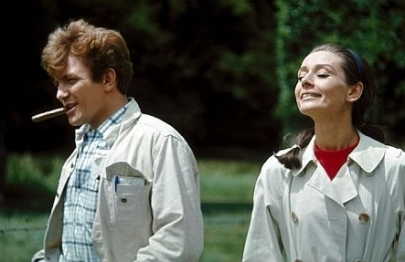 .
.
Two for the Road takes place once more in France. The film depicts the fullness of a relationship from youth to the well-worn years of familiarity. As the couple drives through the French countryside, the film flashes back to the previous trips they have made in the past. The time cuts are sometimes jarring, with the only real indicator of change coming in the cues of Hepburn’s performance (and length of her hair). Donen understood as well as any director that Audrey Hepburn had depths to plumb as an actress, and this film is no different. She has the brunt of work in front of the camera (Finney is great, but largely unchanging as her architect husband), and she handles it beautifully. It’s quite possible that that Two for the Road is the best film performance that Audrey Hepburn ever gave.
It’s not surprising that Donen’s two best non-musical films, Charade and Two for the Road, are European affairs made far from the clutches of Hollywood. There’s such a freedom and liveliness to these, and other films made during his stay in England. The joy of his musicals remains, but with it comes a personal touch that the Studio system largely avoided.
Donen is known primarily as among the best of the musical directors, and rightly so. He came along at the right time to be involved in some of the most groundbreaking innovations in movie musicals. But it’s in movies like Two for the Road that audiences can see the technical ingénue becoming an artist with a voice.
Donen’s career continued after Two for the Road, directing films for another 40 years. He’s still living, the last of the great Classical Directors, though out of the business for more than a decade. He always maintained the attitude of a great collaborator. He was not an auteur but a helmsmen, someone who worked hard to achieve the best possible version of the imaginings of his team.
In 1997, Donen was awarded a Lifetime Achievement Oscar. Martin Scorcese handed him the statue, and Donen proceeded to give a brief, heart-warming speech. A little song, a little dance, and a reminder of what it means to be the guy who just gets thing done: Hire great writers, the best actors, the visionary men and women of the business, and then show up. “You gotta show up,” he said, holding up his Oscar, “otherwise you can’t take the credit, and they don’t give you one of these fellas.”
