This week, in All New X-Men #40, Bobby Drake came out of the closet. Drake is better known as Ice Man, and in a conversation with Jean Grey, he denies, misdirects, and eventually acknowledges that he is gay. The scene was written by Brian Michael Bendis, and the exchange, between Bobby and Jean Grey, is a momentous moment for the X-Men.
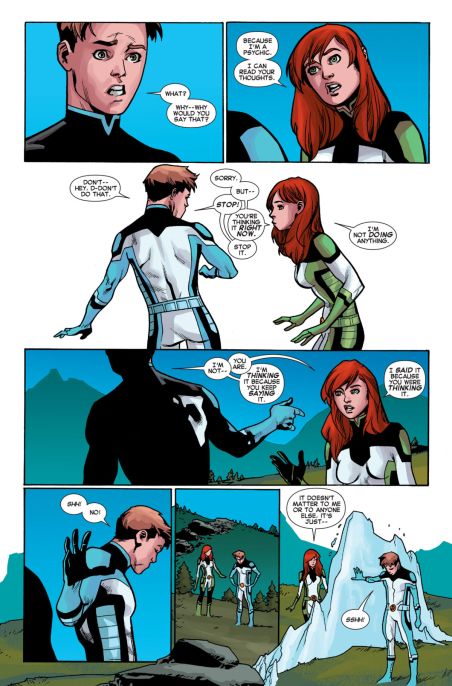 Bobby is not the first X-Men to come out as gay or lesbian (that would be, if memory serves, Northstar, who married his partner in the first same-sex marriage in Marvel Comics back in 2012). But revealing Ice Man’s queer identity carries arguably greater significance given his integral role in the team’s history.
Ice Man is one of the founding members of the X-Men, on the original team of five created back in 1963. Bobby Drake has always been in the X-Men. He is known to readers, has appeared in the films, has been a favorite of many readers for decades. That carries with it a significance that cannot be excused easily, or ignored as a part of some kind of ‘diversity initiative’.
That significance also means extra scrutiny. Some in the LGTB community have been criticizing Bendis’ handling of Bobby’s revelation. These critics view the ‘coming out’ scene as example of bisexual erasure. Bi erasure occurs when bisexual orientation is treated as false or fashionable or non-existent. Here, Bobby tries to deflect his friends assignation of homosexuality by saying “maybe I’m bi.” To which Jean responds: “they say everyone is bi…I think you’re more….full gay.”
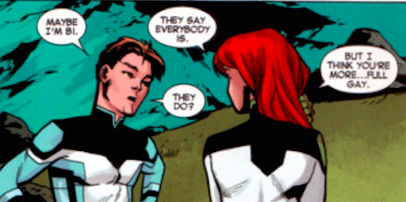 It’s not hard to see why a bisexual reader would respond negatively to this exchange. But embedded in the criticisms is another troubling idea: that Bobby’s coming out is somehow done ‘incorrectly.’ Bobby Drake is a teenager in All New X-Men. He’s coming out reluctantly and looking for deniability. There is, in Bobby’s defensiveness, the truth of being a teenage boy.
Is this bi erasure or a sensitive, personal exchange among youths on a difficult subject? Bendis has been engaging readers on twitter about the subject, and for better or worse, he’s now part of the bi erasure conversation.
Whatever one makes of this moment in Marvel Comics history, Bendis, and Marvel, continue to push forward the company’s commitment to increased representation in their pages. No story will ever please everyone, and revealing a classic Marvel character’s homosexuality was always going to be controversial (not to mention, how this is going to change 50 years of Ice Man characterization). Bendis and Marvel likely didn’t see bi erasure as the attack that would be forthcoming. But benefits of varied character diversity are more than worth a debate about what it looks like to come out in the pages of All New X-Men.
