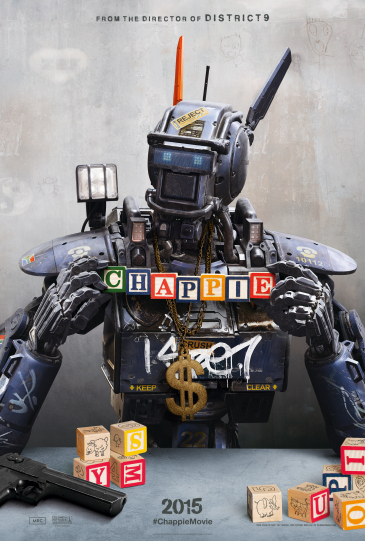
 Would you rather have your city policed by perfectly programmed robots or by a human-controlled drone? Seriously. What is the better choice? Robots follow their programming and with proper programming comes no error. But with them also comes no judgment calls. Humans have a moral sense of right and wrong and can adapt. But with humans also comes greed and anger and occasionally really bad decisions. If I think honestly about the question, I’m not sure which I’d prefer.
The militarization of police forces and the use of robotic technology by law enforcement are no longer concerns stuck in the realm of science fiction films like Chappie. We’ve seen what the high-tech militarization of civilian police looks like. It is not yet mechanical drones and robotic officers. But such a vision doesn’t feel as alien as it might have a decade ago.
Chappie, directed by South African filmmaker Neil Blomkamp, has us thinking about this question almost from the get go. Blomkamp made the fantastic 2009 sci-fi film of racism and apartheid, District 9; he’s been trying to recapture that magic ever since.
This time, Blomkamp has replaced his stranded alien with an artificially intelligent robot named Chappie. And, like Spielberg in E.T., and Andrew Stanton in Wall-E and countless others before him (though Chappie is decidedly not a family movie), Blomkamp uses a non-human character as the emotional center in a very human story. This time, about being a child trying to survive in a violent, unforgiving world.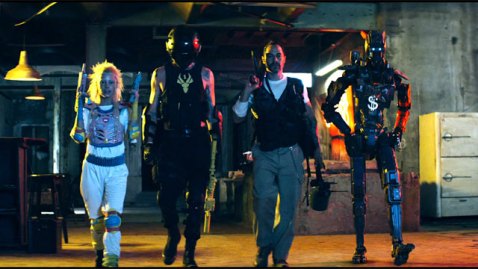
Chappie is filled with tech, spiritual and philosophical considerations about the mind, the body, and soul. It’s also funny, and violent, and strange. It’s part Short Circuit, part Pineapple Express, part E.T., part Michael Bay. That may sound like a unfitting combination. But in an era when most action films are exceedingly dull and lacking in a single spark of inspiration, Blomkamp’s Chappie is a welcome, thoughtful, break. It’s cinema overflowing; I’ll take that gratefully any day.
It’s also part RoboCop. There are giant mechanized machines (think RoboCop‘s ED209 droid, only amped up for modern drone warfare) dropping bombs, and drug-dealers and street gangs and a body count straight from, well, RoboCop.
The film is set in the future, all the way in 2016. The police on the streets of Johannesburg, South Africa are robots. These robots were designed by Deon Wilson (Dev Patel from Newsroom, Slumdog Millionaire), a brilliant engineer who works for a high-tech weapons company Tetra Vaal. On his own time, Deon is also trying to create artificial intelligence. His robot cops do their job in coordination with human officers; they are not artificially intelligent, just well programmed and very effective. They have dramatically decreased crime, violence and drug distribution. All of which remain, however, and when one of these robot officers is destroyed in a gunfight, Deon steals it and uploads his untested A.I. program into the old bot.
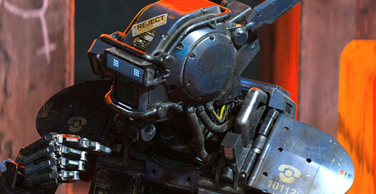 Thus Chappie is awakened as the first artificially intelligent being in history. He wakes like an infant, and ages in the film through his young adolescence. Though just a child in his mind, Chappie has the body of a police robot and the technical capacity of a cutting edge machine. To everyone other than the very strange family he finds, he looks like, and is treated, accordingly. For parents in the audience, however, Chappie is just child.
Chappie finds a mommy and daddy named Yolandi and Ninja (two street punks played by Ninja and Yolandi from the South African rap group Die Antwoord) and a maker, Deon. Ninja teaches Chappie about survival. Yo-landi teaches him about the soul, that what is inside him matters most. And Deon, the maker, teaches him about the mind, to be creative, to learn, to enjoy intellectual pursuits. Chappie discovers he has a gift for painting, and a love for books.
The uncanny resemblance of the toddler Chappie to a human toddler is one of the film’s most successful elements. Sharlto Copley, who played the motion-capture part, is on Andy Serkis levels here. Anyone who spends time with children will recognize the accuracy of Chappie’s growth: remembering faces, picking up words, moving cautiously, testing his surroundings. The curiosity is so realistic that watching him abused by those who see him as simply a machine is troubling. As the parent of a toddler, I felt real anxiety when Chappie was being beaten and tormented, uttering the sad refrain “Chappie has fears, Chappie has fears.” The scene still unsettles me days later.
From the start of his life, Chappie will also know evil, personified in the guise of another Tetra Vaal robotics engineer (played by Hugh Jackman in the worst haircut of 2015), who wants to destroy Deon’s robotic police to make way for his new, enormous and militarized drone that no one will buy because it represents, as one police force representative puts it, “overkill.” (In one scene, Tetra Vaal’s CEO is told “things will have to get a lot worse to even consider it,” a sentiment that might have been funny in the days before cops drove tanks down American streets).
Good vs. Evil, Mind vs. Body. Familiar stuff really; Blomkamp isn’t breaking ground by exploring ideas of human identity in a movie about robots. But it’s a lot for Chappie to absorb, given that he is, after all, a child. Early in his life, Chappie learns that his scrap parts body has only 5 days of battery life, a realization that leads to a simple, unanswerable question: “Why did you make me so that I could die?” A question sci-fi movies have asked for years, and humans have been asking for centuries.
Which is the question that lies at the center Chappie. In a film about robots, artificial intelligence, street gangs and police militarization, lives a quite touching story about what it means to be human. Especially touching, given that Blomkamp’s vision of humanity is condemning: a violent and unwelcoming species, capable of little other than promulgating more violence. We need technological solutions to the problems we have made, and a new life form like Chappie can do little other than look on and ask, “Why do humans always do these hard things?”
What makes Chappie work as a film is its ability to manage its childlike introduction to philosophical themes with a steady stream of humor and explosions. Humanity in Chappie cannot separate them. The engineers that design our tech-police forces are fighting over the same grievances as the street-punks and warlords: is the heart or the head that makes us who we are?

The problem here is that “Would you rather have your city policed by perfectly programmed robots or by a human-controlled drone?” is not a question that needs answering. Nothing about policing nor cities suggests to me that I ought to think about this question, even in the setting of a SciFi film. It’s like field hockey in that way; I don’t need to think anything about field hockey. Ever. What’s a better caprice is the rather pedantic question that the film also asks: Why should we think that artificial intelligence won’t be child-like? What might a child-like artificial intelligence think of all this violence and greed and hate? That’s a more interesting thought experiment, and excellent fodder for a SciFi film.
You don’t need to think about it, LBJ.
But it’s an interesting question to consider, and one that I had not previously considered, and one that opens Chappie.
However, I would argue that questions about robotics and drones are not equalivent to questions about field hockey. Field hockey does not matter. Robotics and drone technology are killing unknown numbers of people around the globe everyday.
Your question wasn’t about drones or robotics. It was “would you rather,” and like most “would you rathers” (see also: a running gag on Extras) it’s not an interesting question. The obvious to all answer is “neither.”
Well, it’s posed by the film, it’s not my question. Sorry for the lack of clarity, LBJ. I am not asking you, you are being asked by Neil Blomkamp.
http://www.npr.org/2015/02/03/383454933/why-we-judge-algorithmic-mistakes-more-harsley-than-human-mistakes
“In many areas, algorithms make fewer mistakes than humans. But new research suggests that we distrust algorithms when they make mistakes, in ways we do not distrust humans who make mistakes.”
All right, I’ll bite, what’s the answer to the question?
well to answer that would be to spoil, but I”ll say that the answer struck me as actually quite radical. Blomkamp actually takes a position on the “interesting thematic questions” that arise in the movie, which is fairly rare, i think, and cool