 Tentpole franchises are endangering Hollywood. At least, that’s the conclusion reached by Doug Creutz, an analyst for Cowen, in his new report: “Memo to Hollywood: You Can’t All Be Successful Doing the Same Thing.” The gist of the report? There’s only so many box-office dollars to go around, and if every studio pursues the same franchise strategy, every studio will suffer as a result.
Annual box-office returns have been down in recent years. And while I’ve always been skeptical about warnings signaling the end of the Hollywood Studio Model, there’s no question that the major studios are all engaged in the same mega-franchise production plans. Marvel/Disney and WB/DC are leading the way on that front, but everyone else is lining up, single-file, to follow suit.
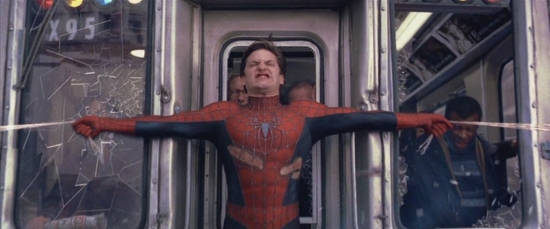
Creutz uses ecology as a metaphor in his analysis, claiming that everyone following one strategy risks “damaging the ecology of the business.” That is an apt comparison. Right now, the Hollywood film landscape has a resource management problem: the superhero franchise. Disney has Marvel; Fox has X-Men; Sony has Spider-man; Lionsgate has The Hunger Games. These are the top priorities at the top level of the major Hollywood studios. Nothing makes money like the superhero franchises, nor risks quite as grand of failure. The superhero franchise is the Apex Predator of Hollywood; it has no natural predators.
But here’s the problem: the health of the apex predator does not measure the health of an ecosystem. Dominant predators are healthy and thriving right until they eat up all their resources and then die. That’s the threat facing Hollywood. If one wants to manage the ecology of the business, then one needs to manage the Umbrella Species. It’s designation comes because if that one species is thriving, it signals the health of everything else in the ecosystem. Protect the umbrella species, and you protect everything under that umbrella.
So what is Hollywood’s Umbrella Species? The mid-level release. The $25-40 Million budget film, released on 1,000-2,000 screens, seen not by every adolescent in America, but by teens and adults who will spend money on good movies (this does happen). If the Hollywood ecosystem is healthy, studios are making big movies to finance their mid- and small-level movies. And those mid- and small-level movies are making money. The potential ROI on mid-level movies is much greater than on the $100M+ franchise film, more and more of which fail to interest audiences anyway.
If the future that Creutz warns Hollywood about comes to pass, if all the money goes to feed the dominant predator, then the whole system will collapse, and discerning film viewers (who like both superhero movies and mid-level dramas and indie gems) will lose out on everything. Protect your mid-level projects, Hollywood. In doing so, you’ll keep your franchise films healthy, too. It’s nature.
Metaphor over.
A few highlights:
♦ “2014 is the fourth year in a row that box-office and film quality data suggests that a downward shift in theatrical demand curve has taken place.”
♦ “Last summer was by some measures the worst summer the industry has had since the original Star Wars came out in 1977, despite the fact that the summer saw launches in the Spider-Man, X-Men, Planet of the Apes, How to Train Your Dragon andTransformers franchises, several of which were very well-reviewed.”
♦ “We are increasingly concerned that the convergence to nearly identical film franchise strategies at the major studios risks damaging the ecology of the business and accelerating already existing negative secular trends.”
♦ “While we think that the studios with the least appealing content and lesser IP are likely to carry the most risk, we believe that even Disney, which has the most powerful-looking collection of IP, will probably see its film performance negatively impacted as all the other studios crowd into the same corner of the film universe.”
