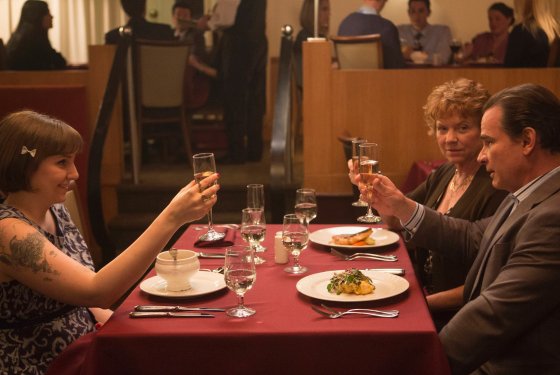
The first scene of Girls‘ fourth season brings us all the way back to the beginning, the very first time we were introduced to Lena Dunham’s Hannah Horvath. The series premiere opened with Hannah sitting across the table from her parents at a fancy restaurant, enjoying her meal only to discover that her mom and dad were in fact only feeding her to soften her up for some bad news: they were going to stop supporting her financially. Season 4 opens with the same setup—same seating arrangement, same restaurant, as far as I can tell, and heck, maybe they’re even sitting at the same table. But the situation has completely changed. Now, instead of giving Hannah bad news, they’re toasting her good news: she’s been accepted to the Iowa Writer’s Workshop. Halfway through the toast, Adam—now Hannah’s committed boyfriend—joins the table with apologies for being late. The superficial similarities of the scene from season 1 to season 4 only serve to highlight how thoroughly everything else is changed.
Well, not everything. Hannah still loves to eat (she interrupts her dad’s toast to order some fries), her dad is still more of a pushover than her mom (he tells her it’s okay to order fries because it’s Friday), and Hannah is still a little manipulative—in her thanks to her parents, she manages to slip in a mention of all the times where they were less than 100% supportive, probably thinking of the last time they visited that restaurant.
But still: growth! Adam may call the move to Iowa “another step in a series of random steps,” but really it seems to represent a genuine step forward for Hannah in her development as a person and as an artist. Over the past three seasons, we’ve seen her turn a fucked-up relationship into a seemingly healthy (if defiantly odd) one, take a series of real grown-up jobs only to realize that what she really wants to do is write, and now get into a prestigious graduate program. She’s not where she wants to be, yet, but who is? Hannah’s making progress.
More on that later—but what I really want to focus on, for a minute, is the parents. Not just Hannah’s parents, but Marnie’s and Shosh’s and, in a way, Jessa’s too. This episode was chock-full of parents, and interested in how parenting contributes to make us who we are. Yet it’s not a parent but another daughter—Beadie’s daughter, furious at Jessa for helping her mom nearly kills herself—who announces what may be the theme of the episode: “Every time I meet someone five years younger than me, they’re a complete asshole. Is it because you were told you were special one too many times and believed it?” I count at least two intellectually lazy millenial-hating cliches in these sentences—1) kids these days, right? and 2) it’s because everyone told them they were special—but really: what about these parents? What is it about what a parent says or doesn’t say that can make their children who they are as adults?
Hannah’s parents may not be directly responsible for her success, but their decision to cut her off financially in season 1 did indirectly put her on the path to Iowa. Contrast with Marnie’s mom, who’s now going to her daughter’s “jazz brunch” performances with Desi and mouthing the words to every song like a stage mom watching her princess sing in a school play, and you have to wonder: did she have anything to do with Marnie’s predicament? Did she tell her little girl that she was special one too many times? Elijah says that what Marnie needs is to grow a thicker skin. If she wants to make it as a singer, she needs to stop caring what other people think. She needs to take risks. And she needs to surround herself with real critics, people who can give it to her straight to help her grow.
Shoshanna, meanwhile, has finally graduated from college—and, once again, the parents make an appearance, played by Anthony Edwards and Ana Gasteyer. We’ve only just met these characters, and the scene is too brief to reveal much—aside from some lingering post-divorce resentments, and a kind of competitively cloying helicopter parenting that Shoshanna obviously finds irritating. In past seasons, Shoshanna has seemed emotionally stunted, almost narcissistic in her inability to really conceptualize the needs of those around her. But she’s growing. The humiliation of not graduating with the rest of her class has taught her a few things, and mellowed her—and when she talks with Ray, she is wise and considerate, even if she’s obviously still hurt. (Now if only Ray would come to his senses.)
And Jessa—well, Jessa’s the only one of our four girls who is effectively parentless. Her dad—who we met in season 2—is an unsatisfying parent, and last night’s episode found Jessa losing yet another potentially parental figure: Beadie, who’s moving to Connecticut. We didn’t get to see much of Jessa and Beadie’s relationship, and I’m a little angry about that. I wanted at least a season’s worth of seeing these two interact. Regardless, Jessa seems to have real affection for Beadie, and Beadie for Jessa. The older woman tells Jessa in parting that “You’re so special, you’re so full of contradictions, you’re so beautiful, and then you’re so ugly.” (Which is pretty much how I feel about all of these characters, and this show.) Jessa doesn’t seem to be too heartbroken about losing Beadie, but the way she lashes out at Hannah later for leaving New York makes it clear that she’s feeling more abandoned—by both Hannah and Beadie—than she wants to let on.
Still, Hannah gets the goodbye she deserves, if not from Jessa then at least from Adam and Marnie. Both boyfriend and best friend can be a little self-involved from time to time, but deep down both seem to really love her. The prospect of Hannah leaving seems genuinely heartbreaking to Adam. And Marnie, even in the midst of her jazz-brunch meltdown, shows up at Hannah’s apartment at the crack of dawn with a coffee to wish her friend goodbye.
How will Hannah like Iowa? And how will her friends survive in New York without her? We’ll see next week.
Odds and ends:
• That Adam shoots an ad for an antidepressant drug named Torpica, with the tagline “because you deserve the sun,” is a great bit of black comedy. But also, Adam seems to be falling into a real depression, and Hannah’s not wrong to fear that he might fall apart without her.
• I love Hannah’s mirror affirmation: “You made the choice you need to survive, everyone’s path will unwind just right.” Now, her anxiety isn’t just for herself—it’s for others, too.
