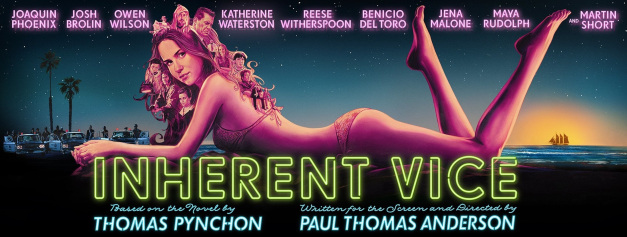
I watched Inherent Vice on its opening night in Los Angeles on the eve of a storm. The storm of the century to hear the locals say it; a Japanese typhoon winging its massive rotation down the coast and spreading floods and destruction, generally speaking. The theater was mostly empty, which might have had something to do with the storm, or maybe the venue, which was the AMC at Century City. This theater is perched high above an open air shopping mall of the fanciest order (with Louis Vuitton and Tesla stores), itself seeming to hang high above the Santa Monica boulevard and set beneath looming towers, one of which is the Nakatomi Plaza; yes, that tower from Die Hard.
The theater was about nine tenths empty, filled mostly with lonely, young to middle aged cinema nerds, rarified geeks who seemed all pulled from the same dive bar. There is a very real anxiety upon viewing the demographics of certain movie audiences: one asks, is this the tribe I belong to? Do these people define me? “P.T. Anderson!” one such nerd exulted, entering the theater late and drunk, seeing how few were in attendance. A special few, one might argue, like wizards in a crowd of muggles.
I wanted this viewing to take on special significance, to be a charged moment: I’m watching a movie about L.A. in L.A. Dude, very intense. But why the hell did I go to an AMC theater? An AMC that could have been any AMC across America, bearing nothing to distinguish itself from Gainsville, Minneapolis, or Witchita. It’s a classic example of corporate-entity homogenization; the systematic eradication of local specificity. Every Starbucks is the same, whether you’re in Jerusalem, or Mexico City. This is a particular vice of late-capitalism that Pynchon is, so to speak, hip too.
I had arrived at the theater an hour early, imagining long lines and crowds, but seeing how empty it was I sat down at a bougy bar and had two manhattans and a straight whiskey. Which is a particular vice I have: I like to have a nice whiskey high going before the movie, otherwise I forget it ever happened.
 And so Inherent Vice was a blast and confusing as fuck. I’ve read the book and listened to the audiobook and still had a hard time tracking. Where the book is labyrinthine in story, its exposition is generally adequate. Plus you can actually stop and like, think about what’s going on. The movie, though has little to zero exposition and so we are propelled joint to joint, as confused, it seems, as the hero is. Which is half the point.
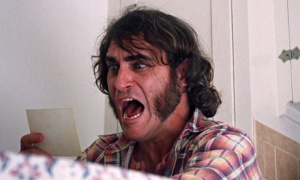
Joaquin Pheonix, as Larry “Doc” Sportello, carries the day. He produces a wealth of strange inarticulate noises. Every time his lips twitch when he hears the name of his ex-girlfriend, you get the willies. Despite all the confusion and general weirdness, something meaningful is going on. But the weirdness is all Pynchon, for it seems that P.T. Anderson has elided some of his more creative tendencies. I wanted the movie to be weird in the way that the car crash and subsequent mystery piano is weird in Punch Drunk Love. But it is not so.
In fact one might even go so far as to say that the movie is, even if a Pynchon adaptation, rather staid for Anderson. Somehow the book remains far more cinematic than the movie. I mean how exactly does one adapt such a wicked prose style? If we could, for a moment, think of the transmission of narrative information like a stereo system, then Pynchon is turned up all the way to eleven and is actually distorting the frequency, whereas Anderson has turned the volume way down to like four or five.
The dialogue, for the most part, is cut and paste. The set pieces are thrumming with little Pynchon peculiarities (although, super bummer alert: for as musical as Pynchon is, no one ever sings any songs in this movie. I mean what the fuck?). But therein lies a problem that I’ve written about before in these pages: that knowing the book prohibits one from clearly seeing the movie. That every moment during the film I’m fact-checking with my knowledge of the text, making notations of exclusion and inclusion, what’s in and what’s out: making comparisons of mood. Any other PT Anderson movie has the virtue of having no obvious and heavy handed precursor; they can be watched on their own terms. Inherent Vice, on the other hand is tangled with its preceding text.
Unless of course you’ve been blessed by never having read any Pynchon: in which case you’re in for a total mind fuck.
There is, however, a through-line. Which is Shasta Fey Hepworth, (Katherine Waterston) Doc’s ex-old-lady who appears in the first scene and solicits the plot to start churning. She is the plot-driving character/macguffin that begins to take on the radioactive glow of metaphor. This aura is really quite wonderful and is, I think, original to the movie. Shasta becomes that holy-grail that contains whatever currency of nostalgia/lost-vitality you dream about. This specific kind of longing is all over Pynchon but it’s rarely so focused. Though the mid-game of the movie cools to a confusing lukewarm, (the whiskey was wearing off) Anderson cranks on the Shasta-as-grail in the last scene to a white hot heat and the whole movie tightens to a tuned A string on the guitar that goes on ringing in your ears. That scene can be found nowhere in Pynchon.
“’Being with you is like being under the sea, where the whole world ceases to matter” Shasta says to Doc, leaning on his shoulder while he drives in the night. “But it doesn’t mean we’re back together,” Doc replies, his melancholy face washed over by the reflection of headlights.
The inherent vice of romance: the corruption symbiotic with the idealized. With those lines PT Anderson is addressing Hollywood: he’s talking to The Movies. And in some capacity he’s speaking of L.A. itself. It’s less a stance of cynicism than one of fierce adoration in the midst of cynicism.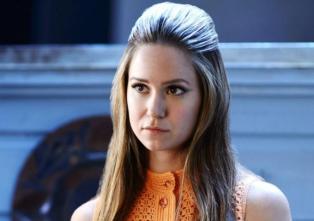
What’s curious here is that the scene is so stylized as to clearly be an hallucination: it’s a dream, a figment. There are other such scenes that also show a tell of illusion, such as when the lovable police Detective ‘Bigfoot’ Bjornson (a crushing Josh Brolin) manically devours all of Doc’s marijuana. This scene also appears nowhere in Pynchon but is the one scene that seems the most Pynchon. Anderson is hallucinating his own Pynchon, his own Inherent Vice. The consequences of which are such that the viewer entertains the same paranoia, the same confusion, the same hallucinations that Doc has. Where does the movie end and Doc’s psychotropic visions begin? There are no good clues.
A tangential example of such paranoia is in the case of Doc’s buddy Denis who is played by the young actor Jordan Christian Hearn and who is, weirdly enough, a dead-ringer for River Phoenix. The paranoia being: is this intentional? I mean is PT Anderson willingly trying to evoke Joaquin Phoenix’s dead brother? In novelist William Gibson’s Los Angeles of the future depicted in Spook Country one can stand outside of the Viper Lounge on the sunset strip and watch through augmented reality glasses while River Phoenix exits the club, has a seizure and dies on the sidewalk. There’s no block in LA that hasn’t had a moment like this, an everlasting moment. A point of no return. How do you like your blue eyed boy mister death?
It’s exactly this kind of hauntedness that PT Anderson’s Inherent Vice is intimating, filmed in a city whose golden era, on account of development, only now exists on film. So the line between the filmed LA and the real LA ceases to exist. Driving the boulevards we don’t see the Starbucks and CVSs but rather, the shreds of movies, the signs of the reality-of-film, a real that can only be real because it’s been filmed, and every film is a document of loss.
In Inherent Vice, Sauncho Smilax (Benicio Del Toro) puts it this way, speaking lines straight from the book:
“Yet there is no avoiding time, the sea of time, the sea of memory and forgetfulness, the years of promise gone and unrecoverable, of the land almost allowed to claim its better destiny, only to have the claim jumped by evildoers known all too well, and taken instead and held hostage to the future we must live in now forever.”
If for Pynchon, this sentiment is often reduced to political paranoia and cultural entropy, PT Anderson allows it to have a little more expansion: his nostalgia takes on an existential element. It’s this expansion, this roominess that lets PT Anderson finally transcend the book’s confines.
Some days after watching the movie I made a pilgrimage to the Hawthorne grill, the café that bookends Pulp Fiction. The grille has been torn down and in its place now stands an AutoZone auto parts store. I stood outside in the heavy rosy late afternoon light and attempted to have some kind of moment, to convince myself that this was not just any AutoZone store, that it was a charged building, a magic location, thrumming with the spooks of Pulp Fiction. But there, as the light fell, it was just a same old AutoZone the world over.
Forest is a carpenter/writer living in Minneapolis. He writes a weekly horoscope for Revolver. Those can be found here. Follow him on Twitter @interrogativs

Hi i really enjoy you blogs, I am new to this and I was wondering if you can follow me and give me some feedback on my first post. Thanks
Pingback: The delayed high of Inherent Vice | The Stake