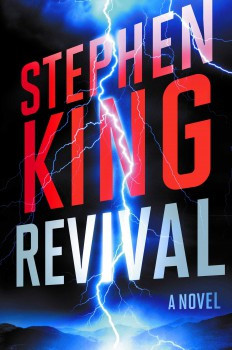
 I don’t know how Stephen King does it. Going on 70 years old and with more than 50 novels under his belt, you might think the horror writer would start slowing down soon—yet the year 2014 has seen the publication of not one but two new King novels, Mr. Mercedes and Revival. Even more surprising is the way that Mr. King is getting better with age. Revival, released in November, is being hailed by some as among the best books of the year. I’ve read it, and I can confirm that it’s at least the best straight-up thriller I’ve read in 2014—unputdownable, scary, and surprisingly emotionally affecting.
Revival begins in the 1960s, when a shadow falls across young Jamie Morton as he’s playing with toy soldiers outside his childhood home in rural Maine. Jamie looks up to discover a man, Charles Jacobs, towering over him. Jacobs is the new Methodist minister in town, a kindly man with a strange obsession: electricity. Later, when his wife and child are taken from him in a horrific car accident, the grief-stricken preacher takes to the pulpit to denounce God and religion, a “Terrible Sermon” for which the parishioners fire him and drive him from town. Jamie, our narrator, is sad to see his adult friend go, but he’ll run into the Reverend again years later when, as an adult, Jamie encounters Jacobs in increasingly menacing iterations: as a carnival huckster using electricity to dazzle his audience, as a tent preacher performing electrically-assisted faith healings with troubling side affects, and finally as a mad scientist in the mold of Victor Frankenstein, determined to involve Jamie in one final experiment on the “secret electricity” he’s discovered, an occult force that seems to have replaced God in the former holy man’s addled mind.
Mad scientists, occult forces—this is the stuff of a classic horror novel, and King indeed dedicates Revival to the writers who came before him and to whom he pays homage: Mary Shelley, H.P. Lovecraft, and Shirley Jackson, among many others. Yet there’s an entirely different school of writers King could have just as easily named, a more “literary” crowd that includes the likes of Frank Norris, Sherwood Anderson, Arthur Miller, and Sinclair Lewis. 55 books on, King is clearly among the scariest and most thrilling of contemporary writers—yet he’s also among our most American writers, his novels of monsters and madmen cataloguing the many varieties of American experience in the 20th and 21st centuries almost without our noticing. Revival is an American tragedy in the guise of a horror tale, a portrait of lives destroyed by obsession and charlatanism and violence.
At times during Revival‘s 400 pages, I thought of another great American storyteller, one who has clearly influenced King in a deep and abiding way: Bruce Springsteen. Springsteen’s lyrics have been a constant presence in King’s novels, referenced by characters when they aren’t voluminously copied into the front as epigraphs. Horror writer and arena rocker, both artists share an interest in the double-sidedness of the American dream: that is, the way it can become a nightmare. In the books of Stephen King and the songs of Bruce Springsteen, cars are vehicles of escape and violent death, small towns are places of nostalgia and horror, the working class is the salt of the earth and the source of myriad evils, and America a place of both hope and despair.
Springsteen is only name-checked once in Revival, when Jamie makes a sideways reference to the song “Highway Patrolman,” from the album Nebraska. It’s appropriate that Springsteen’s most intimate, restrained album is the one King references here, because Revival is an intimate and restrained book. (When you’re talking about the author of It and The Stand, 400 pages is what passes for restraint.) Spanning decades, the book manages to fit a nostalgic trip through Jamie’s childhood in the 60s and 70s, his descent into drug abuse as an adult, and a surprisingly tender meditation on aging and family. Those who are familiar with King’s biography may recognize the ghost of a fictionalized memoir in the shape Jamie’s life takes. King is an aging writer, and as he gets older his novels become ever more tender and elegiac even as the horror of his subject matter remains undiminished.
But in spite of the breadth of his story, the size of King’s canvas remains relatively constrained. His prose and his storytelling is economical throughout. At times, Revival felt a bit like King concentrate: everything I’ve ever loved about the novels of Stephen King, no filler. Characters, story, nostalgia, emotional depth, and of course scares—it’s all here, with none of the distracting King excess.
With fifty-some other Stephen King books to choose from, I can’t say for certain where this fits in his canon. As I set the book down, it felt like one of his best—then again, I may have been simply responding to the headiness of the condensed King brew. But I can say with certainty that if you grew up loving the novels of Stephen King, as I did, you owe it to yourself to give latter-day King a try. He’s still good. Maybe better than ever. He’s our best horror writer, and one of our best American writers, period.
