by Miles Behn
It feels strange to pick on a show like Friends. Sure it defined a generation of viewers, but how could Friends know what the future would bring? How could it know that the same year it concluded, gay marriage would be legalized in Massachusetts? How could Friends know how completely trans, gender, and race issues would change in America? After all, it’s just a sitcom—it’s the chaotic accounts of six (rather wealthy), white 20-somethings.
Let’s give Friends the benefit of the doubt, and rely on the age-old adage that always negates change—it was a different time. After all, the Defense of Marriage Act was only introduced in 1996 (two years after Friends premiered), and LGBT issues were on the sidelines for most Americans. The fight was happening, but it wasn’t part of our entertainment media. It was the 90s. The economy was thriving, and TV shows about straight, cisgender, rich, white people were an unlikely place to find diversity.
So maybe Friends was not a place for the discussion of the gender spectrum. Let’s just say that it was a different time—we don’t fault Disney for its racist cartoons, right? Wrong. We do. We recognize that while Disney’s historical racism is a reflection of a specific culture, it is a negative reflection. It’s not simply dismissed—it’s discussed, we talk about what it means to us now, and what it meant to us then.
So let’s do the same for Friends.
Transphobia and Trans Erasure
Perhaps the most common joke on the show (apart from the Ross/Rachel “we were on a break” argument) is the implied hilarity of Chandler’s childhood. Chandler’s dad is a trans woman, but the show portrays her as a gay, cross-dressing transvestite. The writers purposefully use incorrect pronouns, repeatedly refer to her by her given, male name (Charles), even throw her in Vegas as a sideshow attraction. Chandler’s repeated cracks about his childhood always involve gender specific digs at his father—“I used to wax his eyebrows,” “I would catch him singing show tunes,” “both my parents slept with the best man at the wedding” (The One Where Monica Sings, The One with Chandler’s Dad, The One with Chandler and Monica’s Wedding).
Chandler’s dad performs as a woman in her Vegas show (hence, cross-dresser argument), but she does appear to live as a woman outside the burlesque show (she arrives at the wedding wearing a dress) (The One with Chandler’s Dad). It is implied that in Chandler’s youth she lived as a man, but she now identifies as female. As is our cisgender obsession, there is reference to her genitalia (she has a penis) (The One with Chandler and Monica’s Wedding). I think we can safely refer to her as a trans woman—not a cross-dresser, not a transvestite. But even if you don’t see Chandler’s father as a trans woman, we still have some big issues with transphobia. Chandler’s father is the butt of every joke about gender—her gender is a mistake, something to be laughed at. She is the other, the wrong, the problem. She’s literally a Vegas circus act. Not only is there no room for acceptance, but there is no discussion of her gender. She is first and foremost a joke, a prop. She is less than human, unable to express complex emotions, boiled down to a laughable, blame-able, twisted father figure. She is sexualized yet repulsive—it would be a mistake to love her.
But Friends doesn’t just stop at Chandler’s father with their transphobia. Several cracks are made about Ross “kissing a guy,” a classic (and lazy) joke of mediocre sitcoms (The One with Rachel’s Assistant). It perpetuates the toxic idea that trans people are somehow in disguise, as though any interaction with a trans person is a dupe. It reinforces the dangerous stereotype that trans people are not what they appear, that their genitalia define them—not their own identities. The woman Ross kissed is a mistake, a gag—and so are trans people. If you find one, make sure you discover what they really are before you get into bed with them.
Homophobia
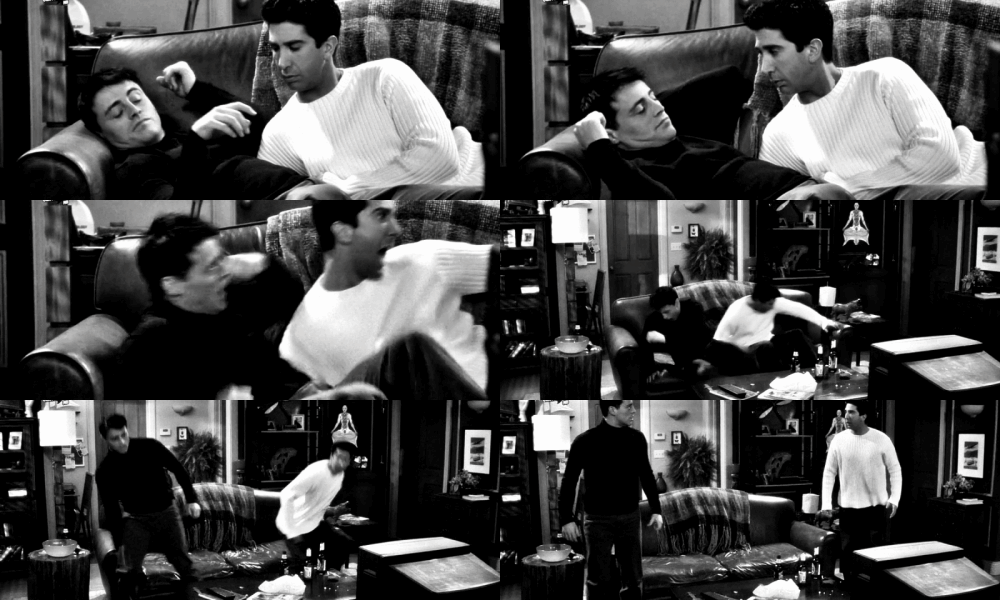
Friends’ homophobia has been a widely discussed topic over the past several years (see Bitch magazine Forbes, and the video edit of every homophobic moment on Friends—at a massive 50 minutes). Friends is definitely homophobic—Ross and Joey can’t even take a nap together without questioning their sexuality (The One with Nap Partners). Not a single male character is confident in his sexuality. Joey can’t wax his eyebrows without someone wondering if he’s looking for a boyfriend (The One Where Monica Sings). The whole show has an undercurrent of “no homo.”
Perhaps this is the central problem with the show—how it distances itself from “the other” by laughing at them. Anything outside the realm of cisgender, straight, and white is off-putting and wrong. The main characters of the show, while quirky, are nowhere near as scary as they could be. They could be gay.
On top of the male homophobia, there is a disturbing amount of sexualized lesbians. Ross’ first wife, Carol, has her first sexual experience with a woman during a threesome, in which Ross mostly watched (The One that Could Have Been, Part 2). The joke is played as poor Ross, poor man who can’t even get anything from his lesbian wife. Couldn’t she at least be bi? (Side note: Friends is also guilty of bi-erasure—not a single character introduced is firmly bi, and if they identify as such, like Phoebe, they are quickly re-defined by their current sexual partner.) Friends’ sexualization of lesbianism continues with Emma’s nanny (The One with Phoebe’s Rats). After Joey spends an entire episode chasing her, it’s revealed (again, the butt of a joke) at the end of the episode that Molly is a lesbian. Joey only wants her more—not only denying her sexuality, but also making her a sexual object in the process.
Masculinity vs. Femininity
Masculinity in Friends is constantly questioned—from how men interact with each other, to how the women (specifically lesbians) interact with the men. Male emotion is viewed as negative, turning the sensitive nanny, Sandy, into a laughable joke (The One with the Male Nanny). Instead of giving us a character that is confident in his emotional spectrum, Sandy’s sexuality is constantly questioned. Is he gay? Is he a girl? No self-respecting man would feel that much.
Both Ross’ and Chandler’s masculinity are questioned throughout the show. Ross is too sensitive (a negative feminine emotion), and Chandler likes traditionally female media (he hates football, knows show tunes, understands some fashion). Ross is guilty of gender policing too—he desperately tries to get Ben to play with boy toys (The One with the Metaphorical Tunnel). On top of that, Ross’ childhood play with gendered toys (dolls, make-up) is off-putting and wrong (The One Where Rosita Dies). Again, these are all jokes. Again, it reinforces the dangerous idea that men are one thing, and women are another. That gender is not a spectrum, but a cut-and-dry either-or.
Finally, we have issues with lesbianism and the lazy “butch” stereotype. Carol drinks beer from the can (Ross should have known), and her lover, Susan, has a firm handshake (just like a man) (Pilot).
Race
It seems a bit unnecessary to say that Friends has a race issue, because in reality, media has a race issue. But Friends should not escape criticism. There is no racial diversity in the main cast, and little in the revolving list of secondary characters (check out this video highlighting the lack of black characters). 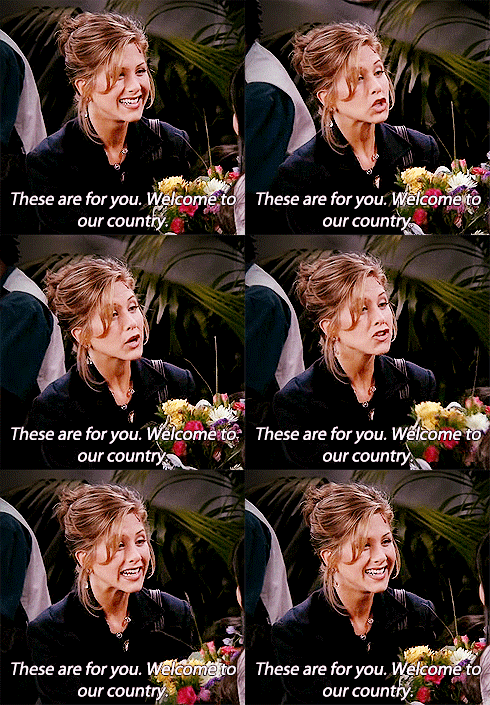 When new, diverse characters are introduced (like Ross’ girlfriend Julie) they are quickly normalized (Julie isn’t a real Asian after all, she’s from New York, not Beijing) (The One with Ross’ New Girlfriend). After Rachel foolishly assumes Julie doesn’t speak English, speaking slowly and loudly, Julie, in some ways, negates her own diversity; “thank you, I’m from New York,” she shouts back. For a show that takes place in a city as racially diverse as New York, it seems odd that the six main characters mostly only interact with other white people.
Friends suffers from an issue with white-washing. It, like many other current shows, assumes that white is the norm, that any variation on white must first be explained and then ignored (Julie’s not really Chinese). By assuming that white is the standard, Friends not only alienates potential viewers outside the standard, but it refuses to acknowledge racial privilege—that six, white twenty-somethings can have crazy experiences in New York, and they never have to think about being white. It assumes that everyone can be part of the gang, when in actuality, the privilege of Joey, Chandler, Ross, Rachel, Monica and Phoebe is miles beyond most New York City residents.
What This Means
So, Friends is racist, homophobic, transphobic, and misogynistic. But what does that mean? What did Friends do that was so wrong, other than reflect the culture from which it came? Well, for starters, in reflecting its specific culture, Friends perpetuated and normalized the toxic elements of that culture. Friends meant that jokes about sex changes were normal and funny (I distinctly remember being a kid and laughing when my mother told me about a “boy who was now a girl”). It reinforced gender stereotypes, pushing men and women into distinct boxes for gender, and shaming men for straying outside those boxes. It denied the gender spectrum—at best erasing trans people, at worst laughing at them, and making them “the other.” It portrayed six white, straight, cisgender people as the norm, and laughed at anything outside it. Friends created a generation of viewers that normalized this behavior and way of thinking, making it all the more difficult to learn the realities of race, gender, and sexuality.
Friends was an incredible television show. It was funny, and heartwarming. It defined a generation and has had a huge cultural impact. But it was far from perfect. We shouldn’t be afraid to discuss those imperfections or question its cultural significance and to demand more from the media we ingest. Yes, you should still watch Friends, and no you shouldn’t get rid of your boxed set. But let’s all acknowledge that we’ve got a lot to talk about. It’s like we’re always stuck in second gear.
Miles Behn is a writer and blogger living in Minneapolis. She currently runs the blog Staving Off Disaster. Follow her on Twitter, @milesbehn.

You might want to remove the brain implant that makes you say xxxphobic each time you see a scene where someone distances themselves or gently mocks xxx. Phobic means irrational fear. Eg of plane flight. Disagreement does not mean hatred. Something the pharissaical left does not seem to understand.
Reality remains reality, no matter how much the left tries to brainwash us into thinking that gender is a construct.
Watch middle class girls go to firemans bars in Nyc, fed up with the ersatz, self emasculating puppies that are metrosexuals.
I pity this generation of men brainwashed by feminazi teachers, raised in fatherless homes. They do what they are told and end up being heldnin contempt by women who in their hearts want a strong man who knows what he wants, not a simpering puppy who cant walk away from her occasional bullshit.
See david deida ” the way of the spiritual man”
Steve B says
To quote The Dude, “Yeah, well, that’s just like… your opinion, man.”
And here’s mine:
You spoke FOR metrosexual males (inferring they all want middle class women?) and for all of womanhood (inferring they all want firemen?). It doesn’t sound like you’re a member of either of those communities. But maybe I’m reading you wrong here.
My experience is that any time people try to speak FOR others it doesn’t add much to the conversation. And your reply follows that pattern, in my opinion.
The part where you speak about your experience- gender is not a construct- is much easier to swallow (despite me disagreeing) since you are speaking for yourself there.
All the best,
Steve
PS Excellent article Miles!
Matthew says
Your article proves why the show was not funny and should not be allowed on TV. You accurate point out many of the things that make it such a bad, bad show, but then you praise it at the end?
Other shows dealt with the same gender issues far better than this show, both before and after it.
pacificampersand says
Reblogged this on pacific ampersand.
Isabella Parkinson says
Just a quick note: it was Chandler that kissed a guy in Atlantic City, not Ross. Just don’t want someone to cite this source and use the wrong name!
Kisa says
I don’t see how Julie being from New York makes her any less Asian than if she had been from China. Negating her own race? More like pointing out that just because you see a person who is Asian, maybe they know how to speak English just fine. Also speaking English really loudly and slowly isn’t going to help anyone understand you if they don’t already know that language.