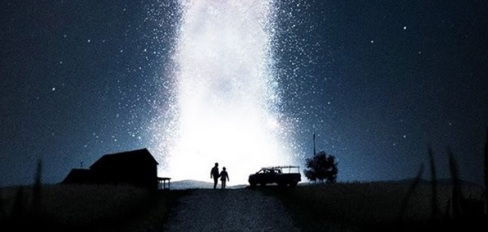
by Anne Taylor
Editor’s Note: Spoilers Ahead
I first saw Interstellar alone. I sat rapt in the front row for three hours. I left the theater dazed. I sat in my car, contemplated my keys, took one big breath and began to cry from the core of myself. It would not be an overstatement to say that I wept. Hard. For minutes. It wasn’t about Interstellar, not the story, the plot, the characters. In those minutes I didn’t care about some bullshit movie—though it was undoubtedly the catalyst for this deep, tidal wave of grief. Interstellar captured and conveyed utter loneliness in a way no movie ever has for me (and in a way that Interstellar itself will never be able to do again).
The movie opens with memories, dust, and a sea of corn. Here we see our first landscape of loneliness: Earth. The Earth has nothing left to give us. The clock is ticking off the minutes until humanity suffocates or starves. Our main character, Coop, is already a widower, his children already motherless, and quickly the audience sees the game of favorites playing out. The bond between Coop and his young daughter Murph is beautiful, yet his doting on his daughter leaves his son practically unseen.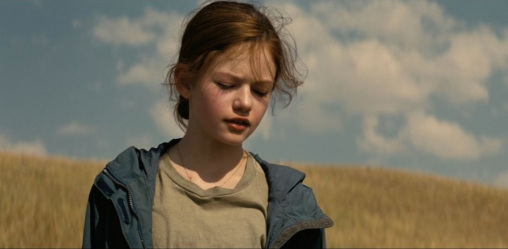
Coop leaves Earth. He leaves his daughter angry and alone and leaves his son with his truck and a you’ll-be-fine man-hug. The audience is introduced to a second landscape of loneliness: space itself. Upon awaking from hyper-sleep, a fellow explorer, Romilly, tells Coop how terrifying it is that mere millimeters of material stand between him and a million of miles of nothingness.
As the movie progresses the audience is exposed to new ways of being alone, most notably: disparities in time. Coop and Brand have spent less than a few hours on Miller’s planet only to discover that 23 years have passed since they left Romilly. The crushing weight of this realization hits the audience as it hits the characters. Unfathomable. And yet, there are messages awaiting Coop that span those 23 years.
The separation of Coop from his children now includes mismatched time, which equates to mismatched experiences of reality. He has lived hours while his children have lived decades. What could be more isolating than separation across all conceivable fronts?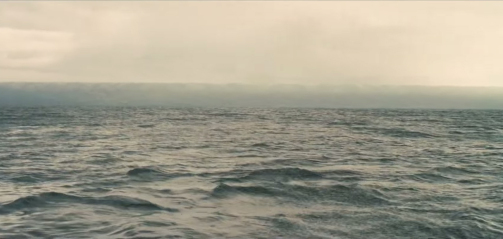
The theme of loneliness persists:
• More landscapes: Miller’s planet of pure ocean, Mann’s planet of ice and frozen clouds, and always the looming foreshadowing of the black hole.
• Music: Resounding organs send subconscious I-universe ratios through our bones and echo in the cathedral of ourselves: we are smaller than specks in an ever-expanding universe.
• In its most heavy-handed form: Mann weeps as he clutches at Coop and proceeds to lay out his theories of humans in isolation. As Mann leaves Coop to suffocate and die, he tells him, “You’re not alone.”
The audience is brought to the pinnacle of loneliness once Coop has gone through the black hole. He finds himself in a three-dimensional space expressed in the fifth dimension outside of time or space. Coop is surrounded (imprisoned?) by “the other side” of the bookcase—his daughter’s bedroom. He sees Murph over the tops of books and is trying desperately to communicate with her, screaming, begging her to make him stay and watching himself leave. The black hole has become the ultimate representation of loneliness: unable to communicate, separated by an alternate reality, and watching your mistakes repeat infinitely around you.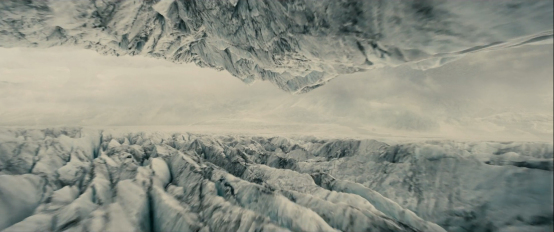
Like a musical note, this feeling of sickening desperation is held. But soon a threshold is reached and everyone is given an out from coming face to face with his or her own loneliness. Christopher Nolan brings us headlong into this storm only to hold our hand and coddle us back out into the sunlight. TARS finds Coop, who relays all the necessary data. Coop has a series of non-stop epiphanies; Murph solves the problem of gravity. Coop is found, saved, brought to Cooper Station, and reunited with Murph. All questions are answered.
Interstellar conveyed a pivotal truth of the human experience only to give us an anesthetic of resolution and baseball—familiar, comforting, safe. This is why Interstellar can never convey the same truth again. When seen for the first time, the possibilities are endless—like space. Having seen the movie a second time, the knowledge of Murph’s “eureka” moment and the reunion at Cooper Station robs the movie of mystery and possibility.
Exploration is inseparable from loneliness in Interstellar. By denying the growing momentum of mystery, possibility, and loneliness within the film—Nolan robs his audience (and himself?) of the terrifying thrill of self-exploration.
Anne Taylor contributed this article to The Stake. Anne lives in Seattle and in grad school for a masters in counseling psychology. Find Anne on twitter @ann_e_tay

Reblogged this on uglyarchives.
Stunning. I felt the same way while watching it, and I felt conflicted by the ending. While I wanted everything to turn out all right, it did feel like the ending did a disservice to the overall themes of the film.