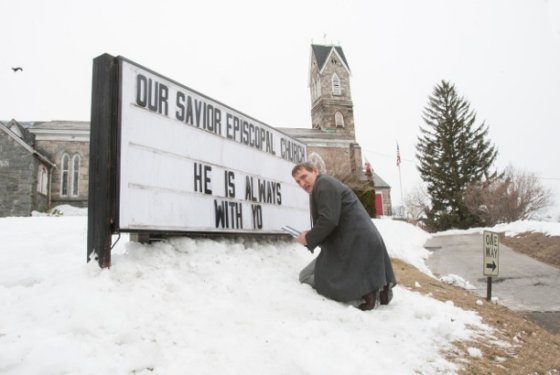
Note: Andrew is filling in for Margaret this week. She’ll be back recapping The Leftovers next Monday.
The first two episodes of The Leftovers were ensemble affairs, skipping between characters and stories to give us a panoramic view of the pain wrought in Mapleton by the Sudden Departure. Episode 3 presents an abrupt change in structure and in tone, focusing on a single character and what makes him tick: Reverend Matt Jamison. It’s an interesting move. Showrunner Damon Lindelof did something similar with Lost, of course, focusing each episode on a different character—but the depth of the episode’s focus on Matt made me think a bit more of Winesburg, Ohio, and of Sherwood Anderson’s definition of the grotesque as life deformed by obsession.
The residents of Mapleton are each grotesques in their own ways, their lives deformed by their obsession with the Sudden Departure. But Reverend Jamison is perhaps more grotesque than most—his faith shaken by the seeming randomness of those who disappeared, he’s taken to distributing a newsletter detailing the sins of those taken: this one beat her children, that one gambled away his kids’ college fund. It’s an obsession that’s taken a toll on his congregation, as evidenced by the near-empty pews on a Sunday morning, and on his health, as we see when an angry townsperson bursts through the doors and gives him a sound beating in the middle of a meandering sermon. It’s never revealed who this assailant is, but Matt’s pissed off so many Mapletonians with his newsletter that it hardly matters.
Matt’s got money problems, too—the reduced Sunday attendance means less money in the offering plate, and Matt’s missed so many payments on the church that the bank has foreclosed on him and is letting him use the building basically as a squatter. But now there’s a new buyer, and unless Matt can come up with more than $135,000 cash in 24 hours, his ministry is over. Plus, he’s got a paralyzed wife at home, and a nurse who needs to get paid as well.
In keeping with the Sherwood Anderson comparison, this is a setup worthy of a great short story—and it’s made even better by the thematic stakes. Matt’s one last chance to save his church is really his one last chance to save himself. Since the Departure, his obsession with the sins of the Departed has alienated his flock and almost everyone in the town. As Nora, the aggrieved mother from the first two episodes points out, his newsletter isn’t helping anyone, much less himself. Meanwhile, he seems to have the potential to be a decent pastor: his painstaking efforts to clean the sanctuary every Sunday are beautiful, almost holy, and a parishioner who comes in to get his new baby baptized makes it clear that spiritual hunger exists in the wake of the Departure, if only Matt could find it in himself to feed it.
So what does the loss of the church mean to Matt? If he could come up with the money to get it back, would that represent a turn away from his obsession toward the thing that led him toward ministry in the first place—or is losing the building a blessing in disguise, a subtle message from the universe that he needs to move on and do something else for a while? The episode doesn’t answer this question; to it’s credit, the significance of what happens remains ambiguous until the final credits. On the one hand, there seems to be some element of divine intervention leading him to save his church—the solution comes to him at night like a message directly from God, and mysterious pigeons seem to be leading him onward. First he discovers a cache of money that Kevin Garvey’s dad left for him (I don’t know why), then finds a hot roulette table at the local casino where he doubles his money until he’s got $160,000, enough to top that other buyer. On the other hand, his attempts to save the church keep leading him into sin: first gambling, then nearly murdering a guy in the parking lot who attempts to steal the take.
Throughout, I was struck by the fact that although Lindelof is best known for twisty stories, it was the character stuff that worked best in this episode, not the stuff that actually happens. The way Matt found his money felt a little contrived—if it was sitting there all along, why didn’t he go get it earlier? A late development in which Matt is knocked out by a thrown rock on his way to the bank with the money doesn’t work well either, nor does a bizarre dream sequence which cycles through bizarre vignettes at random like creepy-image-roulette. The most interesting revelation, also part of the dream scene, is that Matt’s wife was paralyzed in a car accident right after the Departure, when an oncoming car was suddenly riderless.
Ultimately, Matt loses the church, though, and the mysterious buyer is—you guessed it—the Guilty Remnant. What they plan to do with the building, and what the loss of his ministry will mean to Matt, will have to wait until next week.
Stray observations
• The title of the episode, “Two Boats and a Helicopter,” refers to a joke about a man who can’t recognize the hand of God when he sees it. DISCUSS.
• Matt seems to have an affinity for the fanatic Guilty Remnant, and his stopping to help one of them—which ultimately is what loses him the church—echoes the biblical parable of the Good Samaritan.
• Kathy Geiss from 30 Rock is one of the Guilty Remnant. Maybe that’s an in-joke for fans of the NBC comedy: Kathy didn’t talk in that show, either.
• I’m cautiously optimistic about The Leftovers—but the one thing I still find missing is any trace of humor. Tom Perrotta’s books are darkly funny, though it’s sometimes hard to see in adaptation. Election and Little Children, two successful adaptations of Perrotta’s work, succeeded by adding voiceover, which gave the audiences some ironic distance from the nastiness happening on the screen. I can’t help but suspect that Lindelof missed an important layer of the story by not incorporating Perrotta’s gently humorous and even tender approach toward what is starting to become, three episodes in, pretty depressing subject matter.
