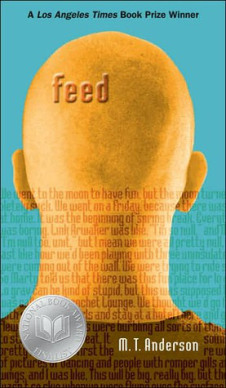
It’s been 12 years since Feed was released. I was a senior in college in 2002, and I imagine Feed would have felt unrecognizable at the time. Tech hardwired into the brain creating a 24-hour live-feed connection to the internet? Come on. I hadn’t even heard of wi-fi back then. Today,though, Feed just seems inevitable. Our brains may not have the chip, but many of us are pretty much wired to the feed already; the rest cannot be far behind.
Science-fiction stories are built upon two equally important foundations: the conceptual science & technology that underlies the plot, and the events and human emotions involved that move the story. These elements may combine in endless variations and with varying levels of success. In the novel The Road, by Cormac McCarthy, the conceptual sci-fi plot device exists completely offstage, concluding before the story’s beginning. We never see the tech that left the world in ruins, but the events and human emotions are powerful in part because of that absence.
Conversely, Andrew Niccol’s film In Time creates a stunning technological concept of currency through life-span and the economic inequality that results, but fails to build a successful human story worthy to carry the technology to any satisfying place.
If the best science-fiction stories, then, naturally interweave a creative science-fiction plot device and a touching human story, then Feed is a master-stroke. In Feed, the human and the science & technology are literally inextricable from one another. The tech is the feed, and the feed is implanted in the brain. Lose one, and you lose both.
This is not the first time such a confluence has occurred. There are great and famous examples throughout sci-fi of this mingling. Do Android’s Dream of Electric Sheep and the film it inspired, Blade Runner, are perhaps the most famous.
But that it has been done before does not lessen the achievement of Feed. Besides, it hasn’t been done quite like this before.
**
The opening ceremonies of the World Cup in Brasil featured a man, paralyzed since birth, wearing a metallic, bionic exoskeleton wired to his brain, which he controlled with his thoughts. He used this machine-extension of his body to walk and strike a soccer ball.
**
Feed is a funny and tragic teen-romance. That it is a young-adult novel I suppose bears mentioning, but should in no way bring with it any pre-judgment of readers. Whatever one might think about YA Literature, love it or hate it or just don’t give a damn, Feed qualifies as an excellent read by any merit. The romance involved in Feed involves two teenagers, and in that fashion, it is YA. But beyond that, and perhaps it’s commitment to social awkwardness, it has few YA credentials.
The story of Feed is this: a teenage boy named Titus visits the moon on spring break (which totally sucked) where he meets a teenage girl named Violet. They visit a nightclub, where a ‘terrorist’ hacks into their feeds and creates a constant refrain of anarchist messages, causing Titus, Violet and their friends to go into ‘mal,’ and pass out.
Out of this a romance blossoms. Titus is wealthy and lives high in the clouds, literally. Titus has a successful father who is rarely around. Meaning Titus has money and the freedom to do pretty much whatever he wants. With money comes the feed. The feed is a chip, implanted physically into the body, creating a bio-mechanical online interface right inside the brain.
For Titus, the feed is natural: implanted at birth and state of the art. Not so, Violet. Violet is poor; her parents are academics and she is home-schooled. Her home is on the ground-a shock to Titus. Her parents rejected the feed when it was first created, and neither have the implant. But not wanting to disadvantage their daughter, they buy her a feed when she’s a young girl, and have it implanted much later than is recommended.
Opposite sides of the tracks, you know, star-crossed young lovers, and, as must be the case, doomed.
***
Rasmussen College in Minnesota recently announced as part of their Flex Choice option a series of courses that are taught not by teachers but are played as video games. Online “game-based courses — with no instructors” are perhaps the logical next step.
***
There’s a great deal at play in Feed. Anderson plays freely with philosophy and the implications of identity and memory, for example. There’s also the play of language and the creation of a youthful alter-language in the feed (think, Clockwork Orange). But my favorite characteristic of Feed is the satire of American consumer culture. It’s not accidental that the fall of the US coincides with a time when shopping becomes an inescapable human activity.
Well, shopping on the feed is not really shopping so much as it is brand management. Brand management is now an integrated part of the individual human experience. Brand profiles are online for every person who has a feed, and advertising happens on the individual level. What you listen to, where you go, what you buy, all such information is accessible to the corporations operating on the feed (again, hello now).
Thus walking through a nightclub is like walking through an advertisement. Clothes are worn by paid models, while the feed promotes the products you are seeing directly to the brain. Buy before you leave for an extra discount! Shipped to your hotel for next day enjoyment!
This satirical play on American consumerism allows Anderson to make direct statements of social commentary. (“We Americans are interested only in the consumption of our products. We have no interest in how they are produced, or what happens to them once we discard them, once we throw them away”). But more biting, and more fun, are the times when Anderson hooks readers directly into the feed, providing asides outside the narrative, selling television shows and commercial goods directly to our brains.
Anderson uses these asides as a way to highlight and denigrate the consumerist tendencies of the culture at large, and in them is a clear kinship with Don Delillo’s White Noise. What complicates Feed‘s ad-noise though, are the times when actual news breaks through the advertising stream. These news breaks inform readers of the world’s activities beyond the feed. And they do not look good.
***
Marrying soft robotics with biological components such cells and tissues, researches in Illinois and created a new generation of muscle-powered biological robots, or “bio-bots.“
***
Biology is what makes Feed special.
This is a book about living a life in and out of the feed. About being a person in the world, literally, while being always at least one step removed from the world, digitally. When a feed support agent chimes into your chat-link to tell you about a product that matches your purchasing history or music profile, who is she talking to, you? Or your feed?
Everything about Feed, the shopping, the travel, the conversation, is the feed. You are your feed. You, your memories, it’s all linked to your brain. If the brain has a glitch as a result of the feed and your memories are lost, what have you lost? Your brain, it turns out. Everything, even the feed, is biology.
If we think we are immortal in our youth, how much more so in our feeds must we feel so. But you cannot escape your biology. The slow climax of Feed is built on this reality. There’s a scene in the final third of the novel, when M.T. Anderson forces Titus to acknowledge some of his cruel behavior towards Violet. Titus’ friend Quendy, who has taken to mixing fake lesions with her real ones in embrace of the latest fashion, tells him to not be a selfish, moping bum. “She’s the one who this is happening to.”
It’s a moving exchange; my favorite in the book and one that young readers should take to heart. After it occurs, though, comes another subtle moment, the kind Anderson slips in just after the “moments” we look for as readers. Anderson uses these times when we are coming down from the emotive heights to remind readers what is really at stake. A young woman in a collapsing world, covered in lesions, comforts her friend. As Quendy pats Titus on the knee, Anderson writes: “Through the holes in her hand, the blood in her veins was blue.”
The Backlist features in-depth appreciations of classic books in the science fiction, fantasy, horror, and crime genres. Click for more in the Backlist series.
