Tomorrow is the 4th of July. To celebrate, we thought we’d put together a list of patriotic movies that you could watch after the meat has been grilled, the beer has been drunk, and the fireworks have been watched.
Well—sort of. Here at The Stake, we sometimes get uncomfortable at fervid proclamations about how “America is the greatest country in the world.” Plus, unthinking jingoism tends to make for pretty bad movies. So we’ve put together a different kind of list: 10 movies for the critical patriot, ones that take a long, hard look at America and see all the ways that it fails to live up to its ideals—and hold out hope that one day, we might live up to those ideals.
Mr. Smith Goes to Washington
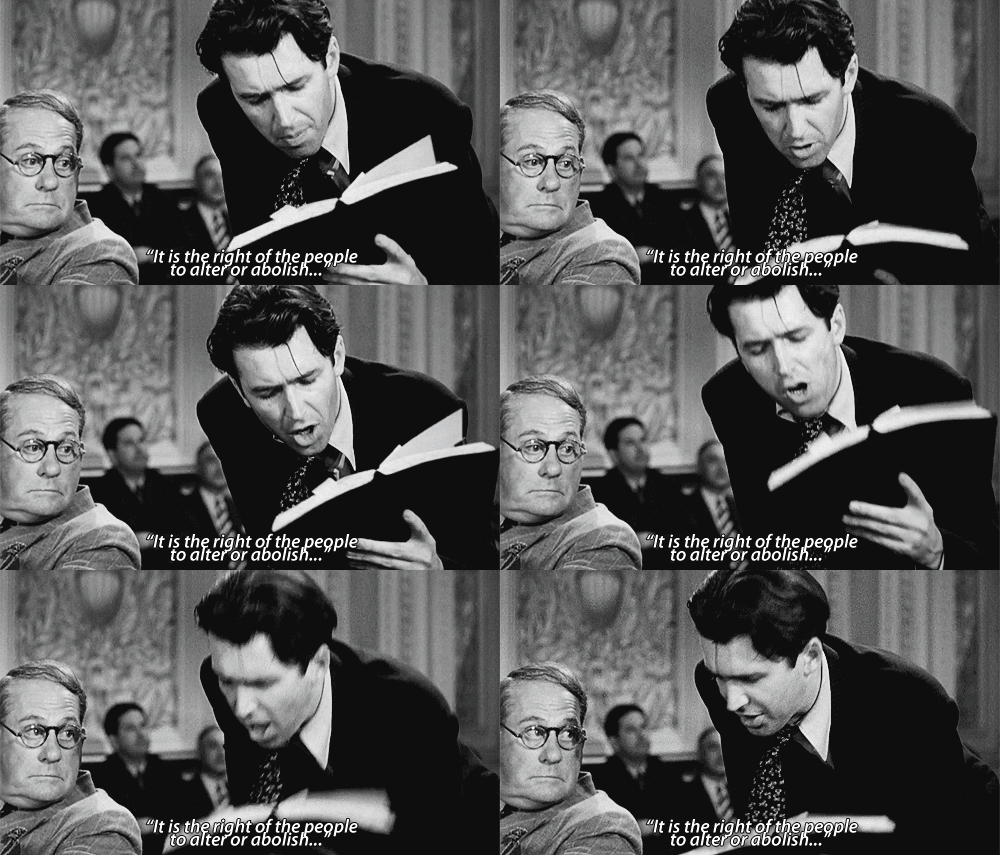
Here’s something you may not remember from watching 1939’s Mr. Smith Goes to Washington in your high-school American Government class: It’s really freaking radical. Frank Capra’s enthusiasm for his adopted country is obvious, and his love for what it means to live in the United States is unwavering. But his portrait of American politics is one of the most indicting you’ll see. Banned across Europe for its pro-democracy message and opposed in the US for being pro-communist, Mr. Smith was particularly disliked by America’s elected officials, who found themselves portrayed as beasts of corruption. It was, in the end, a huge hit, and made Jimmy Stewart (whose performance as Jeff Smith is one for the ages) a huge star.
Mr. Smith is one of the great political fantasies ever told, in which an Idealistic young man from out west beats corruption and inspires the nation in what must be the world’s all-time greatest Senate floor session on an appropriations bill.
JFK
Let’s get one thing out of the way right now: Oliver Stone’s JFK is not history. The film plays fast and loose with the facts of the Kennedy assassination, and Jim Garrison, the New Orleans attorney whose 1969 indictment of Clay Shaw in the killing of the president provides the movie with its story, was probably a bit of a crank.
But JFK is still a masterpiece—a “counter-myth,” in Stone’s words, to the story told by the Warren Commission Report. Stone’s is a paranoiac’s myth, a definitive text for anyone who’s ever believed that the course of history is influenced by tangled webs of conspiracy, or that the truth is held hostage to power. Mixing dozens of filmic methods in single scenes and jump cuts to photographs and archival footage, the film is at times dizzying, suggesting circles within circles that are beyond even the reach of the film.
Yet for all its paranoid madness, JFK is, in its own way, a deeply patriotic film—motivated by the belief that in America, truth belongs not to power, but to the people.
All the President’s Men
Alan Pakula’s All the President’s Men is another paranoid masterpiece, but unlike JFK, this one’s about a conspiracy that was proven to be true: the Watergate scandal. The film follows Carl Bernstein and Bob Woodward, the two Washington Post reporters who blew the story open and are played here by Dustin Hoffman and Robert Redford. All the ingredients of a paranoid conspiracy story are here: the corrupt president with something to hide, the intrepid reporters who know there’s more to the story than anyone will admit, even a crackpot whistleblower meeting in a parking garage to give out one clue after another. It sounds like an episode of The X-Files. Except it all happened.
Free press FTW.
Visually, the film is sparse, even stark—but one shot in particular sticks. Woodward and Bernstein are digging for information in the Library of Congress, and the camera pulls out to reveal the enormity of their task. Get it? People are small, the system is big. But sometimes, people win, and the truth comes out. ‘Merica!
Milk
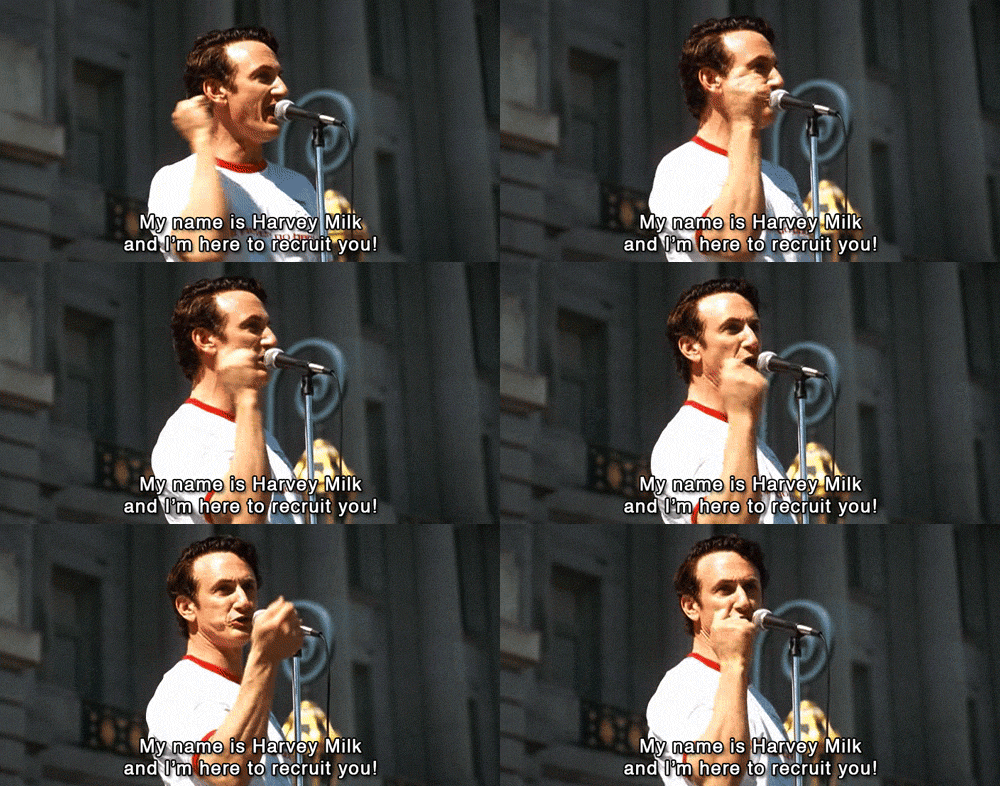
Milk tells the story of Harvey Milk, America’s first openly gay elected official. Milk was an influential man in San Francisco in the 1970s, leading the city’s burgeoning gay community to organize and fight for gay rights before he himself was elected to the city board of supervisors. Later, he was tragically assassinated by a fellow board member.
Powerfully played by Sean Penn in an Oscar-winning role, Milk emerges in the film as a man of powerful conviction, charisma, and hopeful optimism in the face of discrimination and hate. Though the story ultimately ends in tragedy, it is ultimately a hopeful story of the bravery of people who fight for equality—and a reminder that though the arc of the moral universe is long, it bends toward justice.
North Country
The 1984 court case Jensen v. Eveleth Taconite Company was the first class-action sexual harassment lawsuit heard in US Courts. In 2005, the case inspired the Charlize Theron starring North Country. Manhola Darghiss called North Country “an old-fashioned liberal weepie about truth and justice,” which is accurate, Bob Dylan songs and all, but fails to capture just how good a film this is. Filmed on location in northern Minnesota,North Country makes a detailed and thoughtful portrait of American rural life, mining towns, and the case for equality throughout America’s workplaces.
Directed by Niki Caro (who made the incredible Whale Rider), North Country is more than just a parable of truth and justice, uplifting our spirits through a swelling emotional finale (though it does all of this too). It’s an excruciating reminder of the discrimination found in American workplaces, and the tenacity required to eradicate it.

Do the Right Thing
Spike Lee’s Do the Right Thing is still, 25 years after its initial release, the definitive filmic statement on racism in America. Set in a single day on a single street in the Bedford-Stuyvesant neighborhood in Brooklyn, the film confines itself to a microcosm of American life yet manages to be about nearly everything: love, hate, struggle, class, culture, and the strands of history and culture and violence that separate us from one another.
To most people, Do the Right Thing is not an uplifting or patriotic movie. Its ending is pretty bleak. But every time I watch it, I feel a surge of hope in the final scene, and when the film fades to black to show quotes from Martin Luther King Jr. and Malcolm X—each advocating for a different path toward true racial justice.
It’s an important film. Watch it.

Erin Brockovich
Corporations are an indelible part of the American landscape, influencing the way we live, the way we work, and the way that power is wielded at every level of our governments. As the corporation has risen in power, stories of individuals who take on corporations have become more and more popular. Government conspiracies are the paranoia of the past. Corporate conspiracies are the new bogeyman.
If Steven Soderbergh’s Erin Brockovich is among the best of these individual-takes-on-corporation stories, it’s mostly because of Julia Roberts’ performance as the title character, a kick-ass woman who goes up against energy giant Pacific Gas and Electric for putting toxic chemicals into the groundwater of a small town. The real-life Erin Brockovich is still an activist and consumer advocate, still fighting for individuals and against businesses that destroy the environment and endanger people’s health.

Dead Man Walking
The death penalty. The prison-industrial complex. With recent scandals in the news, these topics are starting to get more attention today, in 2014, as it is becoming clear that the way America deals with its convicts is a moral travesty. But back in 1995, director Tim Robbins was way ahead of the curve with his film Dead Man Walking, starring Sean Penn as a convict sentenced to die by lethal injection, and Susan Sarandon as a nun who builds a relationship with him in the time leading up to his death.
Tim Robbins is a political guy, but his film doesn’t preach. It simply shows the reality—the reality both of the brutal crime Sean Penn’s character committed, and of what the death penalty really is. The rest is up for the audience to decide. Is this the way a great nation should treat its prisoners?

Skins
Set on the Pine Ridge Indian Reservation, Skins is a tragedy about two brothers, one a cop, the other an alcoholic Vietnam Veteran. The film’s plot is built around a crime that takes place in this community blighted with poverty and forgotten by the rest of the country. While at times very funny, Skins is mostly a tale of despair unfolding in the shadows of Mt. Rushmore. And while it does not all come together perfectly, director Chris Eyre doesn’t flinch in his portrayal of reservation life. A portrayal that is too rare in American popular culture.
There is little uplift that viewers find in the finale of Skins. But our national history is not comprised merely of uplifting patriotism. The sight of George Washington’s face carved in a mountain does not mean the same thing to all Americans.
https://www.youtube.com/watch?v=4y8t_UgnUG8
Zero Dark Thirty
The killing of Osama Bin Laden was a crucial event in America, met at once by massive impromptu celebrations across the nation. Yet the killing was immediately accompanied by questions: Was this justice? Vengeance? Had something been set right in the moral universe? Or was this just another killing, another act in a long unbroken chain of violence?
These are questions you might ask yourself as you watch Zero Dark Thirty, Kathryn Bigelow’s uncompromising account of the events leading up to the killing of the man who was, for so long, America’s most wanted enemy. There’s been ample debate about whether the movie portrayed things accurately, and in particular whether it justifies torture. Those questions aside, the film provides the viewer a valuable and not entirely pleasant reckoning with the legacy of America’s global war on terror.