Jonathan Kent is the world’s perfect dad—by my reckoning, at least: morally upright, loving, and compassionate. He takes in an infant found in an alien spacecraft without any knowledge of the child’s origin, and never thinks twice about treating him as his own. He raises Clark on an idyllic farm in Kansas, and gave him a childhood I always envied as a kid—especially the part about the superpowers. Clark Kent turns out super, not just because of his powers, but in part because of his loving father.
But here’s the problem with the Kents: it’s too nice and perfect. As a dad, I’ll never be quite as harmless and patient and forthright as Pa Kent. And no matter how well I raise my own son, he’s likely to partake in more poor decisions than Superman, while undertaking fewer deeds of heroism in the skies.
I’ve always found perfection to be of little instructive value. Perfect fathers—even in science fiction—make for boring stories and provide few lessons of value. I’m trying to figure this fathering thing out, and to do that, I turn instead to the imperfect dads: those who do not live to their see their children prosper; who do not always have their act together; who make bad choices—even evil choices—and still have wisdom to share with the rest of us, especially when it comes to how to treat our children.
For this father’s day, here are 5 lessons I’ve learned from the sci-fi dads I admire.
1. What I learned from William Adama: Be firm, but admit when you’re wrong
In Battlestar Galactica, Commander William Adama acts as the father of the human race. He’s the new Adam tasked with finding humanity a path to Earth before civilization is destroyed by the enemy (the Cylons). Faced with the threat of human extinction, Adama must keep alive the men and women who survived the destruction of all human planets and find a new home for his people. No small task.
He’s also a dad, and a difficult one. Having lost his youngest son Zak shortly after his graduation from a military academy, Adama’s relationship with his estranged elder son, Lee, has been brought to the breaking point when Battlestar begins. The story of the Adamas is one of reckoning and recognition, as father and son learn to re-acclimate to each other’s company as leaders and as a family. One of the central thematic elements of Battlestar is the formation and development of families, and the show tells the story of the Adama family through William and Lee’s continual willingness to oppose each other, and how that opposition build respect among the men.
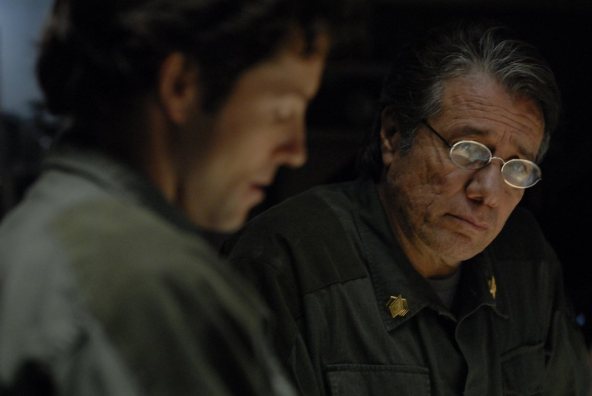
Very early in Battlestar we learn the kind of man that William Adama is. He’s not soft and he’s not sweet, and he’s certainly not perfect. A career military man, he organizes his life around top-down command. His impulse is for order, action, and reaction.
When the Cylons destroy the 12 colonies, kill millions of humans, and strand the few thousand remaining off-planet, Commander Adama wants only to retaliate and get into the fight. He pursues one course of action: retaliation. He is angry, and he wants to indulge that anger. But he does not. He chooses instead, to run. It’s a hard choice, the kind fathers often have to make, between acting in heated moments, and stepping back in reflection. I can think of few more important lessons to impart to new dads than the example made by Adama in refusing to act in anger.
Adama in this instance listens to the counsel of the Secretary of Education, Laura Roslin. Humanity has already lost this war, she tells Adama, now it’s time to run and live. He weighs the consequences of his potential actions against those suggested by Roslin, considers the lives of people he is charged with and concludes that his course, the course of action and anger, is the wrong one. Instead, he acts like a responsible father-to his son, and all those under his charge.
2. What I learned from Marko of Wreath: Fatherhood is a time for self-improvement
I can think of no more appropriate time to reevaluate one’s life, and embrace self-improvement than the birth of a child. When my son was born, I immediately began re-framing my life and choices in new terms: how will my kids think of this? I want to be a person who inspires my son towards compassionate, peaceful behavior, just like Marko of Wreath, from the graphic novel Saga.
The opening images of Saga find two young lovers—Marko and Alana—from opposite sides of an intergalactic war giving birth to their daughter. The birth is a gritty affair, unromanticized and realistic as any I’ve encountered in science-fiction or elsewhere. (I’d never have known this until the birth of my own child, but realistic birthing scenes are amazingly rare). Immediately following the birth, Marko hands his daughter, Hazel, to her mother. As Alana cradles her newborn baby, Marko chews through the baby’s umbilical cord with his teeth. Alana is aghast. “You are wearing a sword,” she says.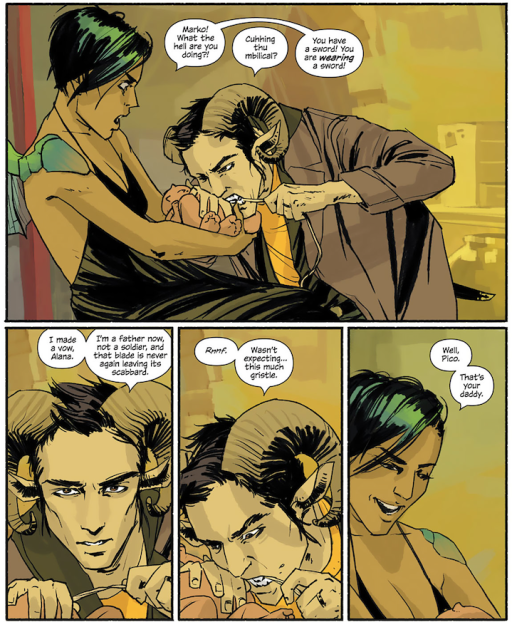
But Marko of Wreath leaves his sword in its sheath. With his new daughter, he’s turning over a new leaf and embracing a principle he’s long valued: nonviolence. Even for a utility purpose like cutting the chord, Marko won’t draw his weapon, an inaction that is deeply moving.
Prior to his life with Alana and the birth of his daughter, Marko was little more than an anonymous soldier in a massive war. Wanting to live up to the expectations of a young soldier, he’s eager for action and looking for battle. Until he finds it. It takes only one engagement with the enemy for Marko to realize that he will not continue. Instead of taking part in a war he can’t participate in, he surrenders to the other side as a conscientious objector. Imprisoned, he falls in love with a prison guard named Alana. They fall in love, have a child, and Marko commits his life to pacifism.
Making life changing commitments often comes with failure. Anyone who has sought major life changes knows how challenging it is. Being the person we truly want to be presents a challenge in every time of life. Most of the commitments I uphold, including nonviolence, tend to be more fluid than rock solid. Many night’s I’ve wondered what would happen to my pacifist leanings should my loved ones be threatened. Probably the same thing that happen with Marko, who, in the course of Saga does use his sword to protect his daughter and wife. But Marko’s commitment to peace remains despite his return to the sword, and in doing so Marko has become an example from which to I a hope to learn.
3. What I learned from Theodore Arroway: Encourage your child to pursue her interests
The 1997 film Contact (based on Carl Sagan’s 1985 novel) tells the story of the astronomer Ellie Arroway and her search for life beyond Earth. The story is inspiring, strange but beautiful, like much of Carl Sagan’s work. In the film Contact, Ellie’s life is inseparable from the memory of her father, Theodore, who died when she was a child.
Theodore identified early in Ellie’s life her interest in science and radio. Upon this recognition, he encouraged Ellie towards science as an intellectual pursuit and way of thinking about the world. He bought her a ham radio and a map to plot her contact with other radio operators throughout the continent. In short, Theodore provided the tools necessary for his daughter to pursue her dreams.
While still a young child, Theodore Arroway dies. Ellie, on her own, turns ever more to science as a manner of interpreting the world, and the loss of her father becomes a touchstone upon which she builds her life.
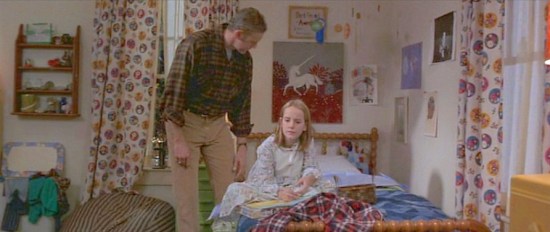
Eventually, Ellie Arroway becomes a radio astronomer and has the chance to interact with life from another planet (maybe?). It is because of her father that Ellie has achieved what she has, and the inspirational role that he played in her life is so clear that even the alien species uses his image as a means of first contact. That’s an inspiring dad.
4. What I learned from Darth Vader: Learn from your children
Darth Vader, of the Star Wars Saga (in case anyone needs an establishing reference), is probably science fiction’s most famous dad. And for the majority of his time in fatherhood, he’s not much to aspire toward. When he was Anakin Skywalker he impregnated a woman, only to leave her for the Dark Side, become apprentice to an evil Emperor, and set about forcing the galaxy to submit to his master’s rule. During these pursuits Vader imprisons his daughter as a political opponent and chops off his son’s hand in a light-saber duel.
And yet even in the life of Darth Vader we find a crucial lesson about being a father: the ability to see in our children the model for how we dads should behave. Despite years of life on the Dark Side, Vader is capable, in the end, of recognizing the good in Luke’s actions, recognizing love Luke still has for his father, and changing his own life as a result. Vader sees in Luke’s life a better path for himself, and takes it.
The willingness to allow our children to be models for our own behavior is a hard lesson to adopt, one that requires humility enough to realize when our own lives are off-course. Not only are we not perfect-we all know that-but too often we’re incapable of believing that we can change. 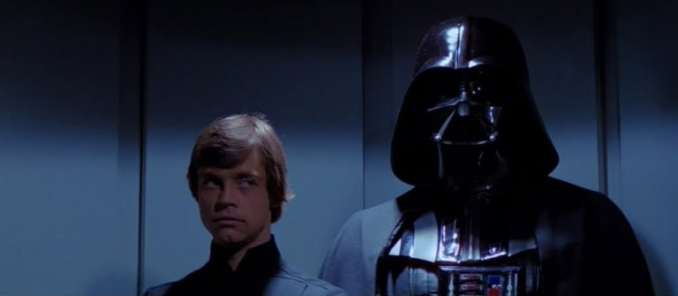
In one of the greatest father-son moments in cinematic history, as Vader brings Luke to the Emperor in Return of the Jedi, Luke tells his father that, even now, he still believes in his old man. “You can’t do this. I can feel the conflict in you. Let go of your hate.” Vader, with compassion in his voice, replies, “It is too late for me, son.”
It isn’t, of course. And in the final moments of his life, Vader recognizes that his son is right. He learns how to live well by following his son’s example.
5. What I learned from Jor-El: Do whatever you have to for your kids
If there’s a theme emerging in these fathers of science-fiction, it is perhaps the need to recognize that we are all imperfect. We are not always right, we can always improve ourselves, we can better encourage our children, and even, learn from them. If none of us are Pa Kent, we can still look to the life of Superman for lessons in fatherhood.
On earth, Superman is Clark Kent, adopted son of the farmer Jonathan Kent. The Kent life is a quiet one (which has its benefits). But before Clark Kent was Clark Kent, he was Kal-El, of Krytpon.
And on Krypton things were different. Kal-El was the son of Lara and Jor-El, the leading scientist on Krypton. When Jor-El discovers Krypton will be destroyed, he is unable to convince the planet’s leaders to take action. In the dying moments of his home world, Jor-El provides what just might be the most important lesson of being a father: be ready to do whatever is necessary for you child.
Faced with the death of everything he loves, Jor-El uses his last moments to do to protect his son’s life. Jor-El sends Kal-El away from his family and their fate, to Earth, where Kal-El will have a chance to live. In his final act to save his son, Jor-El hides crystals in the ship with his son, which will later lead Clark Kent to the North Pole, the Fortress of Solitude, and link to his history. Not only does Jor-El give his son a life, but he provides his son the keys to understanding his past, traditions of his family. In his final act, Jor-El provides his son life and education.
The sacrifice made by Jor-El and Lara has been portrayed many times since the creation of Superman, but never more beautifully than by Marlon Brando in the 1978 film Superman. Jor-El, in Brando’s moving whisper, makes a farewell speech of the kind that elucidates the powerful ways science-fiction can move us, and teach us, to be better fathers.
“You will travel far, my little Kal-El. But we will never leave you. Even in the face of our deaths. The richness of our lives shall be yours. All that I have, all that I’ve learned, everything I feel… all this, and more I bequeath you, my son. You will carry me inside you… all the days of your life. You will make my strength your own, and see my life through your own eyes, as your life will be seen through mine.”
Did I forget anyone? Who are the sci-fi dads that inspire you?
Follow The Stake on Twitter and Facebook

Reblogged this on jkmhoffman.
Pingback: Father’s Day | PA Pundits - International