Before I started Veronica Mars I knew three things about Rob Thomas’ much beloved show. 1) It was cancelled after its third season. 2) The show has a group of die-hard fans who refer to themselves as Marshmallows. 3) Those Marshmallows funded an historic Kickstarter campaign to get a Veronica Mars feature film developed.
There was a fourth idea that I thought I knew, that Veronica Mars was light CW-teenage-camp fare. In reality I had no idea how dark this show would be. Funny, but dark. The misconceptions I had about Veronica Mars likely resulted from a shaky understanding of the show’s premise, which, upon the briefest of description does sound like the stuff of light CW-fare. A High School girl works for her father’s private detective agency, and moonlights as a P.I. herself, solving cases for the wronged students and locals of Neptune, California (Neptune, by the way, would be a terrible place to live). Words like plucky and sassy have frequently been used to describe Veronica, and teen shows about plucky and sassy girls rarely have much appeal beyond their target demographic.
But for Veronica Mars, this is all wrong.
Here’s what viewers learn by the end of the first episode: Veronica Mars’ best friend Lily Kane was murdered. Sheriff Keith Mars’ chief suspect was Lily’s father, wealthy software magnate Jake Kane, creating a scandal in Neptune that became a national embarrassment to the Mars family. Unable to prove Jake’s guilt, Keith loses his position as Sheriff, Veronica loses her boyfriend, Duncan Kane, and Veronica’s alcoholic mother walks out on the family. As the daughter of the man who tried to bring down the Kane Family, the popular kids abandon Veronica, who shortly thereafter is drugged and raped at a party by an unknown assailant. This is where the show starts: Keith Mars now works as a P.I., Veronica works for her father and has (by choice) no friends, and her family is the symbol of the divide between rich and poor in Neptune.
With this backdrop, Veronica Mars reaches, at times with a wink, into the deep traditions of the detective genre. Both Veronica and her father wear the role of private eye with the necessary confidence and swagger. There’s more than a few references to the noir influences on the show, but such in-jokes don’t mask the fact that Veronica Mars is a successful noir pastiche of the hard-boiled detective genre.
The most familiar aspect of the hard-boiled genre is in the dialogue. The witty banter and quick retorts of the P.I. has been a hallmark of the genre since its inception, and Kristen Bell and Enrico Colantoni convincingly, and hilariously, banter with the shows small recurring cast. The crafty, loaded exchanges between Keith Mars and his clients, or Veronica and her classmates would be right at home in the mouth of Sam Spade or other classic P.I.s. Without finding the right note in the dialogue, Veronica Mars could have been a trainwreck. But the show’s writers understand from the onset how to combine the darker elements of the show with an unrelenting humor and wryness.
That wryness is most present in the Mars home (and office). Since this is an entry in the Falling For series, I don’t mind saying that this is what I fell for: Veronica and Keith. The relationship Rob Thomas provides the Mars father and daughter is one built on trust and mutual dependence. The intimacy of their relationship is truly moving, and one that inspires me. Veronica says at one point that the “hero is the one that stays, the villain is the one that splits.” Her father stays; he is her hero. Veronica and her pop put the hooks in me immediately.

But in the bigger picture, the success of Veronica Mars depends on the performance of Kristen Bell, and her ability to turn a character who has been through immensely difficult circumstances into a believable young woman. Her inner-monologue runs through every episode, guiding viewers through the turmoil that is Netpune, CA and its racially and economically diverse residents.
We need Veronica’s guidance to navigate through Neptune, but the writers know we need it more to understand Veronica herself. I would be interested to learn what percentage of Veronica Mars has Kristen Bell speaking or narrating. She literally hangs over every moment of the show, either her humor or the source of that humor, her pain. More than once Veronica mentions what drives her commitment to solving crimes: she needs the distraction to keep her from dwelling on her own life.
When Veronica schemes for revenge, or goes the extra mile to exact a humiliating punishment on a suspect-she does this more than once-we understand that Veronica is filling a need in herself. Unable to punish the people who have ruined her life-find Lily’s murderer or the the person who raped her-she inflicts that revenge on others. Surprisingly, Kristen Bell wears that pain mostly through Veronica’s sense of humor. In fact, perhaps the greatest revelation that I had watching Veronica Mars was that Kristen Bell is such an accomplished comedian. I knew she was a talented actress, but I had no idea she was so funny.
There are few analogs that I’m aware of on TV to Veronica Mars. Buffy Summers is a natural one, another teenage anchor of a drama who must find ways to deal with exceptional circumstances, in part, defined by outside forces. But even Buffy (at least at the start) is less hardened and defensive than Veronica, or as emotionally conflicted. She’s a special character.
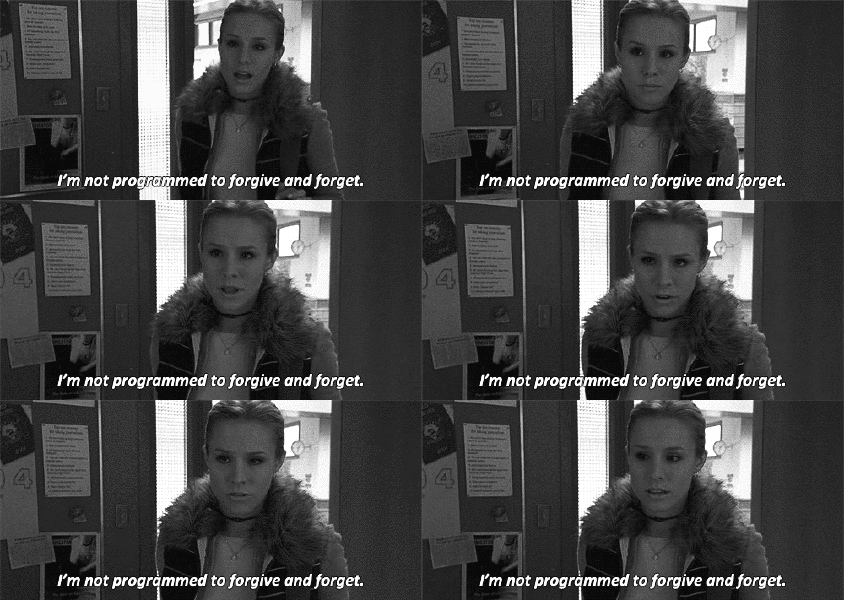
Not that she’s the only one. The halls of Neptune High are (improbably) full of the city’s richest and poorest kids, and as a result Bell is surrounded by a great cast of young actors. The wealthy children of actors and millionaires sit across the aisle from the poor children of the working classes, and the supporting cast is made of just those divisions. The few friends Veronica finds come from the working class side of the tracks, a tech savvy geek, a basketball playing best-friend, and the leader of a local Latino motorcycle gang. Veronica also rubs elbows with her rich ex-boyfriend Duncan and his best friend Logan Echolls, son of a movie-star and former boyfriend of the murdered Lily Kane. From the start Veronica cannot stand Logan, and it’s not hard to see that he will become her love interest that seeks to bridge the chasms of Neptune.
The show isn’t perfect, by any means. At times the weekly crime-solving gets a bit too message-oriented, a problem perhaps inherent in the subject matter. The third season introduces an arc about an epidemic of campus rape that has several problematic components and leads to the occasional after-school special level conclusions. These problems are easily overcome, though, by the characters and relationships. The first season is the best, and each successive season is a little less remarkable. But the under-performing third season of Veronica Mars still centers on Veronica Mars, and that makes it much better than most of what you’ll find on television.
Watching Veronica interrogate her peers, coax the local police into helping her, and exact revenge upon those who have committed crimes against the innocent is an unmistakable pleasure. But Veronica Mars is at its best when weaving murder mysteries and unfolding intersecting story arcs that seemed unconnected. The complexity of the story of Lily Kane’s murder is truly marvelous, as head scratching and misdirecting as True Detective, and fans of the genre owe it to themselves to watch at least Veronica Mars first two seasons.
Veronica Mars hits the ground running faster than any show I can recall. From the first moments of the first episode it is obvious that Rob Thomas knows who Veronica Mars is, what makes her special, and how Veronica Mars will work. The show is, almost immediately, excellent. And while it does not maintain that excellence for the entirety of its three seasons, that is hardly a reason to avoid its delights.
Veronica Mars is streaming on Amazon Prime.
Follow The Stake on Twitter and Facebook
