Good morning, Chris! You skipped GoT last night to go see the TFIOS movie instead, leaving me alone on this wall to recap the most recent episode. I guess Maester Aemon was right all along—love really is the death of duty.
Kidding. But truly, if there was any theme to last night’s episode, “The Watchers on the Wall,” it was duty and its opposites: what it is that makes us stand with our brothers when death is certain, and on the other hand what are those things for each of us that cause us to break our duty and flee the battle.
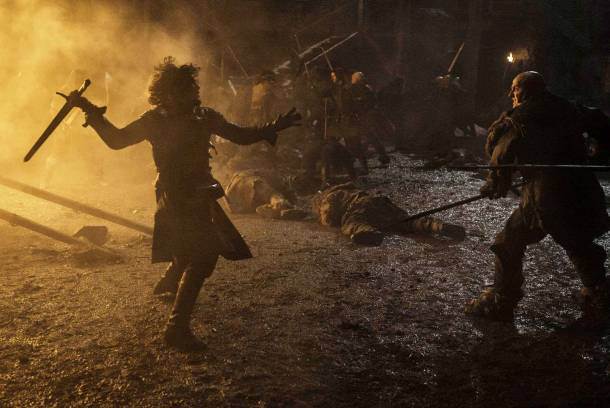
I say “if there was any theme” because for the most part, there really wasn’t: last night’s episode was about spectacle more than anything. And what a grand spectacle it was. Like Season 2’s “Blackwater,” “The Watchers on the Wall” abandoned GoT’s usual story-skipping structure to give us a bottle episode of sorts, focusing entirely on the battle at Castle Black. North of the Wall, Mance Rayder finally lit “the biggest fire the north has ever seen,” signaling Ygritte and her band of fellow Wildlings that it was time to attack from the South.
The action, once it began, was relentless and well-choreographed. As I watched, I couldn’t help but think of the battle of Helm’s Deep, from Peter Jackson’s The Two Towers, another fight in which a small group tried to defend a fortification from an overwhelmingly superior force. Both battles happened at night and were similarly lit, which probably helped as well. But that’s where the similarities ended: the fight at Castle Black was much more violent than the battle of Helm’s Deep, and less Manichean in its portrayal of good guys and bad guys. Though the Wildlings, especially the Thenns, can occasionally seem like cardboard villains, they’re hardly Orcs. And they’ve got their reasons for doing what they’re doing. In the world of GoT, it’s always just a little hard to know who to root for.
The edge, at least for this viewer, ultimately went to the Night’s Watch. But if it’s hard to truly root for one side over another, you can always default to rooting for your favorite individuals, and as the battle wore on, that’s what I did. Don’t die, Jon! Don’t die, Sam! Don’t die, Ygritte!
Alas, this being GoT, one of them had to die, and that one was Ygritte, receiving an arrow through the back as she pointed her own at Jon Snow, considering whether to kill her erstwhile lover. Which brings me back to the theme of love vs. duty. Before the battle began, Ygritte demanded that her fellow Wildlings should leave Jon Snow to her—she wanted to be the one to kill him. But it wasn’t really clear if she really wanted to kill him, or if she wanted, on some level, to protect him. Perhaps she didn’t know, either. And her hesitation cost her her life, forcing her to stand still for long enough so a little boy with shoddy aim could put an arrow through her heart.
Sam, too, has to balance his love for Gilly with his duty to the Night’s Watch. When Gilly arrives at Castle Black, alive, Sam commits a small treason when he breaks the command not to open the gate. Then, when she comes in, he makes a promise to her he can’t quite keep, even now: that he’ll never let her out of his sight again. When he tries to hide her away in a cellar, she points out that if he really wanted to keep his promise, he’d stay there with her instead of going back to the battle. But in this case, his duty toward his brothers is stronger than his love, and he leaves Gilly alone with the promise that he won’t die.
The theme of duty is present with minor characters as well. Ser Alliser Thorne, for all his assholery, is ultimately a man of duty, fighting and dying bravely against ridiculous odds. Thorne’s second in command, meanwhile, becomes a foil to Sam when he runs and hides with Gilly in the cellar—the death of his sense of duty is not love, but fear. And in the tunnel below the castle, a small group of Night’s Watch led by one of Jon’s friends face down certain death at the hands of a Wildling giant by repeating their oath in unison—literally reminding themselves of their duty in the face of their own fear.
The only one who doesn’t really choose love or duty is Jon Snow—or perhaps it might be more accurate that his past actions and current circumstances make his choice for him. When, at the beginning of the episode, Sam asks Jon what it’s like to really love someone, and for them to love you back, Jon’s at a loss for words. But it’s clear that his relationship with Ygritte has changed him. It’s the first sign we get that Jon may truly regret betraying her. But it’s too late now—he’s chosen the Night’s Watch over her, and as circumstances at Castle Black get worse and worse, requiring him to step up and lead, he’s forced further into duty, and deeper into enmity with the woman he once loved.
In fact, there’s a way in which Ygritte, even in death, is luckier than Jon. She ultimately chose her love for Jon over her duty to Mance Rayder—even if that choice was made for her in a moment of weakness. “Remember the cave?” she says when Jon rushes to her side, reminding him of a place where there was no duty, only love, and Jon says yes, he remembers. “We’ll be there together soon,” he says, to which Ygritte answers: “You know nothing, Jon Snow.” Ygritte’s hesitation has led to her death, but her involuntary choice for love is one that she can live with in her last moments.
Jon Snow, on the other hand, chose duty and watched the woman he loved die in his arms. Can he live with his choice? Or would he rather die and be with Ygritte in whatever afterlife awaits them—or none?
It’s unclear, but I find ample reason to wonder by the episode’s end. The battle won, the Wildlings repelled—for now, anyway—Jon looks around him and realizes that the Night’s Watch is basically no more. All the leaders are dead. The brotherhood to which he pledged his duty, and for which he forsook his love, is near to nonexistence. Did he make the right choice? It’s hard to say. But it would be easy to read his self-appointed mission—going beyond the Wall to kill Mance Rayder—as a self-punishment for what he’s done. The woman he loves is dead, and the organization to which he pledged his loyalty is dying. Now, is Jon Snow committing suicide?
We’ll find out next week, I hope, in the season 4 finale—as well as what becomes of fan favorite Tyrion Lannister.
