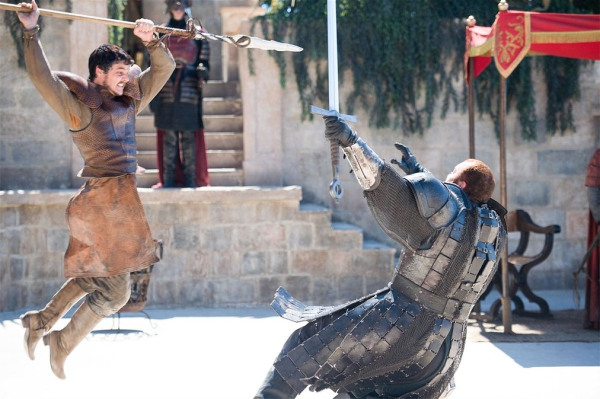
Andrew: Ho. Lee. CRAP. Chris, I don’t know how you felt about last night’s episode of GoT, “The Mountain and the Viper,” but I am totally and unreservedly in the bag for it. I loved it more than Ser Jorah loves Dany, more than Grey Worm loves Missandei, more than Ramsay Snow loves flaying—that is to say, a lot. Based on my social media feeds this morning, many people reacted with frustration to the cliffhanger that closed the episode. My own reaction was not unlike Tyrion’s: slack-jawed awe. My first thought when the credits silently rolled was that this was among the best hours of television I’d seen in a long time.
I’ll regain my critical faculties soon, I promise—but first, I just want to take a moment to appreciate the cinematic and masterful opening scene, which, for me, worked almost as a formal throwdown on the part of director Alex Graves, a boastful statement of intent for the episode to follow. The scene opened with a long tracking shot showing us two men of the Night’s Watch walking through a muddy street into a brothel. From there, the camera swooped through the main room and slipped into the back, where Gilly was hanging clothes on a line. Then, a heightening of tension with the introduction not of image, but of sound—the hooting of an owl—and the breaking of the long take as Gilly walked to the window to see what was going on. From there to the Wildlings’ attack, introduced chillingly in the reflection of a well; then the descent into violence, before the camera settled on Ygritte, viewed first from behind as she strode through the village reaping chaos. The violence itself wasn’t particularly gory by GoT standards; the scene conveyed chaos while maintaining an awareness of space, but largely looked away from the bloodier results of the raid. Then, the scene’s climax in an unexpected and inscrutable display of mercy by Ygritte—and she stepped out of the frame to reveal blood leaking through the floorboards.
Wow. Just wow.
Chris: Amazing work by Alex Graves last night. No question. A tremendously directed bit of television no matter how you slice it. You hit on last night’s formal directing highlight, but the changing power dynamics that we’re seeing in the Vale, between Littlefinger and Sansa Stark was my favorite moment in the episode. This has become the most intriguing arc in all the show, in recent weeks. The quiet, calm confrontation between the two in Sansa’s room, as she sewed on her bed, completely unintimidated by the dangerous Petyr Baelish. Watching Sansa maneuver herself into his machinations, for her own reasons, was remarkable. A stillness that spoke so loudly. I loved it.
But lets get to the point, here, Andrew. While everything leading up to the VERY BIG MOMENT was excellent-better actually than the moment-it was still a VERY BIG MOMENT episode in which viewers waited for what we knew was coming, and watched in awe and horror as it unfolded. To my surprise, what unfolded was the darkest possible alternate ending to my all-time favorite movie: ThePrincess Bride. Inigo Montoya and his overdeveloped sense of vengence was the obvious referent for the Viper in this fight. And his demise, in that light, is quite altered.
The trial is over and we have our answer. Tyrion is guilty of the murder of King Joffrey in the eyes of the Gods. We know this, because the Mountain defeated Oberyn Martell. It was unexpected (sort of), and gross. It was Game of Thrones doing what it does, bringing in a new character that is likable, then killing that character in horrible fashion. It was, more than anything, forcing us into the unfortunate position of watching Tywin and Cersei Lannister smirk and feel superior to the world.
I am one of the people you mentioned, Andrew. I hated the feeling I had upon the ending of this episode. And I know that the point is to make me feel a certain response and blah blah. But I really hope that the cliffhanger we are left with regarding Tyrion brings another shocking holy shit moment right upon its heels, and finally gets the Lannisters off the throne. Because I had a realization last night about Game of Thrones. Benioff and Weiss and their team are fooling us. They’re fooling us into thinking that the men and women who rule Westeros are worthy of some level of emotion and interest. But really, are they? Is the fate of the Lannister family interesting enough to endlessly ride the merry-go-round of manipulation? It’s time for them to go. Benioff and Weiss have to know this.
No matter how stunningly crafted the episodes are, I’m beginning to lose interest in failed attempts to overthrow the Lannisters, who are great villains through and through. The value of a great villain is the pay-off in their demise (or an anti-hero that you can get behind). Martin, Benioff and Weiss can delay that (and have done so with great rewards) or play it into strange corners (also, brilliantly done with Jaime and Tyrion this year), and humanize the characters (even Cersei at times has been sympathetic), but eventually you have to actually have the courage to do the thing that needs doing, and move the larger story, right? After three years of this, it’s time for that to happen in King’s Landing. I probably won’t be interested in the VERY BIG MOMENT formula for much longer, so give me the very big, dramatic, show-altering catastrophe of the Lannister downfall that we’re all waiting for.
Andrew: I disagree about the ending entirely—I actually, and perhaps somewhat perversely/masochistically, enjoyed it. The fight between the Viper and the Mountain itself was among the more well-choreographed and exciting in GoT’s history. And the way it ended, though it was certainly surprising, didn’t feel like a cheap twist to me. On the contrary, Oberyn’s gruesome end, gut-wrenching though it was, arose naturally out of Martin’s and the show’s deep understanding of who this character was: a grieving brother, obsessed with vengeance, and given to grand gestures that flout social convention. It didn’t seem out of character to me that, having gotten the Mountain on his back, he wouldn’t go in for the kill until he’d wrested a confession from the man—and thrown a public challenge to Tywin Lannister as well. With tragic results.
I suppose I also enjoyed that scene because I was put in the right mindset by the comparatively quiet scene that preceded it, in which Jaime and Tyrion discussed their “moron” cousin, Orson. Orson Lannister spent most his days crushing beetles with a rock in the garden—khun, khun, knun!—and a younger version of Tyrion became obsessed with figuring out why he did it—why did these poor, innocent beetles have to die? That this story finished without a punchline elevates it from a mere character vignette to a near-existentialist parable, one that seems extremely significant to the world of death and woe that GoT portrays. Question: Why does suffering happen? Answer: Who knows?
The scene reminded me a bit of Breaking Bad—in his care for insects, Tyrion is a bit like Jesse Pinkman, a gentle soul in a cruel world—but ultimately, the referents I thought of most were Shakespearean. Leave it to GoT to tackle the problem of evil in a way that has nothing to do, ultimately, with God or the Gods—as in Macbeth, suffering in Westeros is “a tale told by an idiot, full of sound and fury, signifying nothing.” It played to me as a moment of resignation for Tyrion, a recognition that his pain is hardly unique in the history of the world, and that if he and the Viper are fated to die…well, in the words of Hamlet: “If it be now, ‘tis not to come. If it be not to come, it will be now. If it be not now, yet it will come—the readiness is all.” Tyrion’s sense of resignation became mine as the fight scene played with dread, then relief, then crushing surprise. Ah well. After last night, it’s clear—Martin, Benioff, and Weiss are Orson, the show is the rock, and we’re the beetles. Question: Why must we be made to suffer so? Answer: Khun, khun, khun!
Chris: I don’t know how to precisely articulate my problem here, Andrew, because I don’t disagree with anything you’re saying. Well, except the Hamlet part. “The readiness is all” is a great Game of Thrones-like quote, but Tyrion is not ready to die, and any resignation he might have had as the Viper taunted his opponent, to me played not as readiness but defeat. Regardless, the Trial by Combat was a great scene, and its outcome was handled well, and the story being prepared over the past season did move us towards this possible outcome.
But doesn’t all that just seem necessary? That Tyrion has a somber, open-ended rumination on his childhood and the unsolvable problems of evil before his trial-perhaps a bit too philosophical and poignant for my taste-is well within the character we’ve come to know. That Oberyn would embrace the performance of public retribution instead of just killing the Mountain, and thus be killed himself, makes sense for Oberyn’s character, and is not an unexpected outcome.
So I don’t know. I don’t quite know what the problem is. I do know that the Lannister arc of Game of Thrones-the one that is most heavily invested in by Benioff and Weiss-has to me become the least appealing, emotionally. I just don’t care anymore about Cersei and Tywin, or the necessary grand deaths that must be awaiting them. So much so that I’m starting to even care less about Tyrion. And Tyrion is, obviously, among the best assets on Game of Thrones. This happens in such a layered show, with so many consecutive stories playing out; not all of them will be equally intriguing. But in a show that is built around VERY BIG MOMENTS, the VERY BIG MOMENT nature of the Lannister arc is starting to feel like it’s own boring formula.
Andrew: The Lannister storyline may have more fuel in it yet—if Cersei and Tywin are fated for a Shakespearean-like fall, then we may be able to harvest some interesting insights from the way they go down, the crumbling of Tywin’s family legacy once and for all, and the reveal (one hopes) of the full nature of Cersei’s motivations. I’m cautiously optimistic.
But onward—because you touched on events in the Vale, and I want to go back there for a moment. Sansa Stark had a very, very big episode. The girl’s finally realizing that there’s a Game being played—and that she, for her part, is capable of playing it. The way she managed the inquiry into her Aunt Lysa’s murder was masterful. She’s learned, perhaps from her time in King’s Landing, that the best and most convincing lies are sprinkled with bits of the truth. The scene in her quarters, which you touched on. And then that scene with her coming out on top of the staircase, the sun blinking behind her. She’s going to be a formidable force, an important player in whatever Littlefinger has planned.
Other major players in Westeros who might be able to stand up to the Lannisters? Last night, for the first time, I wondered about Roose Bolton’s ambitions. With the eradication of the Ironborn from Moat Cailin, he’s gained power over the North—and his speech to Ramsay on the moor proves that he knows it. In his own way, Roose is more terrifying and evil than Ramsay: he bears the flayed man on his family’s sigil, and seems just as willing to employ torture as his bastard son does. But he’s calculating about it.
Meanwhile, the actual taking of Moat Cailin moved the ball forward without much actual interest. The Ironborn surrendered so easily—echoing their betrayal of Theon at Winterfell—that it made me wonder if Ramsay really needed Theon/Reek to take the castle in the first place. I guess all you have to do is march an overwhelming force up to one of the Ironborn’s castles, and they’ll just kill their leader and surrender? Good to know.
Chris: Sansa descending the staircase like a regal queen was a tremendous sight. She’s ready to carry more weight in the actions unfolding around her, and I very much look forward to seeing her do so.
The Ironborn are sure an odd people. Leaders ready to die rather than surrender, leading an army of men ready to surrender rather than die. They are little threat thus far. I do think you’re right about Roose. We have little reason to consider Roose’s tactics as far removed from Ramsay. Everything that Ramsey has done-all the gleeful murder and torture and flaying-has led to Ramsay’s promotion in Bolton’s cause. Clearly the elder Bolton is on board, and with Reek, you can’t argue with results.
We can’t avoid the revelation that Ser Jorah was spying for Varys, and upon the information Dany cast him away. That’s a particularly interesting note, looking back. Varys has always had information to share about the whereabouts and activities of the Targaryen girl. That it was Jorah-a valuable advisor and would be suitor-reveals a major wound for the Mother of Dragons. Jorah’s absence will be felt by Dany, of course, but her pursuit of the Iron Throne will suffer, as well.
Finally, Andrew, you mentioned in your opening the Wilding attack on the brothel. Well, we also saw Jon Snow and his allies at the Wall, who remain unable to convince their bosses about the pending Wildling attack. The Wildlings are, like the beetles under the rock of the unrelenting child, unceasing. No matter how many wildings you smash, there will always be more. You asked who might challenge the Lannisters for power? One contender must be Mance Rayder’s army. Once the 100,000 strong army breaches Wall, what force might stand against them?
I’m very curious.
Follow The Stake on Twitter and Facebook

Pingback: Game of Thrones Mountain And The Viper Recap | Film Encounters
Pingback: GAME OF THRONES Director Discusses That Scene From Last Night’s EpBig Online News | Big Online News