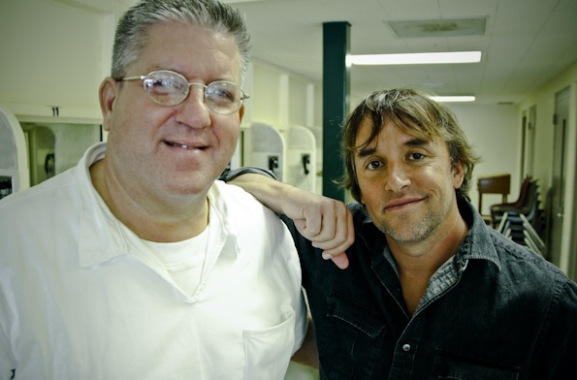
You might recall that film-maker Richard Linklater recently welcomed Bernie Tiede to his home as part of Tiede’s release from prison. Bernie Tiede served 17 years in a Texas prison for the murder of Marjori Nugent, a story that inspired the film Bernie.
That story piqued a lot of interest, and questions. To answer a few, Matt Zoller Seitz spoke with Linklater about some of the practical aspects of living with Bernie (“I have an extra garage apartment behind the house. It’s not a big deal…He’s working, he’s got a job. He’s living like a grad student probably lives”) and local opinion on Bernie’s release (“the people who knew the case or knew Bernie personally, or knew anything about the specifics, think that his release is a good thing”). The two also spoke more broadly about incarceration in the US and our attitudes towards crime and punishment.
Of particular interest to me are Linklater’s thoughts on Texas, incarceration and the American need for ‘tough on crime’ political mantras. Our prison system is a disgrace, one that all Americans should be aware of. Our national character is not defined by how we treat our law-abiding citizens but by what we do to those men and women we would rather ignore, including criminals of the worst sorts. Those are the hard choices that make us. If we are willing to look the other way in the face of blatant racial inequality, rampant violence, physical and sexual abuse, poor medical treatment and numerous other injustices that accompany our Incarceration Complex, what does that say about our moral character? Rather than think about how we treat our prisoners and criminals, we hide behind the rhetoric of ‘they had their chance’, and use platitudes to deflect the morally bankrupt, and criminal, behavior we subject prisoners to. The American prison system is one of our national tragedies. End of rant.
These ideas are, for better or worse, tied to Texas in our national public imagination. Texas has a reputation for its quickness to incarcerate and Execute-one that has become as much a punchline as it is a black-mark on the state. That reputation may hold true down in Texas. As a northerner I’m in no place to speak to the accuracy of that particular cliche. But the joke of Texas helps hide the fact that the entirety of the US has a serious incarceration problem.
And so I appreciate the conversation between Zoller Seitz and Linklater on the subject, and the willingness of both to see through the ‘If you can’t do the time, don’t do the crime,’ mockery of our system.
Below are a few relevant exchanges. Read the full interview here.
MZS: There’s certainly an absolutist attitude towards incarceration for any kind of violent crime in this country, particularly in our shared home state of Texas.
Linklater: There sure is, yeah. I grew up in Huntsville, which is a main prison town. It’s crazy. The conditions are so bad in prison, often, for the inmates. No air conditioning, they literally die every year just from heat exhaustion. But if you bring that up, a democratic lawmaker said last year, “He shouldn’t have done the crime!” Some of the people are in there for petty drug things. You never know. It just runs the gamut.
But you’re not going to lose office for law-and-order position. The human heart kind of likes punishment to that degree—whatever Old Testament thing they’ve got going on in their heads. The legal system encourages that kind of appearance of strength: they elect the guy.
That’s why I’m so overwhelmed by Danny Buck’s public opinion. You’ve read his affidavit. It was really moving, an amazing document about seeking justice. Like, his job is to seek the truth, and you’ve got to do that at all times, not just [when you’re seeking a] conviction.
But you get elected off being a badass. Texas can’t have a governor, regardless of party, who isn’t for the death penalty.MZS: Not just that, he has to act as if he’s willing to personally go in there and throw the switch or turn the lethal injection chemicals loose. Like he’s running for hangman instead of governor.
Linklater: Yeah, you know? I would kind of hope that’s like the gay marriage issue, where even people who were for it couldn’t admit it? It would be great if we turned that corner, where it would be OK to be against it, and be a viable candidate or prosecutor or any of those things. But there can be a lot of rational thought behind it and it doesn’t make the visceral, emotional welling up that you get when you’re all homicides, executions, ‘tough on crime.’
MZS: As if the only alternative is being weak on crime.
Linklater: How about smart on crime? …
(On Bernie’s release): The real question here is: appropriate punishment for different circumstances. It wasn’t like a Memphis Three story, where they just plain didn’t do it. It was just different. It demands a little more nuanced thinking.
But this is that rare, very rare case where the Texas legal system, I think, works. New evidence was looked at, thought out, stuff that wasn’t available on trial, and the Texas DA looked into his heart and actually did the right thing.
We only hear about Texas when we’re executing innocent people, or wrongly incarcerating people, or some kind of corruption. This is an interesting story from the other place.
Make sure you read the whole interview because the gents also discuss Boyhood, and you know how I feel about Boyhood.
