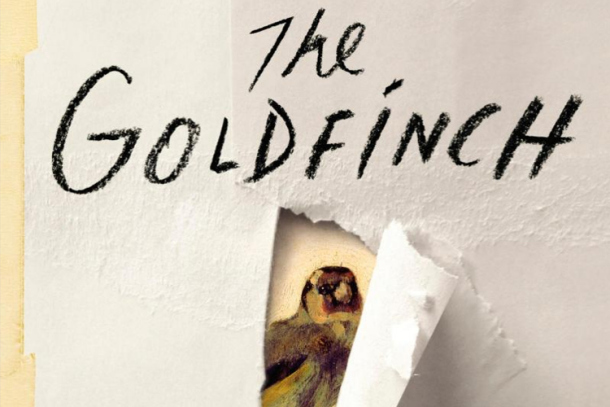
The Goldfinch is a tale of a great art heist, born out of terror and trauma, and narrated by a Harry Potter lookalike, Theo Decker. Holed up (for reasons that later unfold) in a hotel in Amsterdam, Decker looks back over his short twenty-six years, following the long and snaky chain that led to his profession as a thief.
Theo’s remembrances start on the day when he was thirteen years old, in tow behind his mother and waiting for an ominous afternoon trip to the principal’s. They end up at a museum to pass the time before the meeting and while there, look upon a tiny jewel of a painting, the Goldfinch by Fabritius. After they admire and discuss it, Theo’s mother leaves him to go examine another painting, and it is in that moment that a bomb goes off.
Theo awakens to an apocalyptic hell, straight out of the London Blitz. He scrabbles through the rubble in a daze and comes across an elderly man he saw only moments before the bombing. The older man is alive but barely so and Theo, in his inexperienced way, misinterprets death throes for the blossoming of life. The old man, Welty, leaves him with an antique ring and urges him to hide the undamaged Goldfinch painting in a safe place. Theo places the painting in a plastic bag and carries it out of the rubble unnoticed.
In the days, weeks and years that follow, the masterpiece slowly swallows up his life. It’s a radiant spot in his life but also his greatest horror. The beauty of the masterpiece relieves his heartbreak, but it’s an eternal itch in the back his mind. He wants to return the painting to the museum but can’t work up the nerve. He worries constantly about the painting’s welfare but ironically keeps it stowed away in a pillowcase wrapped in duct tape.
After the bombing, which results in his mother’s death, Theo moves in with the family of his best friend, Andy Barbour. The Barbours are old money, belonging to the established families of New York’s aristocracy. They live in a dim, lush apartment, full of art and old furniture. Theo picks his way between the Barbours’ endless parties and family squabbles, but internally he’s curled up in a ball of untreated PTSD and grief.
Things begin to change when Theo starts hanging out with Hobie, an antique furniture restorer and Welty’s partner. Hobie’s workshop and home exist in a sort of perpetual autumnal twilight. The antiques and quiet rooms create a timeless feeling, breathing out the safety and security that Theo desperately craves. He spends his afternoon with Hobie, assisting in minor furniture repairs and doing odd jobs. As the easy afternoons spread over weeks, his heart slowly begins to mend.
Just as Theo’s life stabilizes, his vanished father appears, garish girlfriend in tow. He takes Theo to Vegas, to a mansion in a failed subdivision. It’s here that Theo meets Boris at school, a multi-cultural misfit with Russian origins. They sniff glue, drink heavily when they can, and watch scary movies, bonding over a shared loneliness combined with parental abuse and neglect. They steal from others and each other, sharing their loot whenever the other’s in need.
These two worlds (Hobie’s timeless workshop and Boris’s madcap Vegas) can’t stay separate forever. The painting becomes a catalyst, putting both worlds at risk. After a decade of dithering and drugs, Theo must decide the fate of painting —and what to do with his own life in the wake of the traumas that occurred.
Through her sympathetic characters and Dickensian plot twists, Tartt weaves an immersive world like few others. It took her eleven years to write the novel, and as Stephen King notes: “To write a novel this large and dense is equivalent to sailing from America to Ireland in a rowboat, a job both lonely and exhausting.”
Theo’s final decisions end in his spiritual awakening. He’s able to see past his sufferings and perceive a “middle zone, a rainbow edge where beauty comes into being, where two very different surfaces mingle and blur to provide what life does not: and this is the space where all art exists, and all magic.” Living with a great masterpiece for so many years has enabled Theo to open his wounded heart instead of closing it down. And it’s this ability of art, to make the unbearable become bearable, that is the book’s central message.
The Goldfinch succeeds in weaving a beautiful tale of hope overcoming despair. It is the deserving winner of this year’s Pulitzer Prize for Fiction.
