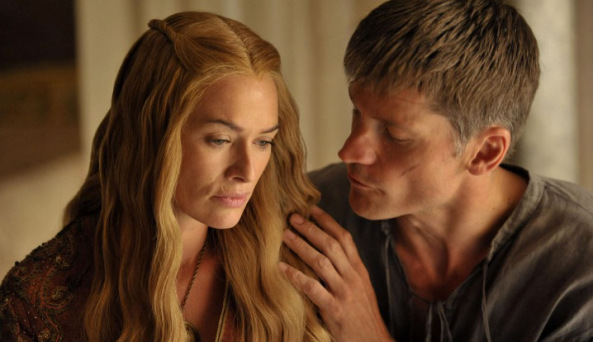
In the third episode of the fourth season of Game of Thrones, Jaime Lannister rapes Cersei Lannister. The two are siblings and long-time lovers, and in the scene Jaime forces himself on Cersei in the sept where their dead son’s body is on view. Terrible moments are common in Game of Thrones, but this one reached a new level of disturbance and even the show’s creators, from series author George R.R. Martin to episode director Alex Graves, commented publicly on this scene.
Now two weeks have passed and, according to some, it’s time to let it go. Yesterday at the Daily Beast, Andrew Romano wote “Why We Should Pretend the Game of Thrones Rape Scene Never Happened.” Instead, Romano writes, we should move forward watching the show as though Jaime’s not a rapist. Romano’s argument is basically this: the rape in the sept is based on a parallel scene in the books, where Cersei is reluctant but eventually consents to sex with her brother. In adapting this scene for television, Alex Graves and his writers intended this scene to be consensual, but failed in execution. This is why Alex Graves, when asked about the scene, said it wasn’t rape: he honestly did not think he had made a rape scene.
Says, Romano (his italics): “The rape wasn’t supposed to be a rape. It was supposed to look consensual. The filmmakers messed up.”
Romano mounts his evidence, some of it convincing, that viewers should not consider this rape scene for the purposes of watching Game of Thrones. “Pull the clip from show. Play it in sex ed class. Use it as a teachable moment.” But if you watch Game of Thrones, ignore it entirely.
On Twitter, Romano’s logic got carried by Christopher Orr from The Atlantic, who made a similar argument after the episode aired. Orr voiced his support of Romano’s piece and among his reasons for ignoring the scene was one of culpability.
@christopherzf@AndrewRomano Showrunners didn’t *intend* it to happen! Blame them, not the character they screwed up.
— Christopher Orr (@OrrChris) May 5, 2025
For the record, I’m not convinced by this argument. The showrunners may or may not have intended to write the scene as it unfolded, but as a viewer, that’s irrelevant. In the HBO series Game of Thrones, Jamie raped Cersei. Whether that was intentional or just bad filmmkaing, Graves filmed and edited a rape scene. It happened; now the show’s creators have to write these characters with the consequences. No take-backs.
But whether or not one is convinced that we should ignore this single moment on a television show in order to perhaps increase our enjoyment of Jaime Lannister and Game of Thrones, I think we would be remiss not to step back one more level, and think about the argument that Romano is making, and logic that it follows.
In Game of Thrones, Jaime raped Cersei. No one disputes this. Jaime has sex with a woman who repeatedly tells him “no” and “stop.” That’s rape.
Alex Graves, director of this episode, did not intend to film a rape scene. This also seems clear. Graves’ defense winds through power struggles and turn-ons and consent, but his take on this scene is that Jaime and Cersei had, by the end, consensual sex. He did not intend to orchestrate a rape scene.
Andrew Romano, a writer for The Daily Beast, is convinced by Alex Graves and the context of the show and the characters, that this wasn’t supposed to be rape, and as a result we should pretend it didn’t happen. Despite what we “unequivocally, unavoidably, undeniably” know was a rape, and “as morally discomfiting as it is,” Romano says it’s time we forget it.
Christopher Orr, taking up Romano’s argument, tweets that we should not blame Jaime, the rapist, for the failures of the showrunners. The showrunners did not intend it to happen, and thus, it’s not Jaime’s fault that he raped Cersei.
You see what’s going on here. A rape occurs. A claim is made that this rape was unintentional. Another person says it’s better if we all just forget it. Then another person says, don’t blame the rapist.
Game of Thrones is fiction, and nobody, Alex Graves or Andrew Romano or Christopher Orr, is staking controversial positions here. Television, no matter how much it might effect our culture, is not reality. But this progress of logic-from We Know It Was Rape to Just Pretend It Didn’t Happen-has become so familiar in our culture we fail sometimes to even recognize it. I didn’t recognize it immediately.
The first reaction I had to Romano’s piece about pretending a rape didn’t happen on Game of Thrones was about formalism as a critical lens, and my belief that once a piece of art is released to the world, the artist no long has any authority to direct audiences’ impressions of that work. That’s the brain-space I inhabit.
When I mentioned Romano’s argument to a friend, her first response was: “They’re doing for the show the same thing that happens all the time, finding reasons to excuse a rapist for rape.”
I have to admit as soon as she said this I was embarrassed that I had not made the connection. I was engaging in a debate about television adaptation of a fantasy series, and the consequences of creative decisions-and this is an important debate. But regardless of what side I was on, I wasn’t recognizing the other argument that was happening right under my nose: debating whether rape is better off ignored.
I’ve long partaken in the conversation about the value and consequences of rape inside the world of Game of Thrones, and I think that conversation will be one the lasting legacies of the show, for better or worse. But here was an instance of removing the argument from the fictional world and applying it to the real world: to the showrunners, the directors, even the audience. The question is not, are Cersei and Jaime better of pretending this didn’t happen, but are we better off pretending this rape didn’t happen? It’s not the same thing.
None of this is to imply that Andrew Romano and Christopher Orr are wrong. They’re arguing for the most effective way to watch Game of Thrones, and nothing else. But the fallout from “Breaker of Chains,” and the implications of pretending a rape, even a fictional rape, did not happen in our world, should not go unnoticed. Game of Thrones, may be fiction, but the world in which viewers live is real, and it’s a world where these arguments are used in a similar fashion for a similar goal far too often.
*UPDATE: I received this note from my friend who pointed out the problem I’m trying to address: “I would add to that that not only are the show’s creators excusing a rapist for rape-but they are actually performing the role of rapist-writing Cersei’s rape without even realizing she is not consenting.”

I’m not convinced the scene from the books wasn’t rape. It’s from Jaime’s perspective, and that’s a limited perspective, so we don’t know if Cersei really is encouraging him or if she is offering verbal consent out of fear. After all, saying “yes” and giving in to an attacker is a defense mechanism.
Sex doesn’t start as rape and become consensual. Rape is rape. Consensual sex is consensual sex. There are no “blurred lines.” If Jaime forces himself on Cersei, assuming she wants it, it’s rape, whether she does want it or not.
I’ll defer to you and others on how to read the text version of this scene, Fiona, since I have not read the books. I’m only experiencing Game of Thrones through the show.
The basic interpretation that I’ve found from readers has been that Martin’s version was consensual and that was my impression from reading only that one scene (it’s here, if folks want to read it: http://www.avclub.com/article/rape-thrones-203499).
But there’s no debating your point. Rape is rape. And it does not become consensual in the act.
I actually haven’t read the books, only the scene. I could see a consensual interpretation for the scene or a rape interpretation. It’s hard to say without the context of all the other novel stuff-how reliable the narration is, what their other consensual sex scenes look like- I don’t think it’s cut and dry as people are making it out to be.