 In the world of books, the name “Georges Simenon” is a bit of an oddity. A Belgian writer of pulp novels who lived from 1903-1989, Simenon is mostly known for his seemingly inhuman writing pace. Legend has it that he could write more than 50 pages a day, and that he finished most of his novels in less than two weeks. As a testament to how prolific he was, consider the fact that I can’t find a single person willing to put a precise count to the number of works he penned: some say he wrote nearly 200 novels under dozens of pseudonyms, but Simenon fans P.D. James (in her introduction to The Strangers in the House) and John Banville put the count at closer to 400.
However many novels he really wrote, Simenon is an undeniable giant of the noir and crime genres. His most popular works fall into two categories. First, there are his Inspector Maigret mysteries—75 novels and 28 short stories. And then, there are his psychological novels, or romans durs, as Simenon called them—literally, “hard novels,” which were hard not in their form but in their content: noir stories boiled so hard they often make the works of Dashiell Hammett and Raymond Chandler look cheery by comparison.
Simenon’s vast body of work is understandably daunting, but Simenon’s work has been enjoying a recent insurgence due to Penguin’s reissues of the Maigret novels, and to the NYRB publication of the romans durs. I’ve not dipped my toe into Maigret yet, but I’ve read three of Simenon’s hard, psychological novels: The Train, a wartime tale with existentialist overtones; Tropic Moon, a sort of hard-boiled Heart of Darkness telling a brutal tale of French colonialism; and, now, The Strangers in the House, thus far the best Simenon I’ve read.
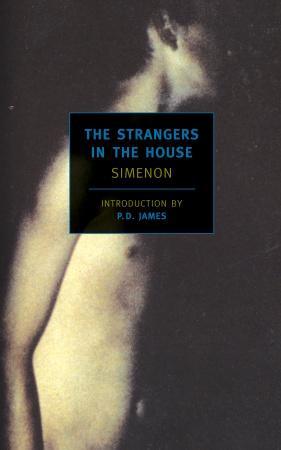 The Strangers in the House tells the story of Hector Loursat, a lawyer living in a small French town—though “living,” as the novel opens, isn’t really the right word for it, since Loursat is basically the walking dead. Ever since his wife left him years ago, he’s lived a drugged, unfeeling life, drunk from morning to night on bottles of Burgundy from his cellar, barely leaving his study while his house crumbles around him. That’s the situation when the novel opens, the stasis from which Loursat will be propelled by events outside of his control.
The inciting event of the novel is a sudden outburst of violence: the sound of a gunshot in the night, and Loursat’s discovery, when he goes to investigate, of a wounded man in one of the empty rooms of his house—a man who dies just as Loursat arrives on the scene. Loursat summons the police, disavows any knowledge of the crime, and that should be the end of it. Back to his life of waking, walking death.
But in typical noir fashion, it’s not the end of it. What sets Simenon and The Strangers in the House apart from other noir novels, though, is that it’s not the details of the plot that suck Loursat in—the one damn thing after another of your typical crime novel that begins with the surfacing of a body and ends by dragging the entire underworld into the light. Rather, it’s the acuity of Simenon’s psychological portrayal of Loursat that drives the story forward. Loursat is not motivated by a detective’s desire to find out whodunit. But he is, nonetheless, drawn to the mystery of the dead body in his house—and tantalized by the idea of a hidden world carrying on just under his nose.
Gradually, Loursat learns that a local gang has been using his house for parties, and that his daughter, Nicole, is romantically involved with one of the members of the gang. The dead man in his house was someone who had leverage on the gang—someone who each of them had reason to kill. But who did it?
As Loursat investigates, it becomes clear to the reader that the crime committed in his house provides an entry point for Loursat to return to real, vibrant living. As Loursat drives around town, visiting the gang’s haunts, he’s struck by thoughts of amazement—to think they went here, they drank at this bar, they danced with these girls, they dreamed these foolish dreams and hoped these foolish hopes! Though it’s never said outright, it’s strongly implied that Loursat finds the strangers in his house so fascinating because their vibrancy is a foil for the drugged, emotionless life he’s been leading, and for the stultifying bourgeois society in town. Ultimately, his reentry into life is made complete when he reestablishes a relationship with his daughter and becomes the defense lawyer for her fiance, who is accused of the crime.
This is fairly typical of Simenon’s romans durs, in which the seedy underbelly of European culture is seen as a vital, tantalizing alternative to bourgeois life, and shocking, horrifying acts of violence become flashpoints around which characters can discover their true selves—or discover that there is no “true” self, only a terrifying existential freedom to do and be anything at all.
Reflecting on the way his life has been upended, Loursat muses:
To discover a new world, new people, new sounds and smells, new thoughts, new feelings, a swarming, writing world, which had no relation to the epics and tragedies of literature, one that was full of all those mysterious and generally trivial details you don’t find in books—the breath of cold air in a dirty back alley, the loiterer on a street corner, a shop remaining open long after all others had closed, an impatient, highly strung boy waiting all keyed-up outside a watchmaker’s for the friend who was going to lead him into a new and unknown future.
That this passage is, essentially, a sentence fragment even in its entirety is a hint at the kind of unbounded possibility Loursat has discovered in this “new world.”
I won’t tell you how the story ends, except to say that The Strangers in the House doesn’t really work as a whodunit—the solution is too pat, too random. The plot is satisfying, however, and the novel’s psychological detail is flawless throughout. To the last page, the novel retains its strangeness and fascination, never staking a decisive claim on what exactly is going on in Loursat’s mind: what made him retire from life in the first place, and what made him come roaring back. Ultimately, the stranger in the house is Loursat himself.
Follow The Stake on Twitter and Facebook

This echoes Flannery O’Connor to me. She found “horrifying flashpoints of violence” a spiritual crossroads or revelation of sorts. Of course, she considered violence to be contact with God/Jesus whereas Simenon views it as discovery of self or terrifying existential freedom but those two things may be different facets of the same thing.
You sound primed to compare the Maigret series to the “romans durs.” The two lists are not night and day as one might think, for the focus is always on psychology.
That’s a good note—though it was often Simenon himself who made the distinction between his detective novels and his “straight” novels or “romans durs.” Though I’m not widely read in Maigret, my understanding of the distinction is that it’s not rooted in psychology but in bleakness: the durs were far bleaker than the Maigrets, featuring a character who went up to or beyond some kind of moral limit. Perhaps the bleakness of the Maigrets was moderated by the presence of the detective, who as in other examples of the genre was a reassuring presence of rationality, justice, and the knowability of the universe?
In any case, it’s not my intention to privilege one list over the other. I love the detective genre, myself, and suspect that the romans durs and Maigrets each provide their own pleasures, no matter what their author thought.