I described the first two issues of She-Hulk as “largely the story of a lawyer looking for work.” Here, in #3, Jennifer Walters has found a case that’s likely to propel the rest of this arc. If the first issues were “distinctly non-superhero stories”, then here we get a further continuation of that trend, and extension of non-superhero status to villains, as well. Even against Victor Von Doom, She-Hulk’s weapon of choice is the courtroom. And so Charles Soule and Javier Pulido’s keep their focus on what makes this book special.
W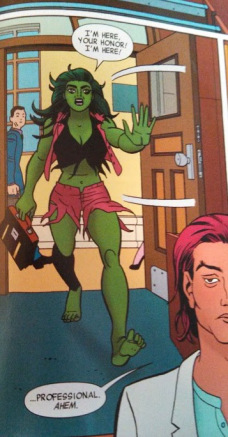 alters takes a case representing Kristoff Vernard. He’s seeking asylum in the US from persecution in his home country of Latveria, where his father, Victor Von Doom is dictator. The persecution he faces: being forced to be heir to the throne, and take up the rule of Doom. Ruling against your will is like a prison, Kristoff tells the judge. Vernard’s been in the US for exactly one year when he shows up at Walters’ office, which means they have until 5:00 PM to appear before a judge, because, as Walters declares, “There’s not a judge in the world who’ll stay past five.” That’s about it for story.
Since this is a review, I’ll just say right out that She-Hulk is book you should read. There’s a unique quality to the story Soule’s writing, one that seems perhaps slight in its variation from the superhero norm, but in reality is quite special. What seems light and merry is light merry, but there’s tonality and depth that even this early is striking.
There’s so much charm in Jennifer Walters as Soule writes her. Walters’ life as a down-on-her-luck lawyer allows her identity as She-Hulk to operate as a great foil for the lawyer. And make no mistake that the foil operates in that direction-Lawyer then Hulk. Though it should be noted that certain Hulk lifestyle elements, battling robots say, just appears part of the job, here. Practicing law in New York means working with and among supers. Punching out a Doombot or clearing the way to the courthouse past an army of henchmen is part of lawyering, not being an Avenger.
And not just for superhero lawyers, either. Kristoff visited 15 firms before he finally showed up at Jennifer Walters’ door. In fact, Walters has been to this point in our story the last resort for clients. Having the She-Hulk as a lawyer is less important than having a powerful firm to back you. Especially if you’re taking on Victor Von Doom.
Doom, as fathers often do, wants to keep his son from achieving his goal of asylum, and in his efforts we see once more why She-Hulk is different. Rather than than confront the pair or send an army to destroy She-Hulk, he sends a Doombot limo drive to take them to the airport instead of the courthouse. What kind of supervillainy is this? When that fails he sends more Doombots, this time to capture Kristoff and delay the court’s proceedings.
That Doom’s objective is not to destroy!, but to keep Walters from filing the paperwork on time, is priceless. It’s the legal strategy of corrupt rulers and deadbeat fathers, which is what Victor Von Doom is here. When Doom finally appears, he doesn’t wreak havoc upon the courtroom. He doesn’t confront She-Hulk. He criticizes his son in public, grabs him by the lapel, and disappears.
Like countless dads before him, Doom embarrasses his kid and storms off.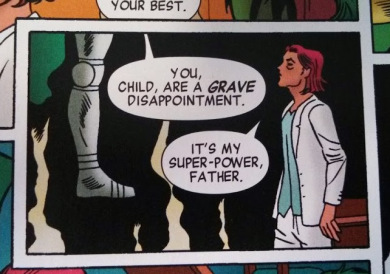
Soule’s a lawyer himself and that knowledge serves the book well as Walters works her cases and navigates through the court. Pulido’s artwork continues the marriage of cartoonish characters and stone-faced seriousness, taking familiar scenes and layering in humor and depth that adds to the core strengths of She-Hulk. Standing in line at a coffee shop looks like a bunch of people milling on their cell phones, nevermind the towering green woman in the overcoat. The scene seems to me to capture perfectly the tone of She-Hulk. It’s funny, but never silly. It takes seriously the endeavor of working as a lawyer but there’s no hint of overwrought conception or plotting.
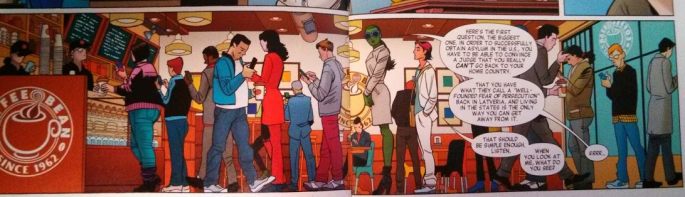
The paneling in this issue was at times confusing to follow, crossing at the fold in awkward movements from time to time, but such is the consequence of this kind of stylized artwork. You’ll realign on the pages a few times realizing you’ve gotten lost. But in this issue it feels of little consequence.

Pingback: Review: Pretty Deadly #4 and 5 | The Stake
Pingback: Funny How That Works: Coming Around to Comic Books as an Adult | Misanthrope-ster