In the last panel of Ms. Marvel #1, Kamala Khan undergoes the transformation into Ms. Marvel. She suits up for the first time and becomes what she longed for: a tall blonde woman with white skin, boots, tights, and superpowers.
Ms. Marvel #2 opens with a critical revelation: being a tall blonde woman in tights and boots with superpowers is not all it’s cracked up to be. First, there’s no underwear in that suit, and it rides. The boots pinch. That long and flowing hair flows right into your face. And the new power she’s found, shape-shifting, does not come with a manual. Being stretched out and altered is an awkward experience.
Thus we meet our new Ms. Marvel.
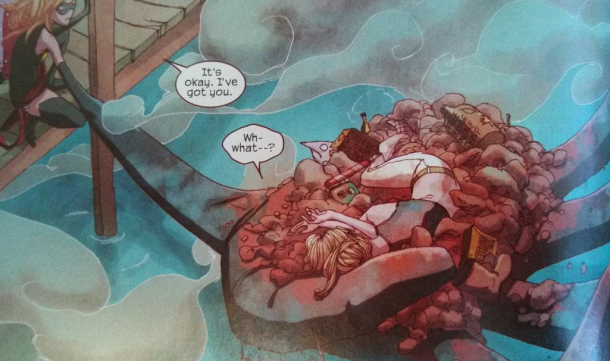
Shape-shifting for Kamala Khan is more than just her super power. It is the very essence of her identity as Ms. Marvel. When Kamala becomes Ms. Marvel, she literally becomes someone else. A teenage kid’s dream come true.
But having this dream come true is not particularly empowering. “Being someone else isn’t liberating,” Kamala says, “It’s exhausting.”
Thus far we have seen in Kamala chiefly a desire to blend in. Most of us who have survived our teenage years can understand the impulse. Kamala looks outside of her own life for comfort. Her imagination takes her away when she writes superhero fan-fiction. Eye-balling a BLT sandwich, wishing she could taste what the other kids eat, wishing her brother was not quite so stand-out-ish in his prayer and dress, these are the imaginative vacations Kamala takes from her own identity. We all wish we were someone else, sometimes.
But now Kamala has become Ms. Marvel, and as a superhero, anonymity is simply off the table. And yet, Ms. Marvel can be noticed in any manner she chooses. She is a shape-shifter. She is Kamala, she is Ms. Marvel. She is anything she wants.
Almost immediately upon discovering her new found powers, Kamala must put them to use. Zoe, a classmate known to Kamala for her direct line of questions regarding Islam, has fallen into a river. Imbued with power but still uncertain how to live with them, and facing a life-threatening situation, Kamala finds her inspiration not in the heroes she admires but in the lessons of her life: scripture. With the freedom to be whomever she chooses, Kamala’s first impulse as a superhero is to find courage in who she already is.
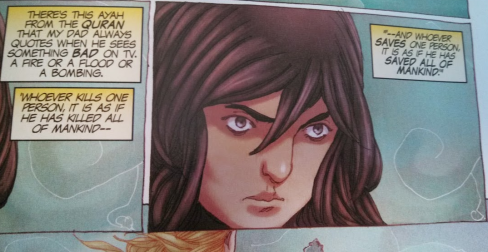
Kamala, knowing what is right, pulls Zoe from the river. And in the process is noticed by a group of young people recording the event with phones (one declares: “This is so going on MeTube”). There’s no anonymity in superhero work.
The life of a superhero has always been one of a struggle with identity. The laborious requirements of living two lives simultaneously remains an earmark of the superhero trade. Superman, in order to be a hero, requires another identity. And thus Clark Kent lives a life of anonymity. He’s no one special, but being no one special allows Clark to be Superman. He wears glasses as Clark Kent, so he can take them off.
G. Willow Wilson and Kamala Khan are again taking up the question of identity and anonymity. But Wilson has found a wonderful new way to turn this around. Kamala is already looking to be unseen, to be someone else. She’s a teenager. Instead of anonymity, however, she gets the opposite.
When Kamala finally bears the image of her hero, she recognizes at once the value of who she always was: a Muslim girl inspired by the Quran. This may seem an obvious lesson for a superhero book. A “believe in yourself” message of little complexity or originality. But it’s more than this. More than a pat lesson of be who you are.
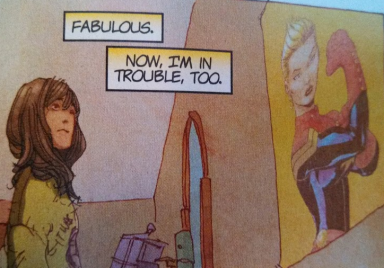
Kamala finds a part herself when she becomes someone else, this is true. But she also rejects a tradition by looking to scripture for inspiration* in her acts of heroism. She inherits an identity that is her own-a teenager, a Pakistani-American, a Muslim- but can only do so by being someone else.
G. Willow Wilson has written Kamala into a fascinating corner. The suit Kamala wears as Ms. Marvel changes her appearance, but her changed appearance allows Kamala to be herself. This is her power-shifting. It is not her weakness. When Kamala is Ms. Marvel, she doesn’t take her glasses off, she puts them on.
*Last week I wrote: “The world of religious iconography is where superheroes have always lived.” This is true, but metaphorically so. While Jews and Christians have long created religious figures within superhero books, rarely have these characters been internally motivated by these religions.
