There’s a trailer out for the adaptation of Lois Lowry’s The Giver—and it’s a good one. There’s something thrilling about seeing a beloved book finally get the adaptation it deserves.
But there’s something melancholy about it as well. My first thought upon seeing the trailer was This is going to be awesome! My next thought—well, it wasn’t a really a thought so much as it was an emotion: sadness. Sadness because, though something new and great is going to come into this world because of this movie, something is going to be lost as well.
Blame it on Stephen King. In his introduction to The Stand, he wrote something that has never left me:
I am inevitably asked if [The Stand] is going to be a movie. The answer, by the way, is probably yes. Will it be a good one? I don’t know. Bad or good, movies nearly always have a strange diminishing effect on works of fantasy […] Movies, after all, are only an illusion of motion comprised of thousands of still photographs. The imagination, however, moves with its own tidal flow. Films, even the best of them, freeze fiction—anyone who has ever seen One Flew Over the Cuckoo’s Nest and then reads Ken Kesey’s novel will find it hard or impossible not to see Jack Nicholson’s face on Randle Patrick McMurphy. That is not necessarily bad…but it is limiting. The glory of a good tale is that it is limitless and fluid; a good tale belongs to each reader in its own particular way.
I’ve certainly found it true that books belong to their readers—such that you and I could never read the same book, even if the text we have before us is identical down to the letter. Books are filled with emotional and interpretive gaps, gaps that each individual reader fills with their imagination and colors with their unique experiences. Movies aren’t quite so fluid; where words are porous, images tend to present an unbroken wall that, while hardly being impregnable, at the very least presents fewer gaps for the human imagination to get into.
Don’t get me wrong, I love movies and TV—the moving picture is a wonderful art form, able to evoke experiences and techniques that the written word has difficulty with. Just try to write a montage, for instance, and you’ll find that the most basic of filmic forms is nearly impossible to duplicate in prose.
But as much as I love movies and TV, I hope it’s clear by now that books are practically a belief system of mine. Movies and TV shows are something I enjoy, but books are a part of my identity.
And The Giver is one of those books that is in my personal pantheon. When I read it in elementary school, it was the first encounter I’d ever had with dystopian lit, and it absolutely blew my mind. It wasn’t chock-full of action, like The Hunger Games or Divergent are—no, The Giver surprised me with its ideas, and with the force of my own emotional and intellectual response to the story. I’m not sure if I knew a book could do that before I read it.
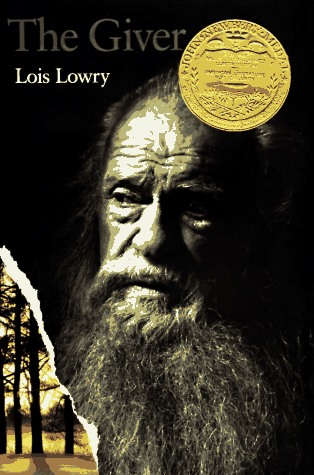 And already, watching the trailer, there are things about young Andrew’s imagining of the tale—my personal The Giver—that are fading away. I pictured the Giver a little older, for one thing, though perhaps that’s due to the bearded old man on the cover of the book that I read all those years ago. More importantly, perhaps, the Community of the trailer looks so vibrant, so slick, so similar to the dystopian landscapes we’ve already been given in other films. As a kid, I pictured everything looking much duller, the colors muted—which seems to be in keeping of the book’s theme of drab sameness.
I’ve felt this feeling before. It was when I first learned of a massive effort to adapt the Lord of the Rings, another book I adored when I was younger. I was excited—eager to see the fantastical worlds and epic battles I’d imagined come to life on screen—but sad, too. And sure enough, it’s now difficult to think of JRR Tolkien’s epic without immediately picturing Elijah Wood and Sean Astin, Sir Ian McKellan and Viggo Mortensen.
For some reason, it’s the books I read and loved as a young person that I’m the most sad to learn are being adapted. The books I’ve read as an adult are no less important to me, but for some reason the emotional, intellectual, and imaginative engagement I’ve found with books as an adult doesn’t even come close to the elaborate imaginative worlds I constructed around the books I loved way back when. That’s not particularly surprising, I suppose. The older we get, the more childhood seems to be the thing we want to protect.
I want the movie version of The Giver to be good. But most of all, I want to preserve the fierce imaginative world young Andrew built around the book 20 years ago. It means something to me. And I want today’s young readers to be able to build those worlds and have those strong emotional responses too.
Perhaps The Stand—the book whose introduction gave me this hangup in the first place—provides a counterexample. It was, indeed, adapted as a TV miniseries in the 90s. But no one really watches it today. Then again, that’s probably because the miniseries was forgettable—the book is obviously better. Adaptation is a zero-sum game, it seems: for one to increase, the other must decrease. Either the book or the movie must come out on top.
If that’s true, and in the interest of putting all my cards on the table, I’m rooting for the book version of The Giver.
Sorry, Meryl.

Great analysis. This trailer is pretty ho-hum, just another addition to the Hunger Games/Ender’s Game/Divergent Games fad. Sprinting away from spaceships? Sterile, futuristic settings? Hrm. I too was immensely influenced by the book, and I remember it seeming calm, though unsettling. And everything in gray. I mean…isn’t the huge plot point when he discovers the color red?
But the thing that’s bothered me ever since they announced the casting was the super safe decisions on the age of the actors, particularly the boy and old man. They aren’t nearly boy and old man enough. Like you mentioned, we need someone as haggard as that guy on the iconic cover. (Bridges might have a cool voice, but doesn’t look like he’s carried the weight of an entire society in the lines on his face.) And good-looking teens do not a good story make. Let’s keep the kid visibly below puberty. It would have been such a fantastic chance to show ages that aren’t usually represented; to show how different these two people are, separated by many many years; but then show how maybe their extreme age and youth is actually what makes them similar.
Hopefully this one comes and goes with a whimper, like Ender’s Game did even after all the extra press around it.
Yes! The protag’s discovery of color is one of the things that really stuck with me when I first read it.
I didn’t think about the age gap until you mentioned it, but I agree with you. Aging the protag to his teens is probably a ploy for ticket sales.