Chances are, when you opened Facebook yesterday, you saw one of two things all over your feed: a video of Barack Obama on Zach Galifianakis’s “Between Two Ferns” web series, and a video of alleged strangers kissing. Both were widely shared and liked—and both, crucially, were basically marketing campaigns: for the Affordable Care Act and a line of clothing, respectively.
Both videos inspired a swift backlash—the Obama video attracted the usual, and predictable, critiques from conservatives. But the reactions to the “First Kiss” video are more fascinating, I think. The love for the video, which depicted strangers put into a room together and asked, basically, to make out, was instant and widespread; the video went up yesterday and it already has 23 million views on YouTube.
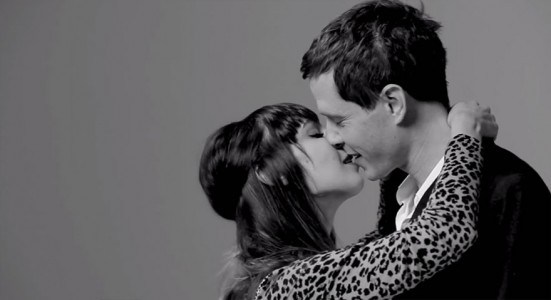
But as fast as the viral success of “First Kiss” was, the backlash was equally swift. Slate’s Amanda Hess quickly pointed out that the video was an advertisement for the Wren clothing line, and that “most of these strangers are professional performers who are experienced in acting out love, sex, and intimacy for crowds.” Jezebel picked up the story after that. Suddenly, this painfully cute video about the power of infatuation, sex, and love started to feel a little different: a manipulative play on the power of youth, beauty, and performance to sell shit.
What the whole episode illustrates, I think, is the push and pull of two fundamentally different cultures on the internet: the deeply sincere and earnest world of Upworthy-style sharing, and the deeply cynical world of viral marketing. On one level, these two worlds are deeply and diametrically opposed to one another; on another, their relationship is practically symbiotic. They’re the yin and yang of the social web.
When it first appeared and spread across the web like wildfire, the “First Kiss” video had all the hallmarks of an Upworthy video. I haven’t gone to the trouble of checking if Upworthy was one of the outfits spreading the video far and wide, but I can write the headline off the top of my head: “These Strangers Were Put in a Room and Asked to Kiss Each Other. What Happened Next Will Make You Believe in the Power of Love!” As much as we might mock Upworthy, though, their model for sharing is fundamentally earnest: their headlines, manipulative though they are, play upon our desire for authenticity and sincerity. This is embodied in Upworthy’s slogan: “Things that matter. Pass ‘em on.”
In a sea of phonies, of hucksters trying to sell you something, the Upworthy video tells us, here is something real, and good.
That’s what the “First Kiss” video seemed to promise us. And so we clicked. And so we shared.
But it turned out to be a viral marketing campaign, which is about as insincere and inauthentic as you can get. Viral marketing is all about trickery, showing you something cool and coercing you into becoming an unwitting accomplice in the campaign by sharing it to your friends. Some viral campaigns are more honest than others, of course; the Obama “Between Two Ferns” episode was pretty obviously a healthcare.gov plug. But “First Kiss” embodied both worlds at once—the video was a thing which seemed to be authentic, that in fact turned out to be deeply inauthentic.
What’s a responsible netizen to do? The simultaneous authenticity and inauthenticity, the yin and yang, of the social web, inspires a kind of feedback loop of responses. In reaction to the cynicism of people trying to sell us stuff, we hunger for authenticity; but we often ironically distance ourselves from that which seems real out of fear that we’re being lied to. Earnestness feeds irony; irony feeds earnestness.
Imagine the plight of someone waking up this morning to learn that the video they rapturously shared with their social circles is a fake. They’ve been lied to. Some self-righteous friends are crowing about how the whole thing isn’t a testament to love but a paean to youth, beauty, the commodification of true intimacy, and capitalism.

I imagine that today, they—which is to say, we—are hungering even more deeply for the authenticity that “First Kiss” promised but didn’t deliver, craving the next Upworthy share-fest, yet more suspicious and cynical than ever.
Ironic sincerity. Sincere irony. It’s a paradoxical attitude, yet it is the pose we all must strike in the world wrought by social media—a world where we must always be circling each other, our natural human responses mediated by the presence of the camera, modulating our postures and expressions before going in for the kill. A world where even a “real” kiss must be performed.
