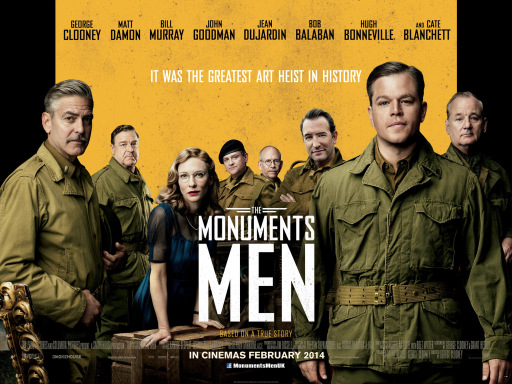
Settling down with my brother in the dimming movie theater, I let out a tremendous sigh. I had run over a few reviews beforehand and knew what I was in for: a movie that couldn’t decide whether it was a comedy or a drama, a movie with too many story lines, a movie that was neither fit for popular audiences, nor crafted for art-house tastes. Coming in at 34% on Rotten Tomatoes, “The Monuments Men” promised to be a cringe inducing bore fueled by George Clooney’s lavish charm.
Only, to my surprise, it wasn’t.
The movie starts as art historian Frank Stokes (Clooney) lectures President Truman on the tremendous need to save Western Art from Hitler’s armies. The war is winding down and the Nazis are retreating, hiding, and burning everything they can’t take with them. Stokes is granted a tiny contingent of fellow art buffs for a mission to save what they can, and after basic training, the team heads over to Europe.
The star-studded team (Bill Murray, Matt Damon, John Goodman, Hugh Bonneville, Bob Balaban, Jean Dujardin and Cate Blanchet) races across Europe in a mad adventure to uncover and save all the art they can before looters, or the Russians, roll in. With so many characters, story lines veer every which way and scene transitions are anything but graceful. Clooney’s script beats viewers over the head with the sanctity of art, and Hitler is reduced to a terrifying and ruthless art collector. Despite being our allies, the Russians are just as bad. They roll in as thieves with tanks and carry off art to Russia as wartime payback. It’s up to Clooney and Company to save the priceless works and return them to their rightful owners before they’re plundered or lost for good. On the surface, “The Monuments Men” is clunky, uncertain of its genre and full of wearying Team America hurrahs.
Despite all this, though, the movie was entertaining. And more important than that, it revered art. While loss of life was truly horrific during WWII, another silent decimation was going on at the same time. Art was being hoarded and destroyed by a mad man. A tiny group of people were willing to put their necks on the line to save a few masterpieces and return them to their owners.

Sitting in a packed theater, surrounded by people who were likely drawn by the star power of Clooney and Damon as they were by a story about the value of art, I suddenly felt reassured. This film isn’t a comedy, a drama or an action flick. Yet people are still coming. And they’re seeing that art is worth saving and standing up for, perhaps even dying for.
In the end, the reviews hardly count. We all walked out knowing art is important and in the face of great danger, still matters.
Catherine Eaton is a contributor to The Stake. Catherine is a writer living in a western suburb of Chicago. She blogs over at sparrowpost.com and enjoys foraging around the neighborhood in her spare time.
