 It’s hard to watch Europa Report without thinking of 2001: A Space Odyssey. Like Kubrick’s masterpiece, it concerns a manned mission to an object orbiting Jupiter—in this case, the goal is to explore the icy moon of Europa, where scientists hope to find evidence of unicellular life. The spacecraft (named “Europa One” to 2001‘s “Discovery One”) is similarly constructed, sprawling fore and aft with a rotating pod to replicate the feeling of gravity. And when the astronauts escape the Earth’s atmosphere and enter the realm of space, the sound of applause and cheering at mission control is paired with the lilting strains of—you guessed it—Johann Strauss’s “The Blue Danube.”
Of course, we need not take these allusions as an act of artistic hubris on the part of Sebastian Cordero and Philip Gelatt, Europa Report‘s director and writer. Presuming the fictional world of the film is one where 2001 exists, it’s plausible that the Europa mission planners would give their astronauts a joyful sendoff with a reference to the most famous film about a Jupiter mission—that the allusion is the characters’, not the filmmakers’. But it’s best to note the filmic quotation anyway—because even if Europa Report fails to grasp the trailblazing, transcendent heights of 2001, the winking reference hints at something of its aspirational reach: in defiance of the dumb or derivative movies that too often dominate the genre, Europa Report wants to be smart, original sci-fi that taps into the awe and wonder inherent in humans standing before the vastness of the universe.
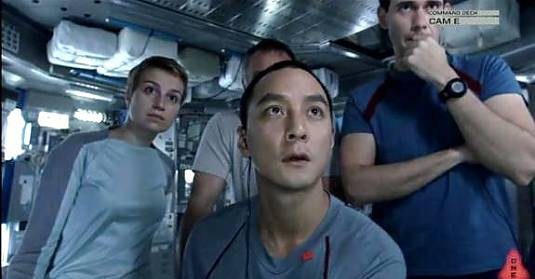
If Europa Report‘s aspirations are 2001, its execution is a bit more Blair Witch. It’s a found footage movie—a genre I’ve never been fond of, but which mostly works here. We’re introduced to the conceit in the opening minutes: the Europa One was sent into deep space, only to lose contact with mission control a few months later. But the cameras kept running—cameras everywhere on the ship, in the landing pod that went down to Europa, and affixed to the helmets the astronauts wore as they conducted repairs outside the ship and walked across the surface of Jupiter’s icy moon—and it is using footage from these cameras that the mission planners belatedly construct what happened.
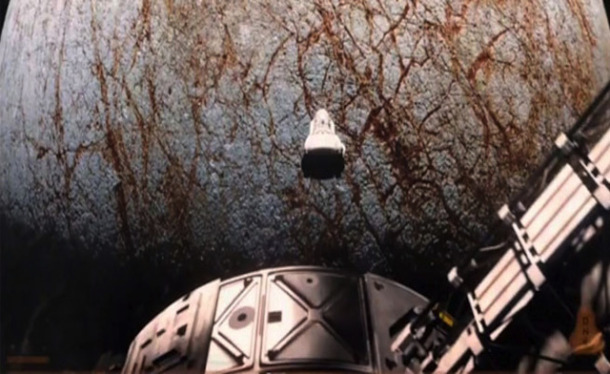 If you read “found footage movie” and immediately think “horror,” I want to disabuse you of that expectation right now—Europa Report is consistently interesting, but it’s hardly a thriller. For most of its runtime, the film is quiet in the way that 2001 was, harvesting suspense out of the sense of foreboding inherent in the “what went wrong” setup and some occasional creative editing that’s seemingly compulsory in the found footage form. Things don’t really get exciting until the Europa One loses contact with mission control, requiring repairs on the exterior of the ship. Further problems follow—and it probably won’t surprise you to learn that things don’t go quite as planned on Europa.
Europa Report is far from perfect. The found-footage conceit felt forced to me, and more than once I wondered if my enjoyment of the film would have been enhanced by a more conventional storytelling style—or, worse, if the method was chosen to compensate for a lack of compelling story. A framing technique in which the mission’s head back on Earth occasionally reflected upon the footage was unnecessary. And the astronauts who participate in the mission largely don’t emerge as real characters, robbing the film of necessary emotional stakes. (Contrast with Alfonso Cuaron’s Gravity, which drew its characters and established emotional stakes with broad but sure strokes.)
But it doesn’t matter. Though Europa Report‘s reach ultimately exceeds its grasp, it’s still a worthy film, and a fine way to spend an hour and a half of your time on a Friday night. If you—like me—believe that there’s a dearth of smart, original science fiction movies out there, you’ll enjoy Europa Report and forgive it its faults—and hope that other filmmakers will find ways to tell similar stories.
