*Editor’s note: this post discusses plot points of Dr. Who season 2, episode 4 (10th Doctor).
When I started watching Dr. Who, I didn’t see the point. It had a low budget, it was silly beyond belief, and I just wasn’t buying it. As my spouse sat fixated, his eyes deep and troubled over Dr. Who’s quandaries, I couldn’t help but laugh as garbage bins attempted to exterminate the world and cat people in wimples experimented dangerously with infectious diseases.I slogged through as a dutiful spouse and hung onto my knitting needles for dear life.
One night, David Tennant, playing the Doctor, stepped off a spaceship and into 18th century France. I stopped knitting and raised my eyes.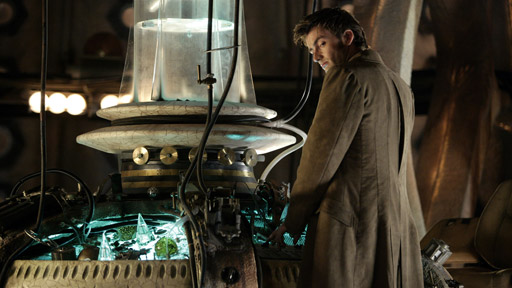
This episode was special, and it was different. Dr. Who swept into the world of little Reinette Poisson, living in 18th century France, and saved her from the monster under the bed. The monster turned out to be a cranky automaton, zipping around in rich velvet clothing and staring at people through a hollow-eyed harlequin mask. With a whirl of the sonic screwdriver and a few quick fighting moves, the automaton was vanquished and the Doctor trundles the automaton back to the spaceship.
The Doctor returns to Reinette Poisson in 18th century France right away but time is a precarious matter and even Time Lords don’t always get it right. He looks for a frightened little girl but finds, in her place, a grown woman. Reinette sparkles and verbally spars with him, ending the scene with a kiss before hurrying out of the room. The Doctor whirls around in a daze, wondering just who this fabulous woman is. It doesn’t take him long to figure it out. Reinette Poisson will become “the mistress of Louis XV, the uncrowned queen of France, actress, artist, musician, dancer, courtesan, fantastic gardener!”
In other words, he has just met a young Madame de Pompadour. It’s no wonder the Doctor is dazzled. Beauty and genius combined is enough to make me dropping my knitting too.
The Doctor darts to and fro the spaceship, meeting up with Reinette at various times, puzzling out the riddle of the automatons. Every time he returns they talk, flirting and exchanging ideas. During one such meeting, he decides to browse her memories, trying to find what the automatons seek. He holds her face, closes his eyes and begins to peer through the doorways of her mind. She suddenly cries out, “Such a lonely little boy, lonely then and lonelier now.” He falls back, stunned.
Reinette Poisson has figured out the memory trick; while he looks at hers, she looks at his. Before he pulls back, however, she reveals she has also learned his true name. The name is not spoken, and while we wonder, the two of them are drawn ever closer.
After this intense exchange, Reinette hauls him off to a dance. Even 18th century people shake it to the rhythm of the night, be it ever so slow and courtly. Wild adventures ensue afterwards and just when everything looks bleakest and Madame de Pompadour is about to be decapitated by the automatons, the Doctor swings in and saves her. There is a price, he reveals, after his last return and the automatons’ demise. He will not be able to return to the spaceship as he did before. He is locked with her in 18th century France, “taking the slow path,” and aging alongside her.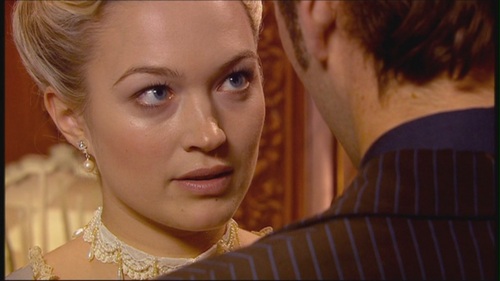
It’s a tender moment as they gaze out the window, discussing his new life. Reinette has a trick up her sleeve, one last chance. Her childhood bedroom, in its entirety, has been transported to Versailles. The doctor first visited her through the fireplace. Perhaps he can return through it and of course, he can. The fireplace is still intact. He decides, however, this time Reinette will return with him. “Pack your bags,” he shouts, “and pick a star!” He hurries through the portal, eager to tell his friends he isn’t stuck in 18th France after all, and to share the news of Reinette joining them.
He zips back to Reinette’s bedroom minutes later, only to find an empty room. She is gone and Louis XV stares bleakly out a window, onto the courtyard below. He gives the Doctor a letter from Reinette, and they both watch as her hearse passes out of the gates of Versailles. She is gone.
The Doctor returns to his time machine, the Tardis, and sets a new course, leaving behind the broken spaceship and the closed portals to Reinette’s world. In a quiet moment by himself, he reads her letter and we see the face of the man Reinette knew, “lonely then and lonelier now.”
I took a deep breath after the ending and lowered my eyes from the flashing close credits. Where once was just a silly enthusiastic man, was now a heartbroken man, making wrenching decisions and nearly undoing himself on the petard of a white knight complex. He was human and recognizable, someone I saw both in others and myself. Parts of him lay shrouded in mystery revealed only by the tiniest alluring tease. I watch for these reveals. There can be no greater hook then the chance of understanding another’s life and mind. It is by these understandings that we uncover the mystery of our own selves.
“Non est ad astra mollis e terris via”- There is no easy way from the earth to the stars (Seneca)
Catherine Eaton contributed this article to The Stake. Catherine is a writer living in a western suburb of Chicago. She blogs over at sparrowpost.com and enjoys foraging around the neighborhood in her spare time.

What’s remarkable about this episode is that it comes in the middle of the Rose/Doctor plot. Their relationship has already begun to bud and yet, here is a love story. It makes the Rose/Doctor relationship also look mundane in comparison. Is that because this is more Romantic/elaborate? Is it because it’s a one-off? Or, it may be the reciprocity that you mention in her looking back at him. Maybe this relationship seems less one-sided.
I love this episode.
I find Madame de Pompadour to be interesting because she’s the first woman who actually matches wits with him. I mean, Rose is…Rose. Fun loving, adventurous, brave, funny and all that but the equality is clearly missing. And you’re right, it’s fascinating where this episode lands in conjunction with the Rose/Doctor relationship. Russell T. Davies, the screenwriter, was writing the script for “Casanova” (also starring Tennant) and fell in love with Pompadour during his research. This episode is kind of like his tribute to her, which I love. My other absolute favorite episode is “Blink” but this is the episode that really got me going with the Doctor.