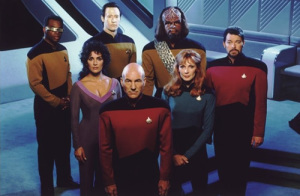
 Star Trek: The Next Generation is probably the best iteration of a franchise that spans five television series and eleven movies, and easily one of the best sci-fi TV series of all time. But any TNG fan will readily admit that its first couple of seasons were a hot mess.
I found this out the hard way recently, when I decided to embark on a complete rewatch of the series. I first watched TNG in syndicated reruns during my early adolescence. Oh, I dabbled in Deep Space Nine and Voyager, but TNG was always my favorite. The show, in my best memories of it, was a sort of sci-fi procedural, each episode bringing the crew of the Enterprise-D in contact with a cosmic mystery—an alien culture or temporal anomaly—and then watching as they solved the mystery with humanist values, cooperation, and, of course, a generous helping of technobabble.
But upon returning to the series on Netflix, I found that the first two seasons were a disaster, a clutter of bad writing, poor characterization, clunky plotting, and rock-bottom production values—and occasionally, downright racist or misogynist storylines. Eventually I pushed through the crap to the good stuff, but I might just as easily have given up, and I know friends and acquaintances who’ve done just that when faced with a laundry list of episodes that are just painful to watch.
When does Star Trek: The Next Generation get good?
The short answer to this question is: Season 3. But if you skip ahead, you end up missing some genuinely good episodes, not to mention some important character development that’s essential for what’s to follow. So, I’ve put together a viewing plan for seasons 1 and 2 of TNG—a plan that’ll get you to the good stuff as quick as possible, without missing anything essential. Just watch these essential episodes, and skip the rest:
1.1, Encounter at Farpoint. TNG’s two-part pilot isn’t great, but it doesn’t suck either. It introduces you to the major players, at least, and the plot revolving around mysterious goings-on at a space station constructed by an alien race is fairly typical of what you’ll see in future (and better) episodes. The pilot also, crucially, introduces the character of Q, a god-like being who frequently returns to torment the crew of the Enterprise under the guise of “testing humanity.”
1.5, Where No One Has Gone Before. This episode, involving some tweaks to the Enterprise’s warp drive that don’t quite pan out, is probably the first decent episode of TNG. It’s especially fun if you like your sci-fi a little Twilight Zone-ish, or enjoy the “Beyond the Infinite” scene in 2001: A Space Odyssey.
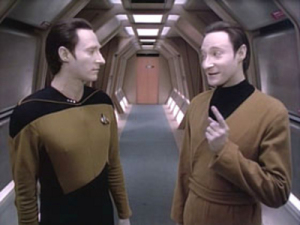 1.12, Datalore. Data, the ship’s android officer, is one of the best characters on TNG, and one that will get the most mileage over the course of the series. Again, this episode isn’t great, but it introduces some crucial information about the man who made Data, Noonien Soong, that will be crucial in later episodes. Watch it.
1.14, 11001001. Not an essential episode, but a good one. This story of an alien species called Bynars who communicate directly with computers shows some of the promise that TNG would later fulfill.
1.18, Coming of Age. Not on most people’s lists of good first season TNG, but I like this one for being a decent Wesley Crusher episode, and a good look at the mysterious Starfleet entrance exam.
1.19, Heart of Glory. The first episode to focus on Worf, the Enterprise’s Klingon officer. Worf gets some great episodes later in the series, but this is the first sense we get of the vast cultural difference between humans and Klingons, and of just how difficult and extraordinary it is for Worf to be living and working on the Enterprise.
1.22, Skin of Evil. The only truly bad episode on this list, with some piss-poor production values and embarrassingly cheesy scenes. Sorry about that. But you’re going to need to watch this episode to see what becomes of Lieutenant Tasha Yar—which will become crucial in future episodes.
2.3, Elementary, Dear Data. Holodeck episodes are generally the bane of most TNG fans, and I’m not a huge fan of this one, even if it does feature Data as one of my favorite Victorian detectives. But it’s still worth watching for illuminating the friendship between Data and Geordi. Besides, the holodeck is a big part of the series, so you may as well get used to it.
2.8, A Matter of Honor. Another great Klingon episode, and a good Riker episode to boot.
2.9, Measure of a Man. The first truly great episode of TNG, and one of the best of the entire series’ run. A scientist attempts to force Data to undergo potentially dangerous tests on the grounds that Data is the property of Starfleet. What ensues is a fascinating debate on sentience, slavery—and some truly fantastic acting from Patrick Stewart.
2.13, Time Squared. The Enterprise gets caught in a time vortex, resulting in two Captain Picards—and introducing a reliable TNG trope, the spacetime paradox.
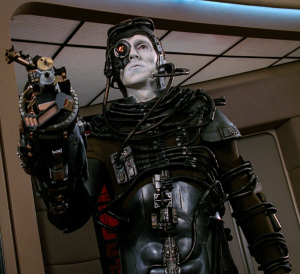 2.16, Q Who? Q’s back, and this time he’s bringing the Borg with him. This introduction of one of the franchise’s best villains is essential TNG.
2.20, The Emissary. Another Worf episode, this one introducing a love interest. This one’s a good reminder that TNG wasn’t just phased data interferences and inverted subspace variances—the show also did relationships pretty well, when it had to.
2.21, Peak Performance. A war games exercise gets out of hand. Nothing deep, just fun.
And that’s it. 14 episodes, roughly the length of a season of Breaking Bad or Game of Thrones, that will carry you through the highly uneven first and second seasons of TNG, and into the heart of one of the best sci-fi series to ever grace our TV screens.


Pingback: Post-Breaking Bad palate cleansers | The Stake
Pingback: “All Good Things…” Have Come to An End - Star Trek TNG | The Leather Library