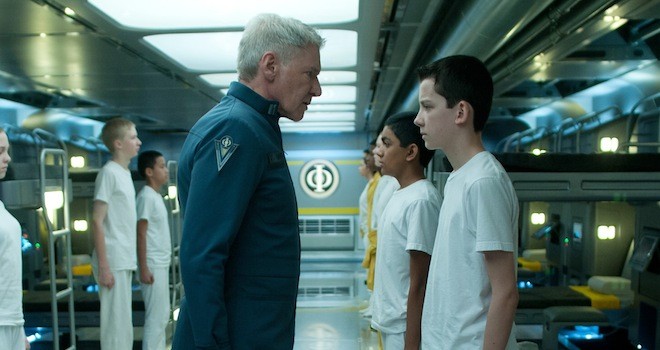
 You probably already know about the upcoming film adaptation of Ender’s Game, Orson Scott Card’s 1985 science fiction classic. And you probably also know about the proposed boycott of the film due to Card’s extreme political views.
The boycott is completely warranted, and I respect anyone who chooses to skip Ender’s Game because of it. Orson Scott Card is a homophobic, xenophobic bigot. He’s a vocal opponent of marriage equality for same-sex couples, and recently sat on the board of the National Organization for Marriage. He’s also a racist; this May, he wrote a completely unhinged op-ed in which he posits a future where Barack Obama becomes the effective dictator of the United States by installing Michelle as a puppet ruler and puts down any opposition by using “urban gangs” as his personal police force.
To such writings, I can only respond with pity, and an honest fear for Mr. Card’s sanity.
Yet Orson Scott Card is also the author of two undeniable science fiction masterpieces, Ender’s Game and its sequel, Speaker for the Dead. Both books won the Hugo and Nebula awards, science fiction’s highest honors, and occupy spots on Goodreads’ crowdsourced list of the best science fiction and fantasy books of all time.
What’s especially perplexing about all this is that these two novels aren’t just pretty good sci-fi stories-they are deeply empathetic works that are actually at odds with Card’s life, to the point where their thematic concerns are a direct rebuttal to their author’s hateful beliefs. What are we to make of all this?
[Here, I must pause to warn you that the following paragraphs contain some minor spoilers of Ender's Game and Speaker for the Dead.]
Ender’s Game tells the story of Ender Wiggin, a boy recruited to an elite battle school where he and other children are trained to fight against a terrifying alien enemy, the Formics, or Buggers. The children are pitted against each other in games intended to test their strategic aptitude, and Ender eventually advances to ever more complicated games as he begins to understand the Buggers’ battle tactics.
This plot summary might suggest a relatively simple humans vs. aliens story full of thrilling battles and heroes who pump their fists as they blow up faceless foes. The reality is a bit more complicated. In fact, Ender’s Game is anti-war, and motivated by a deep ethical concern—perhaps the primal ethical challenge that every human must face: overcoming our fear of that which is strange to us in order to embrace and live at peace with the Other. You see, as Ender learns more and more about the Buggers’ battle tactics, he begins to understand them. To empathize with them. Ultimately, to love them, and to wish that the humans and the Buggers could live at peace with one another.
The sequel, Speaker for the Dead, is motivated even more clearly by this ethical concern, as humans collide with another strange alien species, and once again react with fear. Ender becomes involved, and using his experiences from the previous book, seeks to create empathy and understanding between these beings who have been pushed apart by violence, misunderstandings, and fear.
Orson Scott Card’s best books are animated by the hope that human beings can overcome their fear of the Other to live in peace and understanding. Yet his own life is deformed by his fear and hatred of those he does not understand.
Here at The Stake, we’re all about “Recognizing the best and calling out the worst in pop culture.” Ender’s Game and Speaker for the Dead are among the best of pop culture. But Orson Scott Card himself is just the worst. What to do?
One thing that gets lost in the discussion of the relative merits of the boycott of Ender’s Game is what, if anything, a book or movie can accomplish in the world. Geeks OUT, in organizing this boycott, is saying that Orson Scott Card’s intolerance of LGBT people will not stand—and that’s admirable.
But there’s also a tacit and perhaps unexamined assumption in the boycott—the assumption that while Orson Scott Card’s hateful words and his money in support of the National Organization for Marriage have the power to do a lot of harm in the world (they do), a book or a movie can’t accomplish anything. Money is powerful, but art doesn’t really do anything to shape the world.
And I simply can’t accept that. Art is powerful, and it has real potential to shape—or misshape—the world we live in.
Orson Scott Card is not a very nice person, but when he wrote Ender’s Game and Speaker for the Dead, he added something to the substance of the world. Something good. If these books were never read again, something unique and wonderful and very real would be lost.
Do these two books somehow excuse Card’s behavior? Not even close. But they must figure into our ethical calculations when we consider whether or not to support something like the upcoming Ender’s Game movie. Which is more powerful—the money we put in Card’s pocket to continue spreading hate speech about LGBT people? Or the success of a piece of popular art dedicated to the hope that humans can overcome their fear of the stranger to live together in peace?
I’m not sure. But I’d love to believe the latter, that art is more powerful than money. Maybe I’m just a dreamer.


Very well said. I happened to be drawn to the same topic recently: https://leviandlaura.wordpress.com/2013/08/04/the-tolerance-card/
I thought of Avatar as I read your post. The learning of your enemy is old. I remember Enemy Mine with Dennis Quaid, Louis Gossett Jr., . My enemy is my friend when confronted with a new enemy In this case the environment.
Thanks for sharing this. I have been thinking about this issue too. I loved Ender’s Game and Speaker for the Dead when I first read them in the 90s and wished someone would make them into a movie. But now that it’s happening and as I learned more about Orson Scott Card and his perspective, I am hesitant to spend the money to see the movie.
I also agree entirely. Except that I am not sure that I agree on a boycott of Speaker for the Dead, as the message in that book of tolerance and understanding is important. I cannot believe that Card the author is the same person as the man. It would be interesting to see how Ender would explain Card’s life if he had the opportunity.
If someone does not agree with Obama’s policies, it’s because he doesn’t agree with the ideology. It does NOT make someone a racist. Can we please move on.
Of course, it would be OK if Card speaks out against Obamaʻs policies! The problem is not that Card disagrees with his policies — itʻs that he imagines Obama as a black panther fascist with ghetto gangs backing him up. Thereʻs a BIG difference between intelligent critical response and racist fear mongering.
But wait — Card is playing an interesting game, and his writing IS at odds with his politics, so it may in fact be strategic! Itʻs important to note here that he frames this pseudo controversial criticism as a story speculation, an “exercise,” to explore what he thinks wonʻt happen. He actually thinks: “So today we have a president whose faith in the good will of Muslim leaders is touching but groundless, whose threats and promises mean nothing, and whose ignorance of history is terrifying.”
Then, after some political critique about the ways Obama is a wimp hiding behind American democratic process to support dictators by using diplomacy instead of force, he jumps to a “thought experiment” and writes: “Obama is, by character and preference, a dictator. He hates the very idea of compromise; he demonizes his critics and despises even his own toadies in the liberal press. He circumvented Congress as soon as he got into office by appointing “czars” who didn’t need Senate approval. His own party hasn’t passed a budget ever in the Senate.” Kind of fantasy guilt by association, and it doesnʻt make much sense in the column, but hey, heʻs a sci-fi writer — heʻs paid to be outlandish, to play “what if…”
Since this didnʻt happen, since itʻs a polar opposite to his real criticism, itʻs up to us to decide what the line is between propoganda and fiction? Itʻs an interesting question. Read Cardʻs blog, Civilization Watch, and see for yourself. Heʻs playing an interesting game, and as one commenter said, “Trying to drum up a little controversy for the upcoming film! Very shrewd.”
Maybe the best thing we can do is say, “How sad that this author writes about freedom and compassion but has a serious deficit himself.” Raise the conversation, as you have here, get some consciousness out there. Is a boycott necessary?
You know what I would like to see boycotted…any movie with RAPE in it. I think Hollywood needs to stop using rape as entertainment. I saw an older movie last week on DVD “Once upon a time in America” starring Robert DeNiro. In the movie, DeNiro rapes a woman he supposedly “loves.”
DeNiro is a favorite of many guys; and for the younger males…is this really “entertainment”?
Just my 2 cents.
I agree. Itʻs so eroticized in movies, and even if it isnʻt eroticized, who knows what viewers will see. Iʻd say itʻs more 25 cents!
Wow. This is quite a puzzle. Thank you so much for taking the time to explain it so well to people like myself. This makes a good story, to me, because of the extremes of each case, the writer/author’s work the good, and the author’s politics deeply disturbing. It’s hard to know what to make of such a thing. I’m inclined to say let the work speak, let the art live. I don’t know this man, he’s got his demons obviously, but he did write some books that have deeply touched the soul of many, many people. These books shouldn’t be subject to banning, just as the children of a tyrant shouldn’t be subject to the tyrant’s punishment.
this is not the same exactly, but I remember a similar conversation about Woody Allen about 20 years ago when he shocked everyone by getting together with his then wife’s adopted daughter. People who had been growing up on Mr. Allen’s films were confused about what to do. Could they enjoy the films of a man who would do such a thing? At the time I remember feeling like I was disturbed by what had happened, but not about to stop watching his movies, and felt his works should be allowed a separate life. I realized artists are complex, well, we are all of us complex/conflicted, but artists make their living exploring this complexity, this conflict. This confusion often plays out in their lives in ways that shock and lead to misunderstanding.
As Architect of the Jungle reminds us, this is hardly the first time an artist’s work and his personal life seemingly conflict with each other. Sometimes I wish I never find out anything about authors I enjoy. But then there’s Neil Gaiman, Kevin Hearne, NK Jemisin, and Patrick Rothfuss. They reach out to the world and try to make it better in their lives along with their work. I wouldn’t want to miss that.
So what to do when someone who is obviously accomplished in their craft is not so polished in their life? I am still going to see Ender’s Game. I promised my nephew three years ago that I would take him. That trumps everything else that’s going on. Will I read another OSC novel? Yes. Will I buy one? Probably not. So my library will get the business, but NOM won’t.
It is important to view the totally of a writer’s work and not to cherry pick a few examples. Ender’s Game and Speaker for the Dead make up less than half the story that Card was telling; a story that documents the change of youthful idealism to a reality of consequences of one’s actions and coping with loss resulting in the change of outlook and action of an individual.
Reading through the body of Card’s work, you often find that noble ideas at the beginning of a story give way to satisfying a self interest for the protagonist. This is very much in keeping with the ideals and attitudes that change over time for real people, for example - many of the hippies of the ’60s became the business owners of the ’80s. It is also important to remember that writers of fiction are not their works - they explore an idea and a situation, taking it to a (hopefully) plausible end. Card is not his books, his characters or the themes presented by either. He is not the All Powerful Wizard, but just the man behind the curtain pulling levers and pushing buttons.
One other thing to keep in mind is that movies based on books often do not stay true to their source material. I learned my lesson the hard way after being horribly disappointed with Starship Troopers (the filmmakers ripped out the heart of the story and kept only the action) and expect that much the same will happen with Ender’s Game. I will not be going to see Ender’s Game since I think that once again the heart will be left out and it will be all about the action. I also doubt that Speaker for the Dead, Xenocide, Children of the Mind and Ender’s Exile will be made as there is no action to speak of and the stories are pretty much bittersweet at best.
Card is himself. His works of fiction are a fiction separate from the reality of Card the person. It is the assumption that the man is representing his personal beliefs in his fiction that creates the sense of being at odds - a fiction writer SHOULD be writing about things that are at odds with their reality. Judge not a book by its cover and judge not a fiction writer by the fantasy (s)he spins for you shall be vastly wrong on both accounts.
This is so well stated.
“a fiction writer SHOULD be writing about things that are at odds with their reality”
Such a significant truth. It so rarely happens - and yet people continue to read transparent crap because being challenged isn’t entertaining.
I was less enthralled with many of Card’s continuations, as they seemed gratuitous and belabored for the sake of cranking out more books -
And Starship Troopers. WOW. What robbery Hollywood flaunts. The same will no doubt hold true with Ender’s Game.
People are conflicted when they love the art, and hate the artist. People are seduced by attractive packaging of messages they distrust. The arts are always awash with these tensions. Welcome to the real world.
Excellent conversation here. I read Ender’s Game growing up and it had a profound impact on that time in my life. It was the first literary introduction to more adult concepts as a child.
It was more than disappointing to find out that the author of the book was filled with hate and rejection. I cant help but wonder if Card’s novels are a cry for help: a window that lets him see past his hateful ways and shows us how he wishes he behaved. Any thoughts?
I recently read Ender’s Game for a class, and I thought that it also went against Card’s personal views. And while I support the boycott, the reason I’m not going to see the film isn’t because of Card’s views. It’s just that I thought it wasn’t a very good story and I don’t want to spend money on the movie.
Pingback: Orson Scott Card’s life is at odds with his art | your tl library san carlos
Well written. I knew a little of Card’s bigotries but this fleshed the situation out for me. No plans to see the movie. Hope his mind opens a little more to see what he is really capable of creatively if his first works are any indication, imagine what a more enlightened, opened mind might produce…
I don’t really see what people hope to accomplish by boycotting Card’s works, especially when their message is directly contrary to his own personal views, as you said. They’re hoping to keep money “out of his pocket” but in doing so they are making a great work of art suffer. That would be like atheists boycotting the Museum of Modern Art because they found out that Vincent van Gogh was a devout Christian.
Hi, I actually don’t see how your analogy fits at all. Van Gogh is not a living person who could potentially benefit from monetary support. Card is. The works of both men are held in high esteem and are in no danger of “suffering”-see DeYoung’s link to the Goodreads list, or the hubbub around a newly discovered Van Gogh painting recently. The works themselves do not need money at all, they just need cultural recognition. Card’s book has that. Anything extra is just money in the pockets of him (unfortunately) or a team of filmmakers (probably decent folks) or the publisher of his extant books (good or bad based on their integrity, etc.).
A boycott might be effective if it was clear we could hit Card’s pockets. But apparently he sold the movie rights before all this went down, so he’s already been paid. As for the books, it is a logical move to just get them from the library as someone mentioned above, or find a used copy from your local bookstore, or borrow it from a friend. If Card is still receiving dividends from book sales, refusing to buy a shiny new copy might indeed help. However the work of art itself needs no assistance from us. It will persist-even more so in this controversy. The question is whether or not money or a message can influence the author’s future actions. He is still alive, and that makes all the difference in this conversation.
My fault for using a loose analogy, but actually, the reasons you mentioned are why it fits.
Boycotting the Museum wouldn’t affect van Gogh, but it would affect the people who work there and run the museum because if enough people boycott it, it cuts into their income and hinders them from doing more to promote modern art in the future.
Boycotting the Ender’s Game movie would really only hurt movie theaters (in this case analogous to the museum), the people who work there and run it, as well as the people who actually produced and acted in the movie. You said Card had already been paid, so there’s no real way to touch any money going “into his pocket.” And as you said, the book already stands on its own. So in both cases the artist isn’t really affected by the boycott in any meaningful way
Really you answered everything for me.
In neither case is the work of art controversial or worthy of boycott itself. In neither case does boycotting really accomplish anything other than hurting the ones who host it, alongside other worthy works. In neither case is the artist affected at all. The ONLY thing boycotting does is make a statement, and there are better ways to do that here.
So like I said, I’m really not sure what they’re trying to accomplish.
Reblogged this on AntiRadiation.
It seems like we agree more than disagree. As I mentioned in my own blog post (http://leviandlaura.wordpress.com/2013/08/04/the-tolerance-card/) on the topic, I’m not confident of the efficacy of this boycott, and I’m not really a participant in any in general.
However, if we could definitely verify that book sales would directly benefit Orson Scott Card, I could get behind the idea (if not the practice) of a boycott. Specifically, it would need to be a boycott on new book purchases, not on reading the book itself. The action might have unfortunate bystanders (bookseller, publisher, x number of employees tangentially related), but if it hits Card, it could be justified. Just because an action might adversely affect unrelated members of some working group doesn’t mean it’s not legitimate. By saying that just because someone somewhere who is not Card is benefiting from the book, therefore we should never attempt to distance ourselves from Card’s art in fears of hurting a bystander’s income, or the host institution, you imply that anything goes so long as someone makes their livelihood from it.
If the “only” thing boycotting does is make a statement, sometimes that is enough. People have already thought twice (and three times, and four times) about whether or not to see the movie, and all this without an official boycott yet in place. There are people who have flat out said they would have paid to see it, but now they never will. My guess is that the studio is taking note. The statement is being made even as we type that our culture will have less and less patience for people like Card in the future.
I didn’t know all this about the author’s beliefs. This sadness me beyond belief since this was the book that opened by appetite for sci-fi literature. In a perfect world we, the readers, would and could be able to separate the book from its author. But it’s hard, especially when a book that we loved so much turns out to be written by a person who strongly beliefs in everything we hate. I agree with you though, we shouldn’t just disregard a piece of literature because of its author. But does buying the book/seeing the movie translates as support for the author or just for his work? It’s a mighty fine line. Ender’s Game is a wonderful book, probably inspirational on many levels. I’m really disappointed reading all this stuff about Orson Scott Card, but I don’t believe it diminishes how amazing this book is. I believe Stephen Fry talks about the same issue, referring instead to Wagner in a BBc documentary I’ve recently seen (some parts of it can be seen here: http://www.bbc.co.uk/programmes/b00sjllw)
This book also kick started my sci-fi appetite !!! Wild Cards by George R. R. Martin is an excellent. It touches alot on social taboos and has many interesting sub plots.
While I by no means condone Card’s personal views made public, I have to say, the man still has as much right to them as anyone else in this country. It’s not as if he is personally responsible for genocide or hate crimes that harm other beings. Despite his views, he has produced thought provoking, challenging works - and I don’t believe supporting their message is the same as supporting his biases. It seems to me a crippling political correctness exercised self indulgently by some. The fact he put such important questions in such a public forum by way of artistic expression and publication makes me wonder how much he struggled with related issues himself, and hope (though sans naivete) he is capable of doing so in the future.
That being said, I chose to boycott the movie because it looks like a cheapened piece of crap. 6 of one…
I’ve been boycotting the movies in general for the last 5 years. Let’s face it. The movie industry is a fickle lover. Only a select few(producers) get to put their movies in front of millions of people. And the movies only stay for 2 maybe 4 weeks depending on its monetary intake.
Now on to Card, I like his work. Never met the man. And the media can spin anything on anyone these days, but if he disaggres with policy then he can do that.
But I boycott this movie on a standing issue alone, I refuse to pay (10-12 bucks)
for a movie.
And to everyone who thinks the system is broke. Best way to create change is to join the system itself and work from within.
So true on all fronts.
My old books and old vinyl are usually higher quality, more pleasant passers of time.
Thanks for the thought provocation
I can see a solution in this - if the film fails in the box-office, it will be an implicit message to Card that his personal politics do in fact reflect on his professional life. But the film will have been made; it won’t disappear. In fact, it can then grow an audience after the fact… much like Firefly managed to do as a science fiction series.
That is, the film can grow that audience if it has been well made. There is always the chance that Hollywood has managed to ruin the story. It wouldn’t be the first time.
I for one won’t see the film in the theatre. Any enjoyment I might have felt would be overshadowed by valid concerns that profits from my expenditure would be used to promote hate. I’m very glad I had the opportunity to read Ender’s Game before I knew of the author’s bigotry.
While I also, as TDavis77, do not agree with Orson Scott Card’s views, I must support his right to have them. It is sad that in our current state of political correctness, that we have done the exact opposite of what we stand for. Demonizing those who disagree with what we believe. I would personally not go to listen to OSC speak about his views on marriage and equal rights any more than I would care to listen to Bill Maher on religion.
As for Ender’s Game, I for one am quite able to separate the art from the artist. Ender’s Game is one of the best and most important sci-fi novels ever written and should be judged and viewed on its merits and not the personal opinions and views of its author.
Ideals and values can come from the most unlikely sources.
I personally will not go to watch the movie Ender’s Game because I believe that our current movie culture could only cheapen the story itself. Much like its authors views.
Read the novel, it is worth it.
Here, here!
I fail to see how a film can adequately translate such a uniquely cerebral and emotional work -
Pingback: What’s Ender’s game? | Thinking is the enemy.
This is something I find myself constantly conflicted with: should the artist matter more than the art? I find that one way to settle the debate in my mind is to be realistic. I know that if I do not see a certain film or read a certain book, that will hardly make an impact in terms of sales. But if buying that product supports an idea that I do not believe in, then I cannot allow myself to participate in it. If others wish to, that is their choice.
-JW
Maybe you should read the actual essay OSC wrote. http://www.ornery.org/essays/warwatch/2013-05-09-1.html It was fictional and he plainly states its fiction throughout the writing. Lighten up, besides Obama is a bad president. According to the facts at least…
I’ve read Ender’s Game. Most of the sequels as well as the shadow series. I actually think going through the whole work you can actually see Card’s personal philosophy colouring it. Ender’s Game dealt primarily with children so the characters understandably don’t show adult traits. But you see it again and again in the later books. I found they act very child-like in their personal interactions. No sex, little in the way of drunkenness or immoral acts, they were all too logical and reserved to be believable.
Then of course with children of the mind you end with the aiua a life force that comes from beyond the universe. That has very close parallels with my understanding of Mormon teaching about the soul.
There is probably more of him in the Art than you’d think. That said; Hollywood is bound to run a scythe through it anyway so any hidden message would be long gone.
Good article.
Congrats on being Freshly Pressed.
Really great post…liked it
like
Loved this post. I was a huge fan of Ender’s Game, Speaker for the Dead, and Xenocide. As a gay man, I can’t help but feel like we have become so overly vigilant regarding LGBTQIA rights, that the moment anyone vocalizes dissent it is immediately quashed. I’m not saying I hate it and it should stop, all I’m saying is Card is perfectly within his 1st amendment rights to voice his (skewed) opinions on marriage equity. As an artist he is given the gift to explore and illustrate alternate realities in which he may not be capable of living or achieving, that is what matter the most to me. He created a universe in which characters were able to appeal to higher reason, logic, and morals on the day of darkness. It might not be reality, but it shaped and influenced my life and ultimately that makes the biggest difference. #IMHO
I don’t understand. Some of you attribute OSC with hate and bigotry. All he really has done is express an opinion contrary to your own. We claim privilege of freedom of speech, but as soon as someone with a real public voice says something we disagree with, we want to “boycott” or find some other way to attack them personally. This is truely hateful.
i think little more work is needed but i like this blog
This is a wonderful piece. I completely agree that art is important, and in many ways helps lead our political and personal views on matters such as LGBT+ marriage, but you may be right that in this regard that money made in the name of art may be given to a cause that many people do not wish to support. I was in a bookstore a few weeks ago and was looking at a book about writing scifi/fantasy and almost bought it except OSC wrote it and I do not want to put any money in his pocket.
Card wrote these books 30 years ago. It may be that his younger self was far more liberal than his curmudgeonly older self is. I loved his books, and the tolerance they espoused. Some of his books had intelligent and sympathetic black protagonists. I think he just may have changed during his life, as we all do.
Has anyone here read homecoming or enchantment or redemption of christopher columbus?
I can tell you that the subtext of his beliefs seeps through. The message of ender’s game can be construed in many ways. A young naive boy thinks that aliens and humans should try to coexist, but perhaps what he tried and simply failed to convey is the necessity of destroying the buggers. We just don’t know for sure.
Pingback: ‘Ender’s Game’ TV spot features alien battle scenes in space | Musings of a Mild Mannered Man
Reblogged this on Cogito Ergo Sum and commented:
I thought this was kind of interesting because Ender’s Game is a book that I read every few months/years. In fact my half brother loves this book and the following books… Anyway just a thoughtful piece about Card and his work.
I guess I started my Orson Scott Card boycott earlier than most. I was a huge Orson Scott Card fan till a friend in Greensboro, NC told me that Mr. Card was posting on all his local BBS (remember those before the internet)? I said oh really and asked for the phone numbers as I wanted to read what he was writing. My friend said no you wouldn’t but eventually gave up the phone numbers. I called in with my modem to read and got the shock of my life. Someone who could write so beautifully was so ugly inside. Mr. Card’s rants were terrible…racist…sexist…you name it, if it was ugly or nasty he was all over it. Much of his problem seemed to be he was excessively right wing…I don’t mean Republican either but much farther right then that. I decided then and there never to buy another O.S.C book and didn’t. I could no longer support him and that goes now for this movie too. Once you see just how ugly that man is inside….you won’t want anything more to do with him.
I disagree too with the person who tried to make this all out to be an act by Mr. Card to somehow promote the movie. Card was fully ranting ultra right winger way back.
What a beautiful read, thank you for sharing your thoughts so wonderfully.
I’ve struggled with this very topic since I first heard the film had been green lit. Shortly after I saw the press covering Card’s blatantly horrific and hurtful views.
I can understand a person thinking that marriage should be between a man and a woman. I don’t feel that way at all. But I respect other people’s opinions. I don’t respect them sitting on boards and campaigning to prevent other people being happy. Even if you don’t personally agree, it’s still none of your goddamned business. I think they’re all bigots and if there is a hell, they’ll be the first to rot in it. But I keep that opinion to myself, and don’t campaign to disrupt their lives.
I’ve loved Ender’s Game since I first read it as a young girl and I still do. But I’ve come to the conclusion that it would be morally wrong of me to support Card (in seeing the movie) considering how deep this hate seems to go.
I really love that other people are wondering about this dilemma as well.
I can’t help but hope it flops at the box office x
We ALL live in a reality of our own construction. Card is about as Mormon as a person can get. Do you not know what that entails?
You can condemn the guy all you like for his views on homosexuality. They are repellant and ridiculous and have nothing to do with his ability to tell a story. His belief that Native Americans are really Jews from the “Lost Tribe of Israel” and that wearing underpants with magic symbols on them will protect him from demons should let you know where he is coming from. He is a supernaturalist. He is completely dissociated from anything even close to an objective reality. If you refused to support or have anything to do with people who are supernaturalists and dissociated… you would spend most of your life looking for someone to talk to.
Pingback: Xenocide, Orson Scott Card (TOR, 1991{Macmillan Audio (2006), Narrators: Scott Brick, Gabrielle de Cuir, Amanda Karr, John Rubinstein, Stefan Rudnicki}) | The Archaeologist's Guide to the Galaxy.. by Thomas Evans